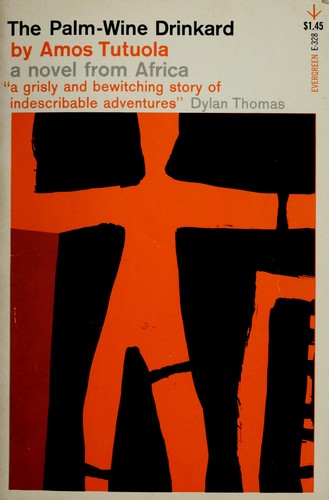
Amos Tutuola's The Palm-Wine Drinkard entered print in 1952 with a problem that was not of its own making: many readers could see its strangeness only by making its author strange. British and American praise often treated the novel as an accidental marvel, fresh because it seemed untouched by literary intention. Educated Nigerian readers, alert to the colonial appetite behind that praise, worried that its nonstandard English would be displayed as evidence of African incapacity. The book was caught between condescension and defense before most readers had reached the second page.[4][5]
It survived because neither response could contain the pleasure of the thing itself. Tutuola sends a prodigious drinker into the bush to retrieve his dead palm-wine tapster, then keeps changing the terms of the journey. A beautiful stranger becomes a skull. Death can be captured. Drum, Song, and Dance become beings with coercive force. The living arrive at Deads' Town and discover that ordinary conduct is now the incorrect kind. The novel moves by addition, reversal, and metamorphosis; every apparent rule opens a door into a more unruly room.[1][6]
The reception history matters, but it should lead back to craft. The Palm-Wine Drinkard is not valuable because later readers learned to excuse its English. It is valuable because its English, its episodes, and its impossible social categories work together. Tutuola does not offer raw folklore waiting for a polished novelist. He makes a printed voice whose repetitions, literal turns, and comic compounds carry a whole theory of how a person can become complete, dead, hungry, friendly, monstrous, or wrong.
A Debut Arrives with Somebody Else's Vocabulary Attached
The material history is unusually clarifying. The Harry Ransom Center holds Tutuola's handwritten manuscript, Faber correspondence, later typescripts, and family papers. Its finding aid records that he wrote the first draft while working as a messenger for Nigeria's Department of Labor, composed his novels originally in English, and later translated some of his work into Yoruba. Faber published The Palm-Wine Drinkard in London in 1952; Grove Press issued the American edition in 1953.[3][6]
Those facts complicate the old fantasy of spontaneous utterance. There was a manuscript, a publisher search, correspondence, revision, and a writer making choices in English. Yet the first wave of Anglo-American reception repeatedly shifted agency away from him. Václav Paris's study of Tutuola and literary primitivism describes the early misconstrual starkly: reviewers imagined a "true primitive" naturally producing effects that European modernists had labored to simulate. Paris argues instead that Tutuola anticipated and manipulated the village-versus-bush division through which primitivist readers tried to understand him.[5]
Even praise could close the trap. Faber still quotes Dylan Thomas's irresistible five-word verdict—"brief, thronged, grisly and bewitching"—and the adjectives are accurate.[2] The trouble begins when bewitching becomes an explanation rather than a response, as though the book cast a spell without anyone designing its sequence. Tutuola's scenes are crowded, but their crowding is controlled. Each encounter presents a rule, tests it to destruction, and leaves the travelers altered enough for the next encounter.
The First Sentence Does Not Ask to Be Corrected
The novel introduces its narrator with a sentence that announces appetite as identity: "I was a palm-wine drinkard since I was a boy of ten years of age."[1] Standard copyediting would smooth the tense and replace the temporal construction. Smoothing it would also lose the voice's peculiar authority. The narrator does not say that he occasionally drank. He gives himself a profession, a history, and a title in one breath.
The opening paragraph keeps repeating palm-wine and drinkard until consumption becomes a verbal environment.[1] His siblings work; he drinks. His wealthy father solves the inconvenience by employing an expert tapster. Friends gather while the wine flows and disappear after the tapster dies. The joke is broad, but its social observation is exact: inherited wealth buys abundance, abundance buys company, and the death of the worker exposes how little of that company belonged to the drinker himself.
This is why the quest begins with more than thirst. The drinkard cannot accept a broken supply chain, a vanished social world, or death's refusal to return skilled labor. His search is absurd and emotionally legible at once. Tutuola lets a selfish motive generate genuine ordeal. The protagonist acquires a wife, meets communities organized by alien rules, judges disputes, survives predation, and returns with a magic egg whose abundance creates a new collective crisis.[1][6] The episodes do not straighten him into a conventional hero. They enlarge the consequences of wanting.
The Complete Gentleman Is Made of Borrowed Polish
The famous Complete Gentleman episode offers the novel's sharpest miniature of reception. A woman follows an impeccably attractive man away from the market. As they travel, he returns his clothes and then his borrowed body parts to their owners until the finished gentleman has been reduced to Skull. Beauty proves to be rented assembly; the social ideal is literally something put on.[2][6]
The scene is frightening because its unmaking is patient. Tutuola does not reveal a monster behind a mask in one theatrical snap. He makes completeness disappear by installments. That rhythm turns a familiar warning about following strangers into a stranger claim: the polished human surface may itself be the supernatural construction. The skull is not the disguise. The gentleman is.
Early criticism often performed a comparable assembly on Tutuola. Reviewers borrowed primitive, naive, untutored, and authentic, fitted the words together, and called the result the author. The categories made him legible to a mid-century literary market while detaching the effects on the page from his decisions.[5] The Complete Gentleman does not secretly predict individual reviews, but it gives readers a useful image for what those reviews did: they mistook a bundle of borrowed parts for a complete account.
Nigerian Suspicion Had a History
It is too easy, from a safe distance, to cast Nigerian critics as grammar scolds who failed to recognize innovation. Francis Nyamnjoh places their anxiety inside colonial education. Standard English had been taught as proof of advancement; British fascination with Tutuola's supposedly unspoiled imagination therefore looked politically double-faced. The same colonial culture that demanded linguistic imitation appeared delighted when an African writer could be marketed as exempt from polish.[4]
That contradiction made suspicion rational, even when it produced reductive judgments of the novel. Readers were not arguing about syntax alone. They were arguing about who would be taken as representative of a nation approaching independence, which forms of English would count as intellectual achievement, and whether metropolitan applause concealed an older appetite for the exotic.[4][5]
Nyamnjoh's better formulation is active and double: Tutuola anglicizes Yoruba while Yorubaizing English.[4] It avoids two bad choices. One need not pretend the prose conforms to standard written English, and one need not treat every nonstandard construction as accidental. The language is a working contact zone. Yoruba narrative materials enter English print, but English also gets stretched by compounds, repetitions, literal categories, and a syntax that refuses to hide the crossing.
Canonization Can Flatten a Book Too
The later afterlife corrected much of the early insult. Faber's current edition presents the novel as a foundational work, surrounds it with praise from Chinua Achebe and later Nigerian writers, and keeps Tutuola's complete works in circulation.[2] The Ransom Center preserves the manuscript and correspondence as the record of a literary career rather than the residue of a curiosity.[3] Scholarship now places the novels within African modernism, colonial language politics, folklore, and the global history of primitivism.[4][5]
Yet reverence brings its own flattening. Calling The Palm-Wine Drinkard "seminal" can turn it into a ceremonial first step on the way to other African novels.[2] The label honors historical importance while quietly moving reading pleasure elsewhere. Tutuola becomes the beginning of a syllabus, and his drinkard becomes a milestone.
The book is much less obedient than that. Its bush is not a waiting room for literary history. It is crowded with bad bargains, grotesque bodies, comic bureaucracy, coercive entertainment, practical magic, and communities whose rules make local sense until an outsider bleeds or walks the wrong way. The prose keeps matter-of-factly reporting impossibility, which is why the strangest events can also feel administratively precise.
The most useful recovery therefore asks for attention, not reverence. Read the opening without silently correcting it. Notice how the Complete Gentleman is dismantled one loan at a time. Notice how deads and alives become social classes with incompatible etiquette. Notice how abundance repeatedly produces dependence. These are not ornaments hung on a simple quest. They are the novel's method.
The Palm-Wine Drinkard survived the word primitive because it was never the passive object that word described. It is a machine for making borrowed categories come apart. Its first readers tried to decide whether its English was too young, too broken, too African, or not literary enough. The book's durable answer is livelier: follow the drinkard into the bush, and see which idea of completeness returns with all its parts.
Sources
- Amos Tutuola, "The Palm-Wine Drinkard" (licensed opening excerpt from the novel, republished by Literary Hub, 2025).
- Faber & Faber, The Palm-Wine Drinkard (publisher page with the 1952 publication note, synopsis, reissue details, and reception excerpts).
- Harry Ransom Center, "Amos Tutuola: An Inventory of His Collection" (finding aid for the handwritten manuscript, Faber correspondence, and personal papers).
- Francis B. Nyamnjoh, "Amos Tutuola as a quest hero for endogenous Africa: actively anglicising the Yoruba language and yorubanising the English language," Acta Academica 52.1 (2020).
- Václav Paris, "Tutuola in the Bush of Primitivism," Comparative Literature 76.2 (2024), bibliographic record and abstract on the novel's early reception and modernist context.
- Internet Archive, The Palm-Wine Drinkard and His Dead Palm-Wine Tapster in the Dead's Town (digitized 1953 Grove Press edition and source record for the cover image).