
Czeslaw Milosz is easy to flatten into a label: Nobel laureate, Polish poet, exile, witness to the twentieth century. The 1991 Lannan Foundation video resists that flattening because it returns him to spoken time. He does not appear as a monument. He appears as a writer still measuring the distance between a lived century and the sentences available for it.[1]
That distance was never abstract for Milosz. Lannan's biographical note places him in wartime Warsaw, where he worked for the Resistance and edited anti-Nazi books and pamphlets, before the long arc of postwar diplomacy, break with communist Poland, exile, and a literary career that ranged across poetry, novels, essays, translation, and political thought.[2] The Nobel Prize's facts page gives the institutional summary: the 1980 prize recognized a writer who voiced human exposure inside severe historical conflict.[3] Those facts matter, but they can make his achievement sound more settled than it was. Milosz's real subject was not simply suffering under history. It was the unstable obligation to keep perception alive after history had trained people to accept slogans, abstractions, and moral numbness.
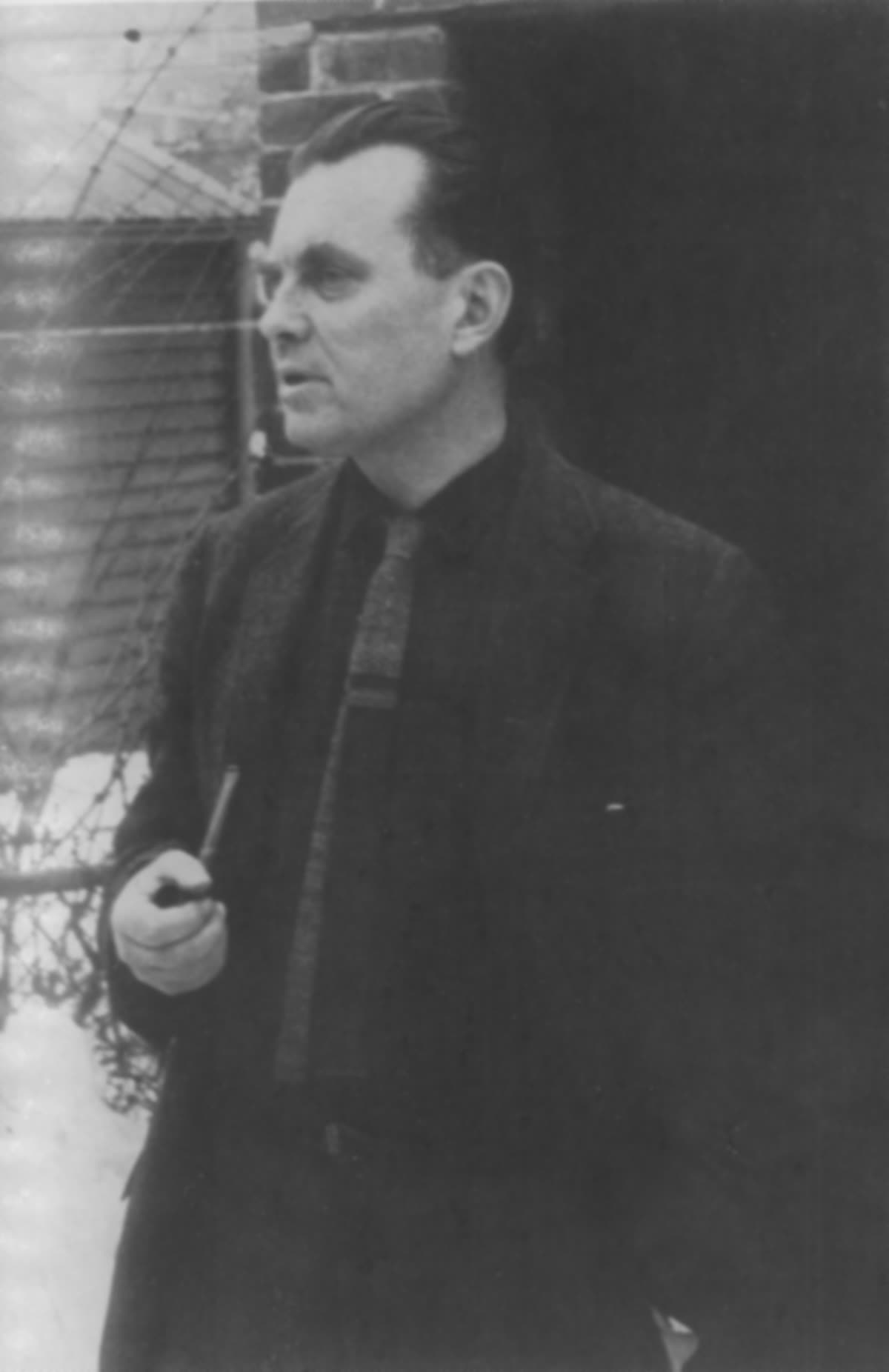
The archival photograph used for this article helps set the right visual scale. It is not a later ceremonial image of the prizewinner. It shows a younger Milosz, outdoors, with the physical grain and damage of a scanned photograph still visible.[7] That texture belongs with the video. Both materials remind the reader that literary authority here is not decorative polish. It is a record of a person formed by villages, cities, borderlands, war, state pressure, exile, and the difficult afterlife of memory.
Milosz's career ran through several historical rooms before it reached the California studio and lecture circuit. He was born in 1911 in the Lithuanian borderlands of the former Russian Empire, wrote in Polish, lived through the German occupation of Warsaw, worked after the war in diplomatic service, broke with the Polish communist state in 1951, and eventually became a professor at the University of California, Berkeley.[2][5] UC's in-memoriam account is especially useful because it refuses to separate the poet from the scholar: Berkeley gave him a long base from which to teach Slavic literatures, translate, write, and think through what a European catastrophe meant when carried into American intellectual life.[5]
The 1991 video matters because it catches Milosz after the Nobel and before the last decade of late poems had fully consolidated his public image in English. The Lannan Foundation's YouTube description identifies the clip as Writers Uncensored: Spring 1991 #67, a program in which Milosz reflects on his life and career.[1] Its provenance is thus both literary and archival: a Lannan Foundation program, preserved and uploaded by the same institution's channel, with the original series title and season attached to the video entry.[1] The format is modest, but that modesty is part of the value. It gives us Milosz speaking as a working memory, not as an award citation.
What the video restores first is the moral tempo of Milosz's thought. His public reputation can make him sound like a writer of heavy declarations: totalitarianism, exile, history, religion, catastrophe. In the recording, the movement is more careful. The voice keeps returning from the large noun to the lived scene, from the idea to the memory, from the century to the person who had to survive it. That movement is central to his literary method. If abstraction is one danger, pure private lyric is another. Milosz's poetry keeps testing how much world a lyric "I" can carry without becoming propaganda.
His Nobel lecture helps explain why this balance mattered. Milosz used the lecture to argue from his own improbable presence in Stockholm toward a larger account of language, memory, and historical complexity.[4] The lecture is not merely autobiographical. It frames literature as a resistance to simplified reality: the world is too layered for ideology, too full of particular lives for systems that pretend to know in advance what a person means. In the 1991 video, that principle becomes less ceremonial. You can hear a writer who has spent decades refusing to let historical explanation cancel sensuous detail.
This is where Milosz differs from a poet who simply "writes about history." He often writes after history has made ordinary trust difficult. The Academy of American Poets profile notes that his work was banned in Poland until after the Nobel Prize and that he translated both into and out of Polish, including major Western writers and parts of the Bible.[6] Translation is not incidental in that profile. It belongs to his deepest literary condition. Milosz lived between languages, governments, homelands, and audiences; he had to keep asking what can survive transfer without turning false.
In the video, listen for the pressure of that transfer. A younger poet might define exile as loss and leave it there. Milosz's later authority comes from making exile a more complicated instrument. Exile wounds the writer, but it also changes the field of vision. It makes the homeland visible from the outside and the adopted country visible through estrangement. It creates anger, nostalgia, guilt, clarity, and distortion at once. Milosz's task is not to purify those feelings. It is to make them answerable to memory.
That answerability is why his prose work and his poetry belong together. The Captive Mind made him a crucial analyst of ideological seduction, but his poems rarely behave like essays in line breaks.[2][6] They keep returning to weather, roads, gardens, bodies, animals, old cities, religious unease, and the small shock of existing at all. The political intelligence matters because it protects the poem from innocence. The concrete image matters because it protects the poem from becoming another political machine.
The video also makes age visible without turning it sentimental. By 1991, Milosz had already moved through the main public stations by which literary history now recognizes him: war, defection, Berkeley, Nobel, English-language readership.[3][5][6] Yet he does not sound finished. The late Milosz remains unsettled by metaphysical questions: why evil becomes ordinary, whether beauty can answer death, whether memory repairs anything, and whether poetry can tell the truth without pretending to master the world. The recording's value is that it preserves this unrest as a living manner, not merely as a theme.
One useful way to watch is to treat the program as an oral footnote to the Nobel lecture rather than as a substitute for it. The lecture gives the formal statement: literature must keep faith with complexity, unpredictability, and the exposed human condition.[3][4] The 1991 video gives the voice that has to inhabit that statement after the applause is gone. Its pauses, turns, and explanatory patience show a writer still translating history back into human scale.[1]
That is why the archive matters now. Milosz can be read as a Cold War writer, a Polish writer, a Catholic writer, a Berkeley writer, a poet of exile, or a moral witness. All of those entries are valid, and all become too small if held alone. The video gives the fuller method: history presses down, memory resists simplification, and poetry must keep finding words for the particular life inside the general disaster. Milosz's lasting force is not that he solved this problem. It is that he made the refusal to solve it into a form of attention.[1][4][5]
Sources
- Lannan Foundation, "Writers Uncensored: Czeslaw Milosz: The Sweep of Time," YouTube video.
- Lannan Foundation, "Czeslaw Milosz," biographical page and Lannan archive entry.
- Nobel Prize, "Czeslaw Milosz - Facts," official Nobel Prize in Literature 1980 facts page.
- Nobel Prize, "Czeslaw Milosz - Nobel Lecture," official lecture text.
- University of California Academic Senate, "Czeslaw Milosz," in memoriam profile.
- Academy of American Poets, "About Czeslaw Milosz," poet profile and selected works.
- Wikimedia Commons, "File:Czeslaw Milosz.jpg," source page for the archival photograph used as the article image.