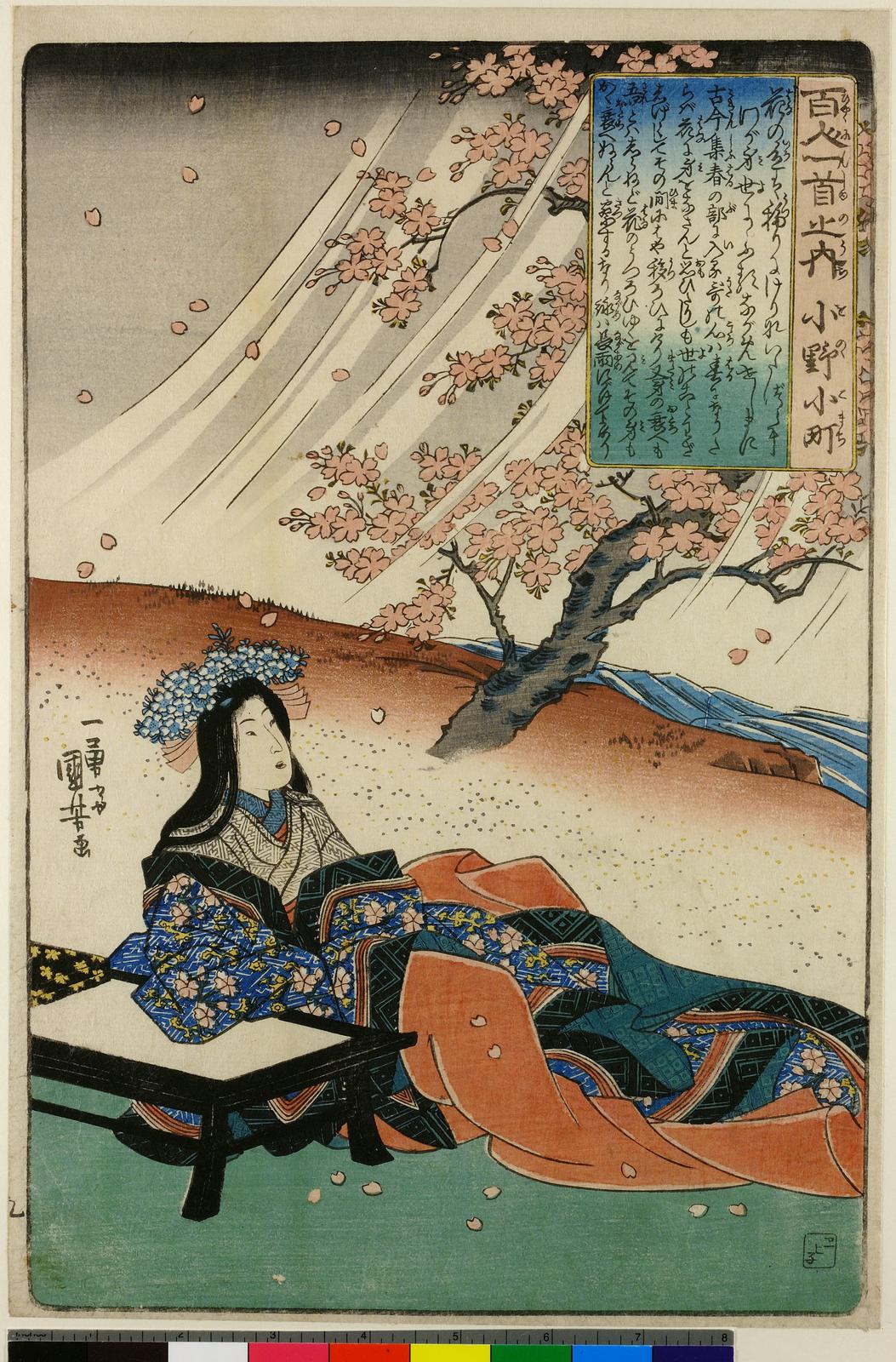
English likes to decide what a sentence is about. Ono no Komachi's most famous waka keeps declining the invitation. Is it about blossoms losing color in a long spring rain? A woman recognizing that her beauty and time have passed? A disappointed lover who has spent too long looking and waiting? In the Japanese, those are not three readings lined up outside the poem. They happen inside the same sounds.
The poem survives as number 113 in Book II, “Spring Poems, Part Two,” of the Kokin wakashū, the first imperial anthology, compiled around 905. Its headnote says only that the topic is unknown. Centuries later it became poem 9 of the Ogura Hyakunin Isshu, the compact hundred-poet sequence through which generations of readers encountered it.[1][2] The text reads:
花の色は
うつりにけりな
いたづらに
わが身世にふる
ながめせしまに[1]
Hana no iro wa
utsuri ni keri na
itazura ni
waga mi yo ni furu
nagame seshi ma ni
A deliberately awkward crib might begin: “The flowers' color has changed—ah, in vain—as my self passed through this world, while I gazed, while the long rains fell.” It is overfull because the original is overfull. A smooth translation usually removes one of the grammatical weather systems that make the poem move.
The flower appears before the woman
The opening phrase, hana no iro, gives us “the color of the flowers.” It does not name cherry blossoms, though its place among the anthology's spring poems makes that association natural. Nor is iro confined to pigment. It can carry beauty and erotic feeling as well as visible color, so the phrase has already made an exterior scene available to human self-description before a speaker appears.[1][5]
Then utsuri ni keri na announces change: the color has shifted, faded, gone over. The ending gives the discovery a belated pressure—less a weather report than the moment of noticing what has already happened. “The flowers fade” would make the change habitual. “The flowers have faded” preserves the sting of arriving after the event.
That sequence matters. Komachi does not begin with “I am growing old” and decorate the confession with flowers. For three metrical units, no first-person self is grammatically present. We meet an altered color, an exclamation, and then itazura ni: uselessly, idly, in vain. Only in the fourth unit does waga mi, “my body” or “my self,” enter.
English versions often promote that late arrival. William N. Porter's 1909 translation supplies “my charms” as a parallel subject and lets both blossom and beauty wane. Yone Noguchi's version begins by coupling “the flowers and my love,” making emotional loss explicit from the first line.[2][3] Both produce coherent poems. Both also reveal how translation writes backward: once the woman is recognized in the final units, English returns to the opening and tells the reader exactly what the flower had meant.
Komachi's order is more pleasurable because recognition remains an event. The flower is not a code word waiting to be replaced by “beauty.” Its physical fading is allowed to happen before it becomes inseparable from a life.
“In vain” has room on both sides
The poem's middle unit, itazura ni, occupies a strategic emptiness. It can mourn the blossoms' pointless fading: their color has gone for nothing. It can also judge the speaker's time as idly or fruitlessly spent. Lorenzo Marinucci notes that the phrase carries loss and disappointment as well as “in vain”; its position lets floral impermanence and a life felt to have been wasted resonate together.[5]
Punctuation can quietly destroy that balance. Compare:
The flowers' color has faded in vain. While I gazed, my life passed.
and:
The flowers' color has faded. In vain, while I gazed, my life passed.
The first spends futility on the flower. The second charges it to the life. Japanese waka did not hand the translator modern commas that could settle the account. The five-unit form creates a pause at itazura ni, but a pause is not a fence. The phrase looks backward and forward at once.
That doubleness also cautions against reducing the poem to a universal slogan about aging. Almost nothing secure is known about the historical Komachi outside the poems associated with her. Alari Allik shows how later biographies, Noh plays, commentaries, and translations assembled the familiar story of a proud beauty abandoned to an impoverished old age.[4] That afterlife is real and influential; it is not a diary key. When a translation turns waga mi into “my charms,” it draws on a reception history, not on a noun the poem actually supplies.
Furu makes passing time fall as rain
The fourth and fifth units are where English must start dropping things:
waga mi yo ni furu
nagame seshi ma ni
Read one way, furu belongs to a human duration: my self passes time, lives on, or grows old in this world. Read into what follows, the same sound activates the ordinary verb for rain falling. The life passes; the rain falls. The poem does not announce a simile between the two. It makes one verbal hinge carry both motions.[4][5]
Then nagame repeats the operation. As a verbal form it suggests gazing or being lost in thought. Heard as naga-ame, it contains “long rain.” The closing phrase can therefore describe the interval during which the speaker gazed pensively and the interval during which prolonged rain fell. Furu nagame gives the weather its action; nagame seshi gives the speaker hers.
Calling this a pun can be misleading if “pun” means that one reading briefly replaces another for a joke. The classical device often called kakekotoba, or a pivot word, lets adjacent constructions claim the same sound. Marinucci's useful emphasis is that the result is not an either/or choice but reciprocal resonance: rain and age, weather and thought, remain active together.[5] Allik's study of translations of poem 113 reaches a related problem from another direction. Translators do not merely select dictionary senses; by deciding who gazes and why, they construct a version of Komachi—a philosopher of impermanence, a woman measuring lost beauty, or a sleepless modern consciousness.[4]
This is why “the rain symbolizes time” is too weak. A symbol leaves rain outside the grammar and asks it to stand for something else. Here time borrows the rain's verb, and contemplation borrows the rain's duration. The weather does not represent the life from a polite distance. It passes through it.
Two translations, two honest losses
A landscape-first version could read:
The flowers' color has faded—
all for nothing—
while the long rain fell
and I watched, lost in thought.
This keeps the scene lucid, but the speaker's years nearly disappear. A self-first version might be:
The flowers' beauty is gone.
In vain, as I passed through this world,
I gazed and grew old.
Now the life is legible, but the rain has evaporated. Adding both tracks tends to produce explanatory English: “while I grew old as the long rains fell.” Accurate enough, yet it turns the original's pivot into a stated comparison and assigns one verb to each subject.
A more openly experimental version can signal the fuse rather than conceal it:
Flower-color has changed—ah, in vain—
while my life weathered through this world
in one long-rain gaze.
“Weathered” and “long-rain gaze” are inventions, not secret equivalents hidden in a lexicon. Their virtue is diagnostic. They make an English reader feel why no single fluent paraphrase can be the poem: the original turns without leaving the word it turns on.
Porter's older version and Noguchi's compressed one remain valuable for the same reason. Set beside each other, they show that translation is part of the poem's reception, not a transparent pane in front of it.[2][3] One chooses beauty; one chooses love. Neither exhausts the less biographically settled waga mi, the self that arrives only after the flower has changed.
The print chooses a scene—and records a reading
Utagawa Kuniyoshi's nineteenth-century woodblock print makes an elegant decision on the translator's behalf. It seats an imagined Komachi at a low table, puts flowering cherry branches beyond her, draws rain across the view, and inscribes the poem above. The British Museum's cataloged scan identifies the work as number 9 in a Hyakunin Isshu series.[6]
The image is not evidence of what Komachi looked like or of a particular rainy day in the ninth century. It is evidence of reception. Long after the poem entered the anthology, a visual artist gave its grammar a body and a room. The print turns nagame into an observable gaze and naga-ame into visible rain; it makes hana cherry blossom and the late-arriving speaker the center of the scene.[6]
Yet even this apparent resolution preserves something the poem knows. Komachi is indoors while the blossoms and rain remain beyond a threshold. She watches the weather, but the poem above her makes it impossible to keep weather outside. Color crosses into beauty, falling crosses into aging, and a long rain crosses into sustained thought.
The sharpest English response is therefore not to hunt for one ingenious equivalent to furu nagame. It is to preserve the order of discovery and admit the trade-off: flower before woman, change before explanation, “in vain” suspended at the hinge, then a self whose passing time is already rain. Komachi's thirty-one morae do not ask whether the poem is landscape or confession. They make the landscape confess.
Sources
- National Diet Library Collaborative Reference Database, “Which poetry collection includes ‘Hana no iro wa…’?”—the Japanese text, Kokin wakashū placement as Book II, poem 113, headnote, and attribution.
- Ono no Komachi, poem 9 in William N. Porter's A Hundred Verses from Old Japan (1909), Wikisource—romanization, public-domain translation, and the translator's note on the poem's double construction.
- Ono no Komachi, “[The flowers and my love,]” translated by Yone Noguchi, Academy of American Poets—a public-domain English version that makes love explicit.
- Alari Allik, “Falling Like Rain through Life: Translating Ono no Komachi,” Methis: Studia humaniora Estonica 7, nos. 9/10 (2012)—poem 113, its translation problems, and the biographical Komachi constructed by later readers.
- Lorenzo Marinucci, “Hibiki and Nioi: A Study of Resonance in Japanese Aesthetics,” Studi di estetica 20 (2020), pp. 117–142—analysis of iro, itazura ni, furu, and nagame as reciprocally active meanings.
- Wikimedia Commons and the British Museum, Utagawa Kuniyoshi, “No. 9 Ono no Komachi”—catalog record and archival scan of the woodblock print used as the lead image.