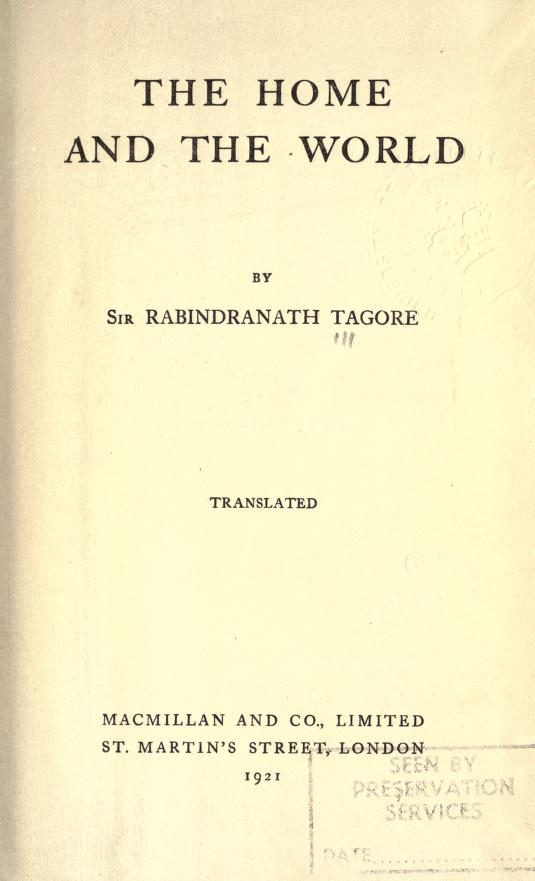
Most novels of political awakening ask whether a country deserves love. Rabindranath Tagore's The Home and the World asks the more difficult question: what kind of love does a country have any right to receive?
The distinction is easy to miss because nearly everyone in the novel speaks the language of devotion. Bimala begins inside an aristocratic Bengali household, where her love for her husband, Nikhil, has taken the ritual form of worship. Sandip, Nikhil's charismatic friend, arrives with the Swadeshi movement and redirects that vocabulary toward the nation. Bengal becomes Mother, goddess, beloved, and absolute claim. Private desire and public duty start sounding alike. By the time Bimala recognizes the difference, money has been stolen, a young follower has been sent toward violence, poor traders have been coerced, and Hindu–Muslim tension has entered the estate.[1][2]
Tagore first published Ghare-Baire in Bengali in the mid-1910s; Surendranath Tagore's English translation appeared in 1919. Its twelve chapters are divided among first-person accounts by Bimala, Nikhil, and Sandip. That arrangement matters philosophically. There is no neutral narrator standing above the dispute to label one voice patriotism, another treason, and a third innocence. Each speaker turns belief into a story about the self. The reader has to notice where an ideal touches another person's life.[1][3]
The novel's central argument is not that one should feel less for a country. It is that service and worship are morally different acts. Service remains answerable to people and consequences. Worship can make consequences look like offerings.
The Dangerous Verb Is “Worship”
Before Sandip appears in person, Bimala has already been stirred by Swadeshi. She wants to burn her foreign clothes and dismiss Miss Gilby, the English companion who has taught her. Nikhil refuses both gestures. He has funded local inventions, tried to establish a bank, and supported indigenous enterprise; his objection is not to economic self-reliance. It is to destruction performed as proof of faith. He will serve his country, he says in Chapter One, but “my worship I reserve for Right.”[1]
That sentence establishes the novel's moral grammar. A country can be served because it contains actual people whose work, safety, and freedom matter. It cannot be worshipped without becoming exempt from judgment. Once the nation occupies the place of a god, disagreement becomes sacrilege and another person's injury can be renamed sacrifice.
Sandip understands this power perfectly. He does not merely argue that locally made goods will strengthen Bengal. He stages politics as revelation. His speeches turn a boycott into a holy struggle; his gaze turns Bimala into the embodied spirit of the country; his requests turn her household wealth into treasure owed to the Mother. The sacred vocabulary does not restrain appetite. It launders appetite until taking looks like giving.
This is why Tagore's philosophical target is larger than hypocrisy. A hypocrite knows the rule and secretly breaks it. Sandip builds a system in which his desires certify the rule. He can want Bimala, Nikhil's money, social command, and political spectacle while telling himself that all four wants are movements of history. The nation does not compete with his ego. It magnifies it.
Sandip Makes Appetite Sound Like Destiny
Sandip's first-person sections are among the novel's boldest choices. An external narrator could have exposed him as a fraud and made resistance easy. Instead, he receives the page. He admits his manipulations, admires his own force, and repeatedly converts greed into a philosophy of greatness. At the beginning of one section he asks, “Am I made of words?” The honest answer is not quite no. Words are the instrument by which he makes acquisition feel inevitable.[1]
His smallest slogan is also his most revealing: “I want.”[1] He teaches Bimala to hear that phrase as women's awakening. There is a genuine promise inside it. Bimala has lived within purdah, inherited an ideal of wifely self-effacement, and been encouraged by Nikhil to encounter a world beyond the household. Sandip recognizes her hunger for agency. He then supplies a script in which agency means confirming his account of her.
The maneuver works because it mixes liberation with possession. Bimala is addressed as Queen Bee and goddess, apparently raised above domestic smallness. Yet the elevation makes her less particular. Sandip does not need to learn what she wants once he has declared what she represents. Her body can stand for Bengal, her jewels for national wealth, her excitement for popular consent. Symbolic grandeur becomes another enclosure.
Chapter Seven gives Sandip an entire chapter to himself, and he fills it with a theory of masculine taking. He pressures Bimala to obtain money from Nikhil's treasury, treats women and the earth as resources perfected by surrender, and plans a goddess cult as political machinery. His boast—“I, Sandip, shall create them”—collapses religion, propaganda, erotic control, and authorship into one sentence.[1] He does not wish to serve a people already present. He wishes to manufacture the image before which they will serve him.
Scholarly treatments continue to place The Home and the World at the intersection of nationalism, cosmopolitanism, gender, and colonial power rather than reducing it to a simple quarrel between patriot and moderate.[3][4] Sandip's importance lies in that mixture. He is persuasive not despite confusing the political with the personal, but because he makes each intensify the other.
The Novel Makes Metaphor Pay in Cash
Tagore tests Sandip's language by steadily changing its material scale. At first there are speeches, songs, clothes, and charged glances. Then the boycott reaches village markets. Traders who cannot afford the patriotic choice face pressure. A Muslim boatman, Mirjan, loses his boat to the movement's enforcement. Police, estate managers, bribes, and intimidation enter the story. The supposed unity of Mother Bengal fractures along class and religious lines.[1][3]
The decisive object is money. Sandip demands an impossibly grand sum, then lowers the figure when grandeur has done its emotional work. Bimala takes gold from her husband's safe. Its physical weight breaks the spell: an abstract gift to the nation becomes rolls of stolen coins tied into her sari. The scene is not a retreat from politics into private guilt. It is political knowledge arriving through touch. The money belongs to a web of household trust, estate power, labor, and unequal access that the word sacrifice had concealed.
Amulya makes the chain still harder to ignore. He is young enough to treat Bimala's symbolic motherhood and Sandip's slogans as commands. When theft leads to armed action, the adults' metaphors become a teenager's risk. Bimala's attempt to undo the theft cannot restore innocence; it can only begin the slower task of accepting responsibility for what her exaltation authorized.[1]
This movement from chant to coin to body is the novel's best philosophical method. It does not refute Sandip with a superior slogan. It asks what his slogan requires other people to carry.
Nikhil Is a Counterargument, Not a Perfect Answer
Nikhil comes closest to stating Tagore's ethical alternative. He distrusts coercion, refuses to punish Muslim merchants for resisting a boycott, and insists that the means used for freedom already shape the freedom that will result. The country cannot be rescued by treating its inhabitants as material.
Yet the novel does not make him a frictionless mouthpiece. Nikhil is a wealthy landlord with unusual freedom to absorb failed enterprises and defend unpopular principles. He wants Bimala to leave the seclusion of the household, but he also imagines that her freedom will vindicate his design for their marriage. Near the end he recognizes a “vein of tyranny” in his wish to shape their relationship into a perfect form.[1]
That admission matters. Sandip's domination is loud, but Nikhil discovers that benevolence can also become authorial. To invite another person into the world is not the same as deciding in advance what her liberated self should look like. Srabonee Mustafiz's study of the novel presses this instability further, arguing that its treatment of women and the Muslim community remains unsettled even as it criticizes aggressive nationalism.[3] The warning is useful: a humane character's self-critique does not automatically repair every hierarchy the book depicts.
Nikhil's ethical strength is therefore not perfection. It is corrigibility. Unlike Sandip, he can discover that his ideal has injured the person it meant to free. His idea of Right remains alive because it can judge him too.
Bimala Does Not Simply Go Back Home
A shallow account of the ending says that Bimala is seduced by the world, learns her lesson, and returns to her good husband. The novel makes return much less available than that. Bimala's narration opens in recollection and closes after knowledge that cannot be reversed. Her home has already contained the world: colonial education, imported goods, estate money, nationalist visitors, class authority, and religious difference were inside its walls long before Sandip crossed the threshold.[1]
What changes is Bimala's way of reading those forces. She learns that being made a goddess is not the same as being recognized as a person. She learns that worship can feel like power while transferring power elsewhere. She also learns that remorse is not purification on demand. Amulya cannot be restored to safety, the coerced villagers cannot be turned into abstractions again, and Nikhil's final ride into communal violence ends with grave injury rather than domestic closure.[1]
The novel thus refuses the neat opposition promised by its English title. Home is not naturally ethical, and world is not naturally free. Either can become a theater of possession. The more durable distinction runs between relationships that remain answerable to particular lives and ideals that consume particular lives for an imagined whole.
A Country Small Enough to Serve
Tagore's international reputation was secured first through poetry and the 1913 Nobel Prize, but his fiction and essays kept returning to the moral pressure of nationalism.[5] A 2021 Penguin India student edition tellingly pairs The Home and the World with Nationalism, presenting the novel alongside Tagore's warnings about sectarianism and xenophobia.[2] Later scholarship has continued to debate how his cosmopolitanism, anti-colonial commitments, gender politics, and social position fit together.[3][4]
The novel deserves that debate because it offers no comfort to imperial rule. Nikhil's alternative is not obedience to Britain, and the suffering produced by colonial power does not disappear from the frame. Tagore's harder claim is that liberation can reproduce domination if the nation becomes too sacred to answer to the people enlisted in its name.
The ethical test is consequently small and stubborn. What happens to the trader who cannot afford the approved goods? To the Muslim neighbor excluded from a Hindu national image? To the woman praised as a goddess but used as an instrument? To the young follower who mistakes adult rhetoric for permission? A patriotism capable of answering those people may become service. A patriotism that asks them to vanish into a symbol has already begun to worship itself.
Sources
- Rabindranath Tagore, The Home and the World, translated by Surendranath Tagore—Project Gutenberg ebook 7166, the primary text used for chapter references and short quotations.
- Penguin Random House India, Nationalism and Home and the World (student edition, 2021)—publisher context on the novel's treatment of nationalism, violent revolution, and women's emancipation.
- Srabonee Mustafiz, Indeterminacy in Rabindranath Tagore's Representation of Women and Minorities. University of Alberta MA thesis, 2012, preserved by Library and Archives Canada—analysis of the novel's multiple narrators and its representation of women and the Muslim community.
- K. L. Tuteja and Kaustav Chakraborty, eds., Tagore and Nationalism. Springer, 2017—scholarly collection on nation, nationalism, cosmopolitanism, gender, and Tagore's fiction, including Ghare Baire.
- The Nobel Prize, “Rabindranath Tagore—Biographical”—contemporary Nobel biography and overview of Tagore's poetry, fiction, essays, education work, and relation to the Indian nationalist movement.
- Wikimedia Commons, “The Home and the World—cover page”—source page for the 1921 archival scan, with original Internet Archive provenance and image metadata.