Before anyone in Herman Melville's The Confidence-Man asks for money, three public notices compete on one patch of steamboat deck. A placard near the captain's office offers a reward for a mysterious impostor. A stranger holds up a slate urging charity. Then the boat's barber opens his shop and hangs out the crispest message of all: “No trust.”[1]
All three signs tell passengers how to read other people. Only the last one passes as common sense.
That acceptance is the quiet shock of Chapter I. Melville does not begin his 1857 novel by hiding a swindler inside an innocent crowd. He begins with a crowd already organized by suspicion—buying protection, consuming crime stories, inspecting a stranger, and treating distrust as the neutral language of business. The opening never proves that confidence is safe. It asks a harder question: what happens when vigilance becomes so respectable that charity itself looks like an offense?
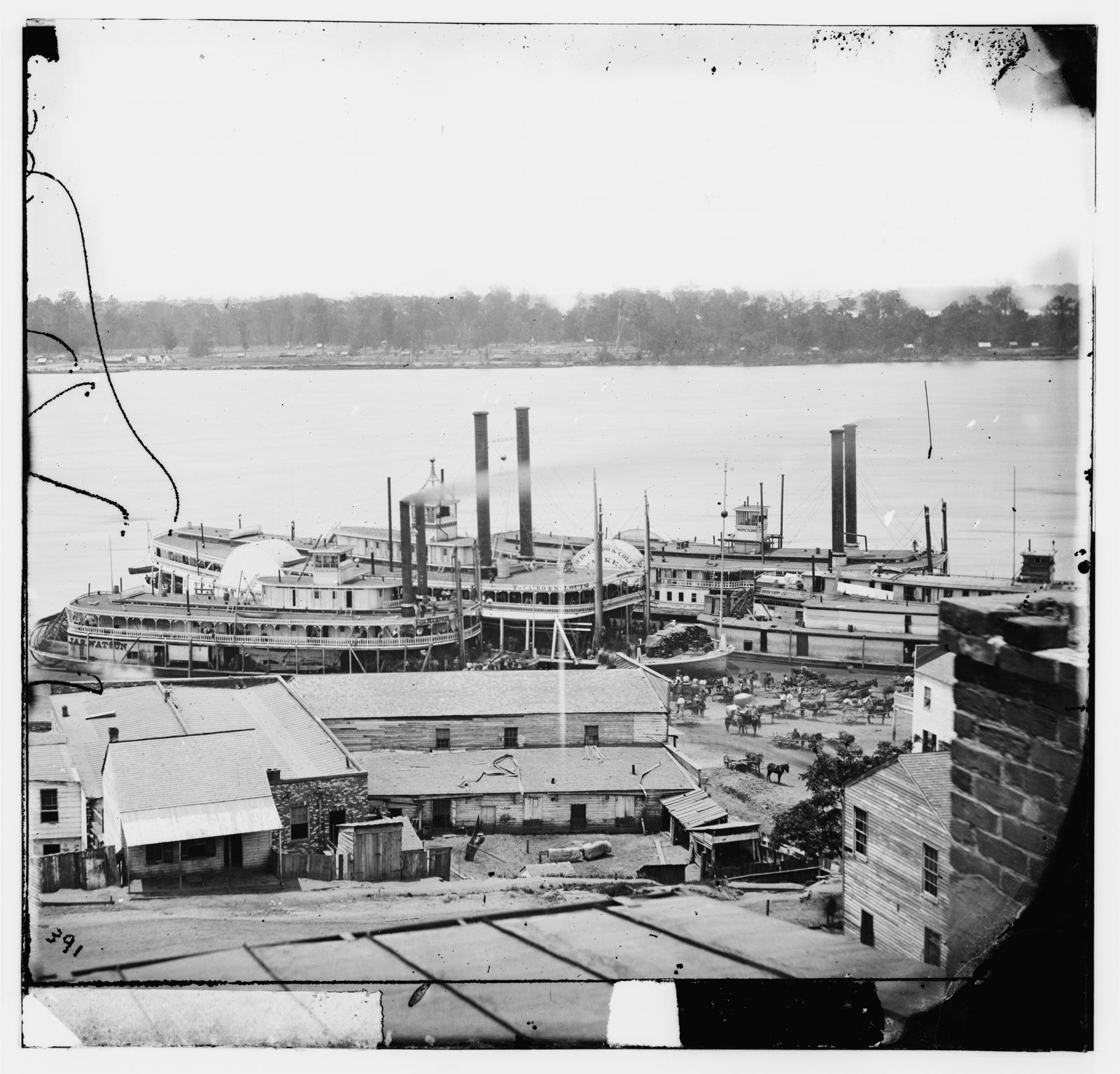
Image context: Pywell's glass-negative photograph records a working Vicksburg levee in February 1864. Its boats are military-era vessels, not Melville's fictional passenger steamer, but the packed hulls, gangways, storefront-like decks, freight, workers, and traffic give physical scale to the floating marketplace his opening imagines.[6]
The description that the reader cannot inspect
The stranger arrives at sunrise on April 1 wearing cream colors. He has no luggage, porter, or companions. His pale, soft appearance makes him conspicuous before he does anything at all. The crowd shrugs, whispers, and laughs; Melville calls him a stranger “in the extremest sense,” then sends him aboard the Fidèle, bound from St. Louis toward New Orleans.[1]
The boat's name promises faithfulness. The calendar promises a trick. Neither promise settles the man's identity.
The first delicious act of obstruction comes beside the captain's office. The reward placard supposedly carries a “careful description” of the impostor, but the narrator does not reproduce it.[1] Passengers can compare the stranger with the notice; readers cannot. Melville gives us the existence of a clue while withholding its content. The omission prevents the chapter from becoming a fair-play detection exercise in which alert eyes simply match a face to a list.
That frustration is not an accidental prelude to the difficult book ahead. Elizabeth Renker's study of the novel makes unreadability itself central to its reception: early reviewers repeatedly complained that they could not discover what Melville was driving at.[2] The contemporary notices collected by Brian Higgins and Hershel Parker show the split immediately. One paper called the book a unique affair; another regretted that Melville had abandoned simple narrative for theoretical fable; another kept waiting for a conclusion that never arrived.[3]
Chapter I has already staged the reason. The usual instrument for resolving uncertainty—the authoritative description—is present but unavailable. Instead of asking only Who is the impostor?, the scene forces a prior question: What makes any description authoritative enough to govern our treatment of a person?
Suspicion becomes a market
The warning placard draws a crowd as if it were a theater bill. That comparison turns public safety into spectacle, but Melville makes the joke sharper. Among the readers are “chevaliers” whose hands the narrator refuses to account for plainly. One buys a money belt from another. A nearby seller hawks sensational lives of dead river bandits. People gather to learn the appearance of fraud while probable thieves and entrepreneurs sell them protection from it.[1]
The scene is funny because everybody may be right. A money belt can protect savings. A warning can prevent a theft. A crime story can preserve useful knowledge. Yet fear also creates customers, and the people profiting from vigilance need not stand outside the danger they describe.
Melville condenses the change into an animal fable: eliminating wolves can leave the field to multiplying foxes.[1] The old spectacular outlaw has become marketable history; subtler forms of predation circulate among ordinary transactions. Brook Thomas reads the novel against an antebellum market and legal culture struggling to distinguish legitimate exchange from swindling. In The Confidence-Man, he argues, the boundary repeatedly proves arbitrary because goods, promises, charitable appeals, and stories all depend on claims whose value cannot be guaranteed in advance.[4]
The steamboat is therefore more than a colorful setting. It is a moving market with no easy exit, carrying strangers who must transact before they can know one another. The impostor notice does not interrupt that market. It helps open it for the day.
The slate does not supply a clean opposite
The cream-colored stranger places himself beside the placard and raises a small slate to the same height. On it he writes phrases from Paul's account of charity in 1 Corinthians 13. The first says that charity thinks no evil. After the crowd jostles him, he changes the line: charity suffers long and remains kind. After more blows come endurance, belief, and the claim that charity never fails.[1]
The staging makes the slate a counter-notice. One text tells passengers to identify a deceiver; the other tells them not to begin with evil. One borrows authority from the captain's office and a cash reward; the other borrows it from scripture and a visibly vulnerable bearer. They occupy the same visual plane but not the same social position.
The stranger has no “badge of authority,” and that absence matters more to the crowd than the content of his words.[1] His gentleness looks inappropriate to the time and place. When he persists, passengers interpret persistence as intrusion. They flatten his hat, push him away, and finally strike him. The placard can command attention because it is official. The slate must first prove its right to be seen.
Melville nevertheless refuses to certify the stranger as pure moral correction. The word charity stays on the slate while the rest of each sentence is erased and replaced, like the fixed first digit on a date form.[1] The detail can signify constancy: charity survives every revision. It can also make the language look reusable, a portable formula ready for a new audience. A possible saint and a possible confidence man can hold the same words.
David T. Mitchell and Sharon L. Snyder argue that this is the novel's governing collision. Its appeals to charity are also exchanges; bodies, stories of need, and promises of moral benefit enter the same economy as medicines, investments, and credit. Their reading does not reduce charity to fraud. It shows why the book keeps making benevolence and the confidence game uncomfortably adjacent: each asks someone to act now on a future or invisible good.[5]
“No trust” looks like ordinary business
Then the barber wakes and opens his shop. He rattles down the shutters, sets out his pole, elbows the crowd aside, and hangs a decorated sign above the door. Its two words—“No trust”—announce that he extends no credit.[1]
The phrase is perfectly practical. A barber on a transient boat may never see a debtor again. Melville does not ask him to run an insolvent shop, and the novel never offers credulity as a moral system. What matters is the crowd's response. The barber's message is no less intrusive than the stranger's, the narrator observes, yet nobody mocks it. Nobody calls its maker mad. Nobody punches him for insisting that strangers should receive nothing on promise.[1]
Trust pivots between money and ethics. On a shop sign, it means credit: service given now against later payment. In the novel's larger vocabulary, it means confidence in testimony, identity, medicine, friendship, institutions, and goodness. Mitchell and Snyder read the barber's sign and the charity slate as a confrontation between economic and religious systems, while noting that both reach toward a future return.[5] The barber expects payment; the charitable giver may expect repayment in gratitude, status, social order, or heaven.
The difference is not that commerce has interests while charity has none. It is that commerce's refusal announces its interest openly and receives the protection of normality. “No trust” needs no evidence about the individual customer. It converts uncertainty into a universal policy. The stranger's slate, by contrast, asks each viewer to remain ethically exposed to a person not yet known.
That exposure may be dangerous. It is also the condition the crowd eliminates before any con begins.
A body becomes another public notice
As the stranger continues along the deck, porters swing a trunk into him. His startled moan and hand movements reveal that he cannot hear as well as cannot speak. He retreats to the forecastle, where his clothes, exhaustion, and lack of luggage are inspected from a distance. In Chapter II, passengers who did not witness the earlier abuse supply mutually incompatible readings: innocent, prophet, humbug, convict, victim; one observer takes his sleep as reason to suspect pickpockets are aboard.[1]
They are not reading a person so much as writing competing placards over him.
This is where a modern reader should resist treating disability as just one more clever mask. Mitchell and Snyder emphasize that Melville's disabled figures participate in a nineteenth-century culture that used bodily appearance to assign social station and decide who deserved aid. The novel unsettles those classifications, but it also draws its suspense from the fear that visible need may be performed.[5] That structure has a cost: a person who cannot hear or speak is made to carry the audience's argument about whether need can ever authenticate itself.
Chapter I does not let us solve that problem by declaring the stranger genuine or fake. Even the narrator's softest images—lamb, snow, sleep—describe an appearance, not a certificate of innocence. His body may move the viewer, but the whole scene has shown how quickly visual evidence becomes a role imposed by others.
The con begins with the verdict
At the chapter's end, the stranger sleeps at the foot of a ladder and the Fidèle starts downriver. He has not solicited a donation, sold a cure, proposed an investment, or offered his name. Still, almost everyone has reached a verdict.
That sequence is the opening's trap. If the placard is accurate, suspicion may save a passenger. If the slate is sincere, suspicion has already licensed cruelty. If the slate is part of a performance, its scriptural truth does not become false; it becomes harder to use without risk. And if the barber is merely prudent, his policy still reveals how easily a refusal to trust can pass for reason itself.
The scene never asks readers to choose blind faith over judgment. It asks whether judgment can stay awake without turning every stranger into a forecast loss. This is why “No trust” is the first sign everyone accepts: it offers safety from being fooled and safety from having to respond.
Melville's confidence game begins there, before the first request for cash. Reading is already a transaction. Every interpretation extends, spends, or withholds confidence—and no official placard can spare us responsibility for the terms.
Sources
- Herman Melville, The Confidence-Man: His Masquerade (1857), Project Gutenberg — full text, especially Chapters I–II and the original title page.
- Elizabeth Renker, “A----! Unreadability in The Confidence-Man,” in The Cambridge Companion to Herman Melville (1998), Cambridge University Press — the novel's designed difficulty and hostile early reception.
- Brian Higgins and Hershel Parker, eds., “The Confidence-Man (1857),” in Herman Melville: The Contemporary Reviews (1995), Cambridge University Press — dated notices and reviews from the book's publication month.
- Brook Thomas, “Contracts and Confidence Men,” in Cross-Examinations of Law and Literature (1987), Cambridge University Press — contract, market exchange, and the unstable border between selling and swindling.
- David T. Mitchell and Sharon L. Snyder, “Masquerades of Impairment: Charity as a Confidence Game,” Leviathan 8, no. 1 (2006) — disability, charity, credit, and exchange in Melville's novel.
- Library of Congress, “[Vicksburg, Miss. Levee and steamboats],” William Redish Pywell, February 1864 — catalog record and original wet-collodion negative used for the article image.