The first thing William Morris’s traveller does in the future is go for a swim. The Thames is clear; a boat is waiting; the morning is warm. Then he looks toward Hammersmith Bridge, sees a structure so unlike the one he remembers that he forgets to keep swimming, and briefly goes under. A better world has arrived as a bodily pleasure before it becomes something he can explain.[1]
That order matters throughout News from Nowhere. Morris lets us want the place, makes us listen to the history that produced it, and finally prevents his traveller from settling there. The journey ends with the loss of an invitation. What survives is a reason to return to the world that needed changing.
This essay discusses the novel’s ending.
A wish becomes a way of seeing
The book opens after a socialist meeting has dissolved into competing accounts of the future. Its frustrated participant travels home in an unpleasant underground railway carriage, still composing the arguments he failed to make. His wish is modest in duration and enormous in implication: “If I could but see a day of it”. He wants a future he can experience (chapter I).[1]
There is a small comic evasion in the telling. An introductory voice initially describes this man at a distance, then decides to tell the adventure in the first person because it understands him unusually well. The impersonal report slides into an admission of desire. We enter the future through a particular tired, irritable person, carrying his habits with him.
Morris first published the novel in the socialist newspaper Commonweal in 1890; the revised English book edition followed in 1891. The opening quarrel therefore belongs close to the world of its original readers. A political movement’s difficulty imagining its destination becomes the occasion for a story.[2]
Once the traveller arrives, explanation keeps lagging behind perception. He can admire the boatman’s beautifully made clothes before he understands a society in which such clothes do not identify a gentleman playing at manual work. His familiar categories make unfamiliar arrangements look like exceptions. The future must repeatedly correct the visitor’s reading of what is directly before him (chapter II).[1]
This is one reason the book needs a journey. A list of institutions could tell us what Morris proposes. A succession of encounters shows how difficult it would be to stop expecting the old relations between people.
The afternoon that holds the journey still
Before the long excursion upriver, the visitor spends much of the book questioning old Hammond, whom he meets at the British Museum. The movement through London gives way to conversations about love, government, work, and the past. Tony Pinkney’s introduction for the William Morris Archive distinguishes three forms working together here: the dream that frames the visit, the exposition of a utopian society, and the romance of the later river journey. The changes of pace belong to the book’s construction.[3]
The sharpest turn comes after dinner in chapter XVII. Dick offers entertainment: music, architecture, a ride home. The visitor stays with Hammond. He needs to know how this comfortable present became possible. A leisurely afternoon, with sunlight passing through wineglasses, opens onto the violence of a revolution.[1]
Hammond’s account includes repression, strikes, civil war, and the practical organization of work during conflict. Within the fiction, the people who eventually build the new society acquire capacities through struggle. The peaceful landscape already shown to us is the outcome of a history its appearance cannot disclose (chapters XVII–XVIII).[1]
There is a useful friction between the visitor’s route and that history. He has crossed into the future by falling asleep. The people whose descendants welcome him had no such shortcut. Morris interrupts the pleasure of arrival long enough to make that difference felt.
Hammond is also a speaker with loyalties. His retrospective assurance that the struggle was necessary belongs to his account; the reader need not treat it as proof that history must follow this course. What the arrangement establishes more securely is a limit on the holiday: clean water, generous hospitality, and satisfying work have conditions beyond the visitor’s wish for them.
A familiar house cannot make him belong
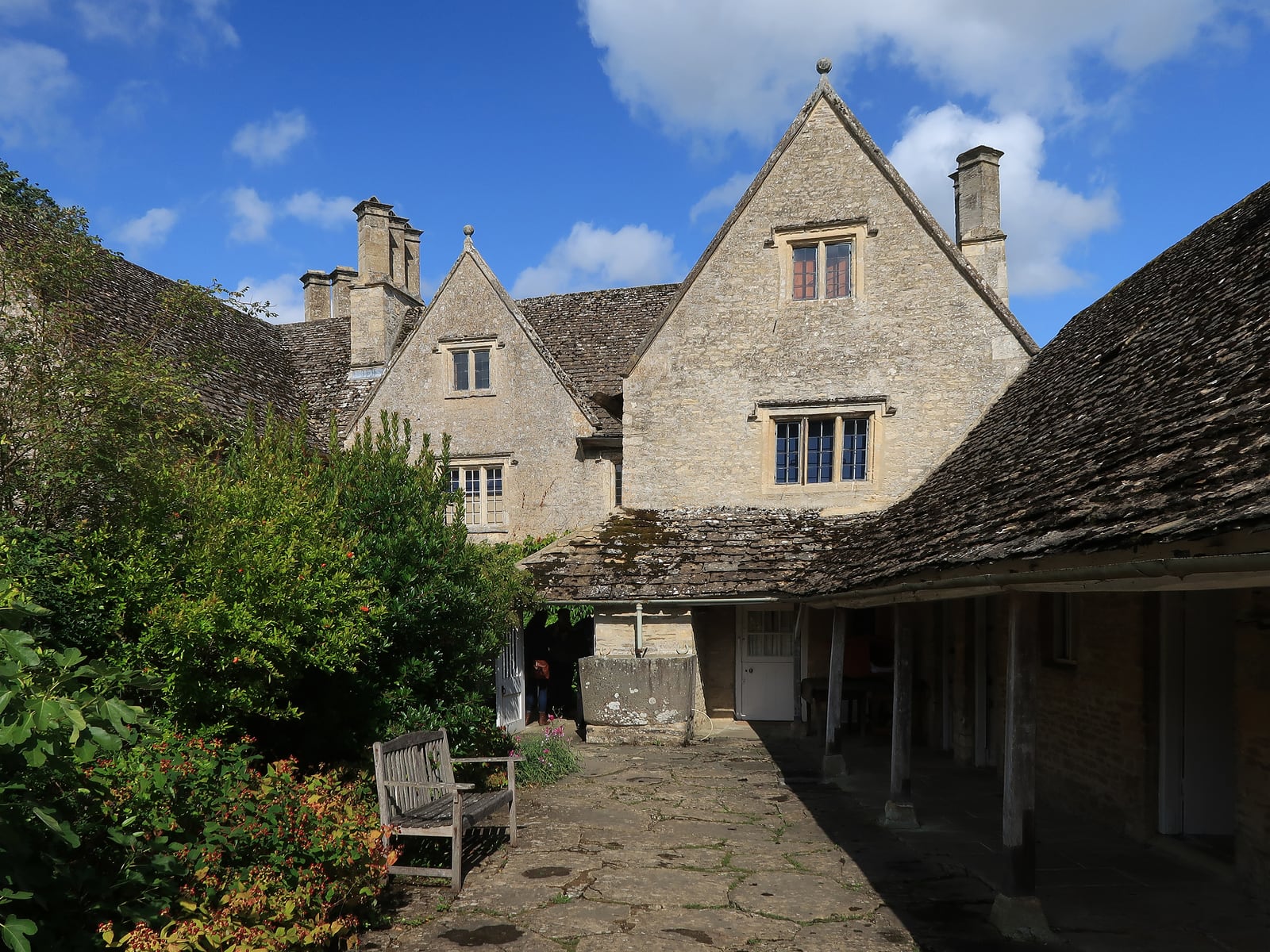
When the book returns to movement, its boats carry the company upstream toward haymaking, friendship, and the old house recognizable as Kelmscott Manor. The setting is intensely personal. Kelmscott was Morris’s country home; an image of its entrance also became the frontispiece of the Kelmscott Press edition.[2][3]
In chapter XXXI, the traveller’s feet know the way before he can explain that knowledge. His hand lifts the garden latch almost without his willing it. The house offers the promise of a homecoming deeper than conscious recognition. Ellen, his companion, loves its weathered walls and the continuity between the building and the earth around it.[1]
Yet familiarity with a building is not the same as membership in the life now conducted there. The novel makes that distinction painful by bringing him so close. A strange country could keep him at a comfortable distance; a house his body remembers cannot.
Nor does the final approach simply erase his old habits. After another swim, Dick talks about the pleasure and sadness of the seasons. The visitor treats the year as something that might be appreciated like a drama. Dick objects to imagining himself seated outside it: he participates in the work, and feels its gains and losses. Immediately before the feast, their conversation exposes the difference between enjoying a prospect and sharing a life (chapter XXXII).[1]
The feast continues without him
The last chapter’s title, The Feast’s Beginning—The End, divides time in two. For the people gathered in the village church, an evening of celebration is starting. For the traveller, the visit is over.
No one throws him out. At the threshold he smiles, expecting welcome, but his companions cease to register his presence. Ellen seems to recognize him briefly, then her face turns sad. He leaves while the company’s happiness continues. The scene gives the future an existence beyond its usefulness to the man who has come to look at it (chapter XXXII).[1]
Outside, he encounters a worn, deferential labourer whose appearance brings the old world back into view. Darkness follows. He wakes at Hammersmith.
The final instruction is easy to misread as a speech Ellen delivers. It is actually the returned narrator’s interpretation of what her last look seemed to mean. “Go back again,” he imagines it telling him. That distinction leaves the responsibility for the message with the person who must act on it.[1]
He has lost the chance to remain, but finds himself less despairing than he expected. His original wish was to see one day of the future. The ending asks what seeing has changed. If the visit merely supplied a beautiful place in which to hide, waking would cancel its value. If it has enlarged what he can hope and work for, the journey continues through his return.
Morris closes with the possibility that other people might see what the traveller has seen. The book we have just read is his attempt to make that happen. Its last movement carries us out of the garden and back toward the difficult conversation with which it began.
Sources
- William Morris, News from Nowhere; or, An Epoch of Rest, Project Gutenberg transcription of the 1908 Longmans edition—chapters I–II, XVII–XVIII, and XXXI–XXXII; primary text for quotations and analysis.
- William Morris Gallery, “News From Nowhere (1891),” collection record K967—serial and book publication history, and the Kelmscott Manor frontispiece.
- Tony Pinkney, “Ask Me Questions: An Introduction to News from Nowhere,” William Morris Archive, University of Iowa—dream frame, utopian exposition, river romance, and Kelmscott setting.
- Michael Coppins, “Kelmscott Manor,” photograph taken 10 August 2019, Wikimedia Commons—image source and CC BY-SA 4.0 license; reproduced here at reduced resolution.