At first, Louisa Ellis and Sarah Penn seem designed to cancel each other out. Louisa, the heroine of “A New England Nun,” keeps her small house so precisely that a visitor moving two books feels like an event. When marriage threatens that order, she quietly releases herself from a fifteen-year engagement. Sarah, in “The Revolt of ‘Mother,’” has spent forty years in a house too cramped for her family while her husband enlarges the farm around it. When argument fails, she carries the household into his new barn.[1][2]
One woman protects a room by preventing a marriage; the other changes a marriage by occupying a building. Yet the stories belong together more closely than that neat opposition suggests. The 1891 collection A New England Nun and Other Stories opens with Louisa and closes with Sarah.[1][2] Across that long arc, Mary Wilkins Freeman asks the same material question twice: who gets to decide what domestic space is for?
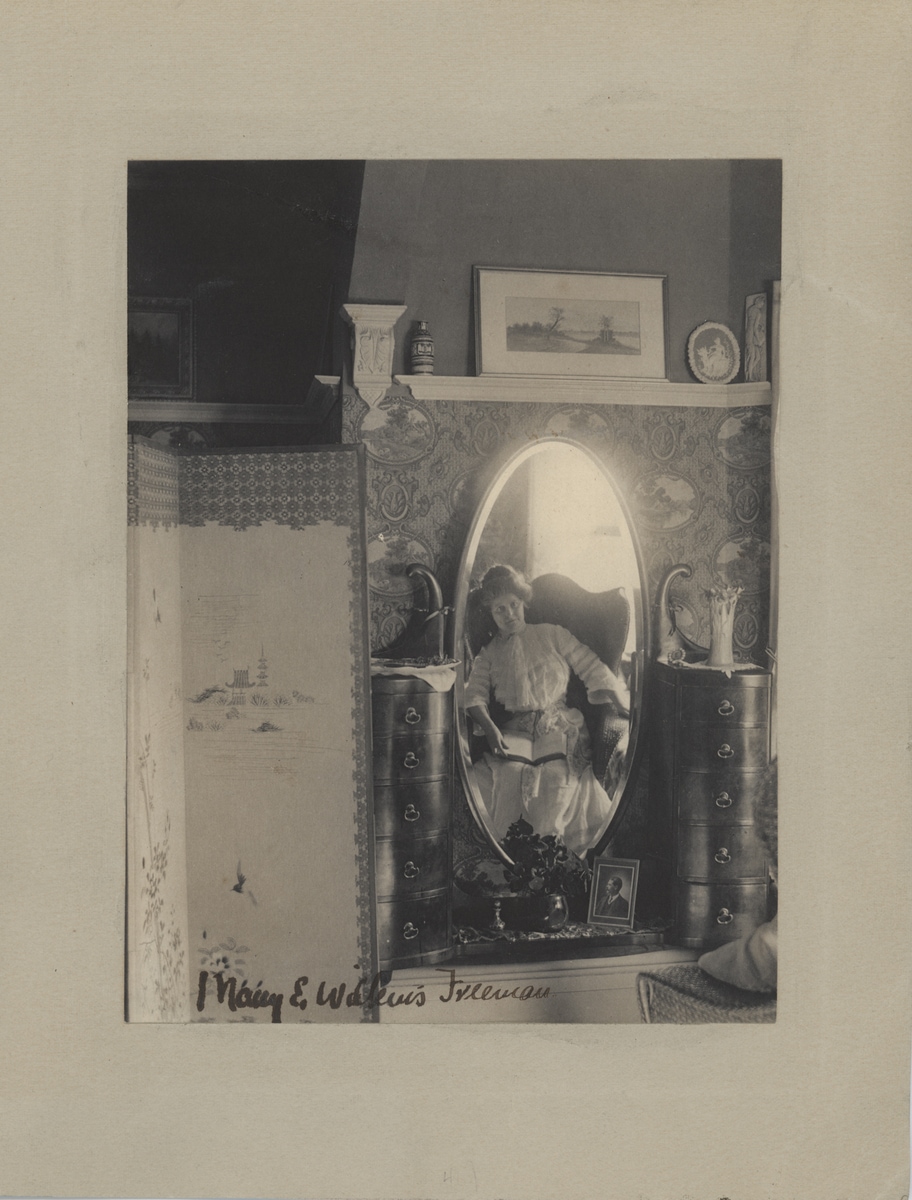
Freeman is often introduced as a New England regionalist, a label that accurately names her geography and can still diminish her scale. The introduction to the recent collection New Perspectives on Mary E. Wilkins Freeman stresses how poorly a single category contains a career that crossed nearly fifty years, several genres, and the threshold into modernism.[3] Her villages are not quaint enclosures. They are laboratories of will. A teacup, a pantry, a workbasket, or a stall can reveal who controls time, labor, money, and the future.
Two interiors, two maps of power
“A New England Nun” begins by making Louisa’s routine sensuous rather than merely obsessive. She folds her sewing, gathers currant stems, polishes her china, and sets one pink cup for tea. The narrator says she serves herself “as if she had been a veritable guest to her own self.”[1] That phrase is the ethical center of the room. Louisa does not save her best things for a social life that may never arrive; she grants everyday ceremony to the life she already has.
Then Joe Dagget enters. He is decent, loyal, and catastrophically out of scale. The canary beats its wings, Joe reverses the order of two books, and on leaving he knocks the sewing basket to the floor. Freeman’s joke is generous to both characters: Joe feels like an innocent bear leaving a china shop, while Louisa feels like its long-suffering owner.[1] The comedy matters because it keeps Joe from becoming a villain. Louisa’s danger is not malevolence. It is the ordinary destruction that can follow when a good person assumes there will be room for him.
“The Revolt of ‘Mother’” draws its power map more bluntly. Sarah asks why men are digging in the field where Adoniram promised, forty years earlier, to build her a house. He tells her to go inside and “tend to your own affairs.”[2] But the new barn is already her affair. More cows mean more milk to process in her tiny pantry, more work inside a house the narrator calls “infinitesimal” beside the barns and sheds. Adoniram’s sentence tries to separate male property from female household labor; the proportions of the farm show that they have never been separate.
Sarah, like Louisa, is easy to misread if quietness is mistaken for surrender. Freeman describes her meekness as the result of her own will, “never of the will of another.”[2] That distinction makes both stories possible. These women are not waiting to acquire a will. They are deciding when, and in what form, to use one.
Louisa protects a scale of life
Louisa’s engagement has survived because Joe spent fourteen of its fifteen years in Australia. During that absence, marriage changed from expectation into abstraction while her solitary habits became a complete life. His return makes the bargain concrete. She must leave her house, care for his mother, entertain company, and surrender the apparently “foolish” work she loves: distilling rose and peppermint essences, sewing a seam for the pleasure of the stitch, keeping her drawers fragrant with lavender.[1]
These details are not a checklist of eccentricities. They describe control over tempo. Louisa can choose when labor becomes craft, when an object is useful, and when a day has been properly arranged. Marriage would not simply add Joe to this system. It would relocate her into his house and redefine her time around a larger household. The story’s famous “hedge of lace” is therefore both refuge and boundary.[1]
Her escape is ethically complicated. Louisa does not end the engagement as soon as she recognizes her dread. She acts only after overhearing Joe and Lily Dyer confess that they love each other but will sacrifice that love to honor the old promise. The discovery gives Louisa permission, but what she does with it is her own. She never exposes the lovers. Instead, she tells Joe that she has lived one way too long to change, allowing all three people to leave the contract with dignity.[1]
Critics have long divided over whether this ending represents autonomy or fear, and a recent Cambridge chapter summarizes that debate as a contest between chosen independence and passive retreat from sexuality and change.[4] Freeman keeps both pressures alive. Louisa wakes feeling like a queen whose “domain” is secure, but the narrator also calls her peace “placid narrowness” and invokes the biblical exchange of a birthright for pottage.[1] The ending is not a certificate of total liberation. It is a lucid account of a bounded freedom that Louisa values more than the approved alternative.
Sarah changes the building’s grammar
Sarah first tries to make language do the work. She walks Adoniram through the undersized house as if presenting evidence: the bedroom where she bore four children and endured a fever; the pantry where she handles the milk of six cows; the unfinished rooms where their surviving children sleep; the absence of a parlor for their daughter’s wedding. She converts forty years of accommodation into an audit of space, work, and broken promise.[2]
Adoniram answers, “I ain’t got nothin’ to say.”[2] His silence defeats rhetoric because it refuses the premise that Sarah’s evidence requires a response. The story then changes genres. What began as a domestic argument becomes an operation. When Adoniram leaves and a hay wagon approaches the completed barn, Sarah orders the hay sent elsewhere. She packs plates and cups, has the bed taken apart, moves the stove, and leads her children across the yard.
The narrator compares this relocation to Wolfe’s assault on the Heights of Abraham.[2] The scale is comic, but the joke cuts two ways. It inflates an afternoon of household moving into military history, and it exposes a definition of courage that can recognize a captured city more easily than a woman repurposing property she helped sustain. Sarah’s action is heroic precisely because its tools are so ordinary.
Once occupied, the barn’s nouns change. Box stalls become bedrooms behind quilts. The harness room becomes a kitchen. The central aisle becomes a future parlor, and the door intended for Jersey cows becomes a front entrance.[2] Sarah does not destroy the building or reject domestic labor. She revises what the farm’s capital is allowed to serve. Her revolt is a work of interpretation made physical.
That is why Adoniram’s final claim—he had no idea she was “so set on’t”—lands as both moving and inadequate.[2] Sarah had told him, shown him, and measured the injustice room by room. He registers her meaning only after it becomes architecture. His tears and promise to install partitions are real concessions, but they do not erase the mechanism that made them necessary. Scholarship on the story continues to circle this tension between duty, domesticity, and defiance: Sarah wins by using the household role that confined her as the authority for changing its material terms.[5]
Refusal and occupation
The cleanest difference between the stories is temporal. Louisa faces an impending merger and stops it. Sarah lives inside a marriage whose unequal arrangement has hardened over forty years and alters it from within. Louisa can preserve a private scale because no children or shared household bind her to Joe. Sarah has no equivalent exit; her agency must travel through beds, dishes, milk pans, a daughter’s wedding, and the labor of making a building habitable.
Their methods also reverse each other. Louisa gains freedom through a tactful conversation that conceals what she knows. Sarah gives an explicit speech, discovers that speech can be ignored, and turns to logistics. Louisa keeps her possessions in place. Sarah moves every possession she can carry. One prevents a threshold from being crossed; the other crosses the yard and makes a new threshold.
Freeman binds those differences with recurring objects. Louisa uses her best china every day; Sarah packs plates and cups into the barn. Joe overturns Louisa’s workbasket; Sarah uses a clothes-basket to move the household. Louisa protects labor that looks useless because it gives pleasure; Sarah demands decent space for labor everyone treats as necessary. In both stories, domestic detail keeps an account that polite social language has failed to keep.[1][2]
Neither conclusion is a public revolution. The village order remains, and each victory stays inside severe economic and social limits. But calling the endings merely private would repeat Adoniram’s mistake. Freeman shows that privacy is already organized by contracts, property, care work, reputation, and access to time. A room can be small and still contain a political argument.
That is why these stories have survived the shrinking effect of the “local color” label. Recent scholarship emphasizes Freeman’s resistance to simple categories, while the critical afterlives of Louisa and Sarah keep reopening the same unsettled questions: Is chosen narrowness still freedom? Is a revolt complete if it preserves the family? Can accommodation become a source of authority?[3][4][5] Freeman does not solve those questions by making either woman exemplary. She gives each one a form fitted to her circumstances.
Read together, “A New England Nun” and “The Revolt of ‘Mother’” make freedom less glamorous and more exact. It may mean keeping a cup where one placed it. It may mean carrying that cup across a yard. The engagement is not destiny, the barn is not inevitably a barn, and a room is never neutral when someone else has decided what it is for.
Sources
- Mary E. Wilkins, “A New England Nun,” pp. 1–17 in A New England Nun and Other Stories (Wikisource transcription of the 1920 Harper edition).
- Mary E. Wilkins, “The Revolt of ‘Mother,’” pp. 448–468 in A New England Nun and Other Stories (Wikisource transcription of the 1920 Harper edition).
- Stephanie Palmer, Myrto Drizou, and Cécile Roudeau, “Reading Freeman Again, Anew,” introduction to New Perspectives on Mary E. Wilkins Freeman (Edinburgh University Press, 2023) — genre, period, and reception context.
- Aušra Paulauskienė, “Redefining the New England Nun: A Revisionist Reading in the Context of Pembroke and Irish American Fiction” (2023) — overview of the autonomy-versus-passivity debate around Louisa Ellis.
- Emily Toler, “Rethinking the Revolution: Duty, Domesticity, and Defiance in Mary E. Wilkins Freeman’s The Revolt of ‘Mother’,” Articulāte, Vol. 12 (2007) — critical context for Sarah Penn’s mixed mode of resistance.
- Loyola University Chicago Digital Special Collections, “Mary E. Wilkins Freeman” — archival portrait, letters, and biographical context for Freeman’s work and domestic life.