
A Nobel lecture usually tempts a career into looking inevitable. The early experiment points toward the masterpiece; the masterpiece points toward the prize; the prize certifies the shape in retrospect. Han Kang's Light and Thread refuses that flattering geometry. It begins with a handmade booklet of childhood poems, moves through novels that left their questions unresolved, enters the historical violence of Gwangju and Jeju, and returns to the image of a thread between human hearts. The return is not a victory lap. It is a test of whether the first image can bear everything learned since.[1][2]
Han delivered the lecture in Korean at the Swedish Academy in Stockholm on December 7, 2024. Two months earlier, the Swedish Academy had honored prose that confronts historical trauma while exposing the fragility of human life.[2][3] Her lecture accepts that description but quietly changes its emphasis. Fragility is not only what violence reveals. It is also what makes touch, testimony, conscience, and reading possible.
That distinction is why the recording deserves more than a ceremonial watch. Light and Thread is a compact account of literary method: not a list of themes, but a sequence showing how one urgent question generates the next. A reader who never presses play can follow that sequence below. The video adds something prose cannot quite duplicate—the composure with which Han lets terrible material arrive without turning calmness into distance.[1][2]
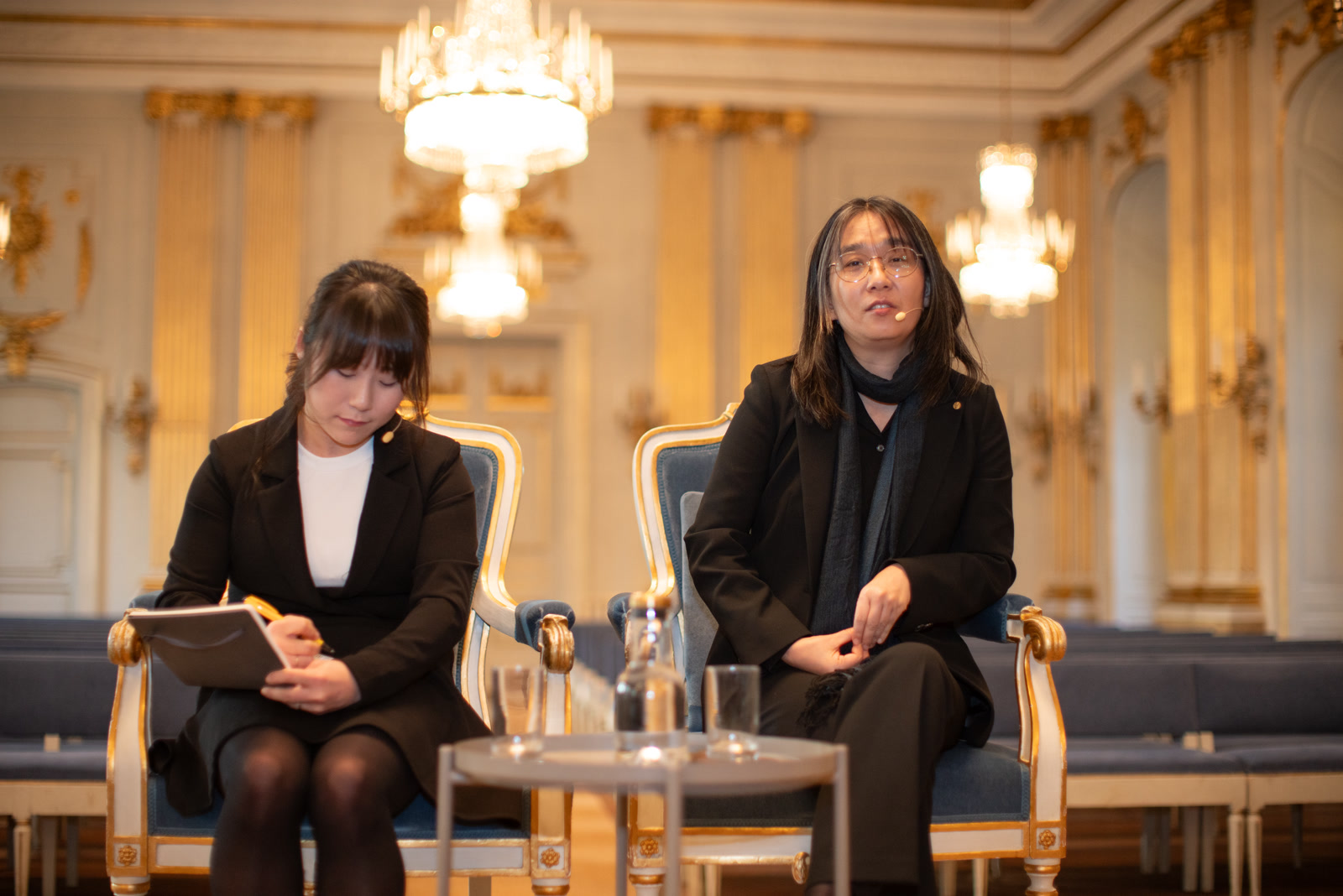
Image context: the cover photograph shows Han speaking beside an interpreter during Nobel Week. Its microphones, notebook, formal room, and visible act of listening fit a lecture concerned with how language crosses from one interior life into another.[6]
The Lecture
The official Nobel Prize upload presents the complete lecture with English subtitles. It runs a little over 34 minutes and keeps the frame spare: Han, her pages, her voice, and a room asked to listen.[1]
The most useful way to watch is to follow the changing direction of Han's questions. At first they move outward from a private self: What is love? Why write? Can human beings refuse violence? In the lecture's central turn, history answers with questions of its own. By the end, the dead are no longer only people to whom the living owe attention. They have become agents capable of altering the present.[2]
The Child's Thread Is a Structural Key
The lecture opens with an object small enough to hold: five folded sheets that Han made into a poetry booklet in 1979, when she was eight. One poem locates love inside a beating chest and calls it the “gold thread connecting between our hearts.”[2] The anecdote could have served as an origin myth—the future laureate already writing poems—but Han is interested in continuity rather than precocity. She remembers the pencil extender, eraser dust, and borrowed stapler. Writing begins as handling material, assembling pages, then withholding them from view.
Those tactile details establish the lecture's scale. Its large words—love, violence, humanity, the dead—will matter only when attached to bodies and objects. In Greek Lessons, as Han later explains, a woman who has lost speech writes into the palm of a man losing his sight. In Human Acts, candles burn beside bodies in a gymnasium. In We Do Not Part, heavy snow, a pet bird, survivor testimony, and a candle lit at the bottom of the sea keep history from becoming a disembodied subject.[2]
The golden thread is therefore not a decorative symbol placed over suffering. A thread is narrow, vulnerable, and made to cross a gap. It does not merge two hearts into one. It connects them while leaving the distance visible. That is already a useful description of reading: another person's interior life reaches us through a material line, but never becomes ours to possess.
A Career Told as a Chain of Questions
Han's account of composition resists the language of solutions. A novel takes her from one to seven years, she says, because she lives inside questions until she reaches their end—explicitly not the same thing as finding their answers.[2] The distinction organizes the middle of the lecture. Each finished work leaves behind a changed writer and a remainder that the next work must take up.
The Vegetarian asks whether a person can become innocent by refusing violence, then makes that refusal lethal: Yeong-hye's wish to leave the human species and become plant life moves toward self-erasure. Greek Lessons shifts the pressure. If withdrawal cannot save us, what small contact might make continued life possible? Its answer is not a doctrine but a scene of touch, one person writing words into another person's hand.[2]
This question-chain helps explain why Han has resisted reducing The Vegetarian to a single social allegory. In her official Nobel interview, she describes its years of composition through vivid images of people, trees, and sunlight, and returns to the wider problem of what it means to be human.[4] The Nobel lecture places those images inside a longer sequence. Refusal, bodily vulnerability, language, and connection do not repeat as branding. Each book discovers where the previous question was too narrow.
That is also the lecture's first lesson about literary afterlife. A work does not remain alive because it resolved its subject. It remains alive because its form makes a question inhabitable for someone else. Han's summaries are brief, but each names a precise formal pressure: alternating typefaces, second-person address, intersecting voices, the hand as a writing surface. Ethical seriousness resides in these choices, not above them.
Gwangju Reverses the Direction of Witness
The lecture's hinge arrives when Han recalls trying, in 2012, to write a bright, life-embracing novel. She stopped after roughly 20 pages because she could not move toward light without confronting Gwangju. Her family had left the city in January 1980, months before the uprising. At 12, she secretly opened a book of photographs showing both mutilated victims and a long line of people waiting to donate blood. The paired images fixed two incompatible questions in her: how can humans do this to one another, and how can they stand against it together?[2]
The historical archive supports the weight Han gives those photographs. UNESCO's Memory of the World register describes the May 18–27, 1980 uprising through documents, photographs, witness materials, records of punishment, and compensation claims; the collection was registered in 2011.[5] Han's childhood encounter was not with “history” as an abstract backdrop. It was with a clandestine documentary practice built to preserve truth under suppression.[2][5]
To write what became Human Acts, she read more than 900 testimonies and encountered the diary of the young night-school teacher Park Yong-jun, killed after remaining in the YWCA building when troops returned. His final entry includes the plain declaration “I wish to live.”[2] That sentence matters because it prevents later readers from converting conscience into a taste for martyrdom. Staying was courageous, but the person who stayed wanted life.
Here Han reverses two questions she had written in her diaries. Instead of asking whether the present can help the past and whether the living can save the dead, she asks: “Can the past help the present? Can the dead save the living?”[2] The reversal is the lecture's deepest formal move. It changes the grammatical subject of witness.
The claim is not supernatural bookkeeping, and it does not suggest that a novel repairs murder. It describes what testimony can do to the person who receives it. Park Yong-jun's words give Han a direction when research has nearly made the book impossible. The dead cannot be restored by narrative, but their recorded choices can interrupt the living person's despair, self-protection, or historical amnesia. Witness becomes reciprocal: attention travels toward the past, and pressure travels back.
Light Is Not the Same as Optimism
Once Gwangju enters the lecture, “light” can no longer mean innocence. In Human Acts, candlelight falls on bodies. In the account of writing We Do Not Part, snow both reveals and threatens to bury traces of the Jeju massacre. The recurring brightness does not bleach violence into beauty. It makes acts and objects briefly available to sight.[2]
That is why the lecture's visual vocabulary is more exact than the generic contrast between darkness and hope. Han's Nobel citation emphasizes historical trauma and fragile life; Light and Thread shows the craft underneath that description.[3] A candle marks care because someone lights it. A photograph bears witness because someone preserves and risks circulating it. A thread connects because someone sends or follows it. None of these objects guarantees rescue. Each names a practice.
The same restraint governs the lecture's ending. Han returns to her childhood line, but the thread now passes through failed innocence, damaged bodies, documentary evidence, translation, and the labor of novels. Love has not defeated violence. It has become the reason violence cannot be treated as merely conceptual. The greater the wish to trust human beings, Han suggests, the more painful the evidence of what they do—and the more significant the evidence of those who resist.[2]
What the Recording Adds
On the page, the lecture can look almost too elegantly circular: childhood thread, career questions, historical rupture, recovered thread. The video roughens that symmetry in a useful way. Han's measured delivery gives each transition time, while the English subtitles remind an Anglophone viewer that the thread is crossing languages in real time.[1] We do not receive an unmediated authorial presence. We receive Korean speech, translated text, camera framing, institutional staging, and our own act of attention.
That mediation suits the argument. Han's international reception has depended heavily on translation, and a publisher interview accompanying Human Acts discusses the delicacy and patience she found in collaborative translation work.[7] Light and Thread does not pretend language abolishes distance. It treats language as the means by which distance can be crossed carefully.
The recording also protects the lecture from becoming a bank of quotations. Its memorable questions gain force from sequence: private wonder comes before artistic method; artistic method reaches an impasse; the archive changes the questions; later fiction tests the change. Extract “Can the dead save the living?” and it may sound mystical. Watch the path toward it, and the line becomes practical. A diary, photograph, testimony, translated sentence, or novel can enter the present and change what continuation requires.[1][2]
That is the reason to watch Light and Thread now. It offers no clean opposition between brutal history and consoling literature. Literature belongs inside the same fragile human field. It can be suppressed, mistranslated, commodified, sentimentalized, or forgotten. It can also keep a question moving between bodies and across time. Han's lecture does not ask us to admire the thread. It asks whether we will take hold of it without pretending it cannot break.
Sources
- Nobel Prize, “Nobel Prize lecture: Han Kang, Nobel Prize in Literature 2024 | English subtitles,” official YouTube video.
- Han Kang, “Light and Thread,” official Nobel Prize lecture text in English, delivered December 7, 2024.
- Nobel Prize, “The Nobel Prize in Literature 2024,” official press release and prize motivation.
- Nobel Prize, “Han Kang — Interview” (December 2024), including her account of composing The Vegetarian and the questions driving her work.
- UNESCO Memory of the World, “Human Rights Documentary Heritage 1980 Archives for the May 18th Democratic Uprising against Military Regime, in Gwangju, Republic of Korea.”
- Wikimedia Commons, “File:Han Kang, 2024 Nobel Prize Laureate in Literature 3.jpg,” John Sears's December 6, 2024 press-conference photograph and source record.
- Penguin Random House / Hogarth, Human Acts official book page and author interview, including Han Kang's comments on collaborative literary translation.