Guy de Maupassant's "The Necklace" is famous for its last-minute reversal: Mathilde Loisel and her husband spend ten years replacing a borrowed diamond necklace, only to learn that the original was paste. That summary is accurate and still too small. The ending does not work merely because information arrives late. It works because the entire story has trained Mathilde, her husband, and the reader to live inside a false price system before Madame Forestier corrects the account.[1][3]
The final scene is therefore best read as an audit, not a prank. Maupassant lets social fantasy become debt, debt become labor, labor become bodily transformation, and bodily transformation become a kind of bitter pride. Then, in a few quiet lines on the Champs-Elysees, he makes all that effort answer to a number Mathilde never asked for at the beginning: the necklace was worth far less than the life she spent repaying it.[1][3]
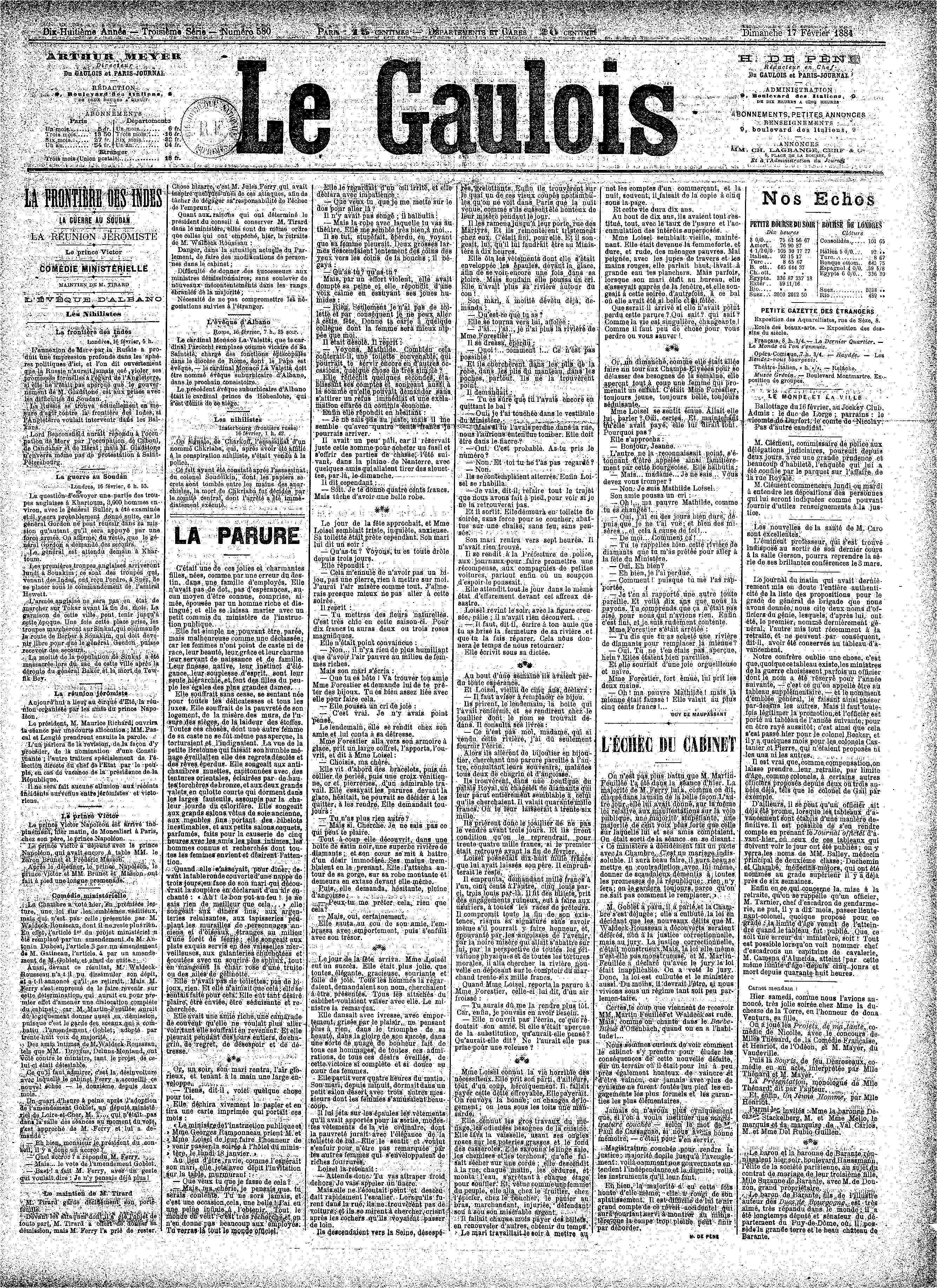
The archival setting matters. "La Parure" first appeared in Le Gaulois on 17 February 1884 and was later collected in Contes du jour et de la nuit; BnF's work page and Encyclopedia.com both preserve that publication frame.[2][3] Maupassant was not writing a folktale about vanity in the abstract. He was writing in a modern newspaper culture, for readers who understood status, urban display, credit, clerical salaries, and the humiliations of wanting to seem better placed than one is.[2][3][4]
The party is brief; the bill is the story
The ball receives less space than its consequences because Maupassant is not primarily interested in luxury as pleasure. He is interested in luxury as exposure. Mathilde's triumph at the ministry party is real enough: she is admired, desired, and briefly released from the apartment and meals she experiences as insults.[1] But the scene matters because it depends on borrowed surfaces. The dress is financed by her husband's sacrifice. The necklace is borrowed from Madame Forestier. The social identity she wears for one night has no reserve behind it.
That is why the lost necklace changes genre so quickly. A social fantasy becomes a household accounting problem. The Loisels do not confess. They search, delay, borrow, buy a replacement, and enter ten years of repayment.[1] The decision is morally important because it comes from shame as much as honesty. They do return a necklace. They do pay their debts. But the central debt is created by refusing a smaller truth at the start.
Maupassant's cruelty lies in making the repayment almost admirable. Mathilde learns hard work. She bargains with tradesmen, dismisses the servant, carries water, scrubs, and becomes visibly altered by labor.[1] A sentimental version of the story might turn that change into moral purification. Maupassant refuses. Labor gives her stamina and bluntness, but it does not retroactively make the original value true. Suffering can be real and still be attached to a mistake.
The final meeting reverses recognition
The last scene begins with a social shock before it becomes a financial one. Mathilde sees Madame Forestier, but Forestier does not recognize her.[1] That failure of recognition is essential. At the ball, Mathilde's borrowed glamour made her visible. Ten years later, the hidden cost of that visibility has made her almost unreadable to the woman whose necklace started the disaster.
For the first time, Mathilde speaks without disguise. She names the lost necklace and the replacement. She even claims a kind of victory: "I have had hard days," she says, but the debt is finally paid.[1] The line is moving because it is not self-pitying. Mathilde has turned catastrophe into endurance. She can stand in public and tell the truth because she believes the account has closed.
Then Madame Forestier reopens it. Her answer is tender in tone and savage in consequence: the original necklace was false.[1] The word "false" does enormous work. It means the stones were not diamonds. It also means that the social reading Mathilde built around them was false, the debt calculation was false, and the decade of sacrifice was founded on an untested assumption about value.
This is why the ending remains harsher than a standard twist. The revelation does not cancel the preceding years. It makes them heavier. A cheap surprise says: you were fooled. Maupassant's surprise says: you lived, worked, aged, and remade yourself inside a world where nobody checked whether the glittering object was what it seemed.
Paste is not emptiness
The paste necklace is often treated as a simple symbol of vanity: Mathilde wanted glitter, and the glitter was fake. That reading is not wrong, but it flattens the story's social intelligence. Paste still works as ornament. It still shines well enough at a ball. It still gives Mathilde the confidence to enter a room where she would otherwise feel exposed.[1][3]
The problem is not that paste has no value. The problem is that its value depends on context, belief, and social performance. At the party, the necklace succeeds because it is read as diamond. In the jeweler's ledger, its value would have been much lower. In Mathilde's imagination, it becomes a passport into the life she feels cheated of. In the Loisels' marriage, it becomes ten years of austerity. Maupassant's object is small, but it moves through several economies at once.[1][3]
That is the story's modern pressure. Many lives are still organized around mispriced signs: credentials, addresses, clothes, feeds, invitations, names, and rooms where being misread can feel briefly like freedom. Maupassant does not need to moralize that condition heavily. His structure does it for him. The object remains the same; the price changes according to who is looking and who is afraid to ask.
The last receipt is ethical
The final disclosure also tests honesty more carefully than the usual classroom moral allows. If Mathilde had confessed the loss immediately, the damage might have been small. But the story does not simply say "tell the truth." It asks why truth can feel socially impossible when status is at stake.
Mathilde's shame is not irrational from inside her world. She has been trained to believe that appearances decide worth. To admit that she lost the necklace would mean admitting not only carelessness but illegitimacy: she had entered a higher social register for one night and failed to manage its objects. The lie begins as a desperate attempt to preserve form.[1][3]
Maupassant's sentence-level control keeps the ending from becoming melodrama. Madame Forestier does not give a speech. Mathilde does not collapse into an operatic punishment scene. The story stops almost immediately after the correction.[1] That abruptness matters. The ending leaves the reader with no compensating aftermath, no second chance, no scene in which the two women repair the lost decade. A ledger has been balanced, then discovered to have used the wrong currency.
That is why "The Necklace" still cuts. Its final scene is not a trick door hidden in a neat plot. It is the moment when social fantasy receives a receipt. Mathilde's suffering was not imaginary. Her work was not fake. Her aging was not symbolic only. But the value she served was misread from the start. Maupassant saves his cruelty for the last line because that is where the story's real question lives: what does a life become when it is spent paying the price of an illusion that never had to be bought?
Sources
- Guy de Maupassant, "The Necklace," in Original Short Stories, Volume 4, Project Gutenberg HTML text used for passage reference.
- BnF Essentiels, "La Parure" - publication note and work page for Maupassant's story.
- Encyclopedia.com, "The Necklace (La Parure) by Guy de Maupassant" - publication history, Paris/Third Republic context, and critical overview.
- Syracuse University Libraries, "Guy de Maupassant Letters" - biographical note on Maupassant's short stories, novels, and career context.
- Wikimedia Commons, "File:Le Gaulois 17 février 1884.png" - source page for the archival newspaper image used as the article cover.