Kusamakura is often introduced as Natsume Soseki's nearly plotless 1906 retreat: an unnamed painter leaves Tokyo, climbs into the mountains, stays at a hot-spring inn, and tries to regard the world as art. That description is accurate in outline and misleading in motion. The novel does have a plot, but it is carried less by incidents than by three linked motifs. The road creates distance. The mirror reveals what distance does to sight. The railway train ends the experiment by bringing war, separation, and pity into the painter's chosen frame.
Follow those three objects and the book stops looking like a bag of aesthetic reflections. It becomes a sharply staged test: can an artist step outside human feeling without also turning other people into materials? Soseki never delivers a tidy verdict. Instead, each motif revises the one before it, until an apparently completed picture leaves an ethical question exposed.
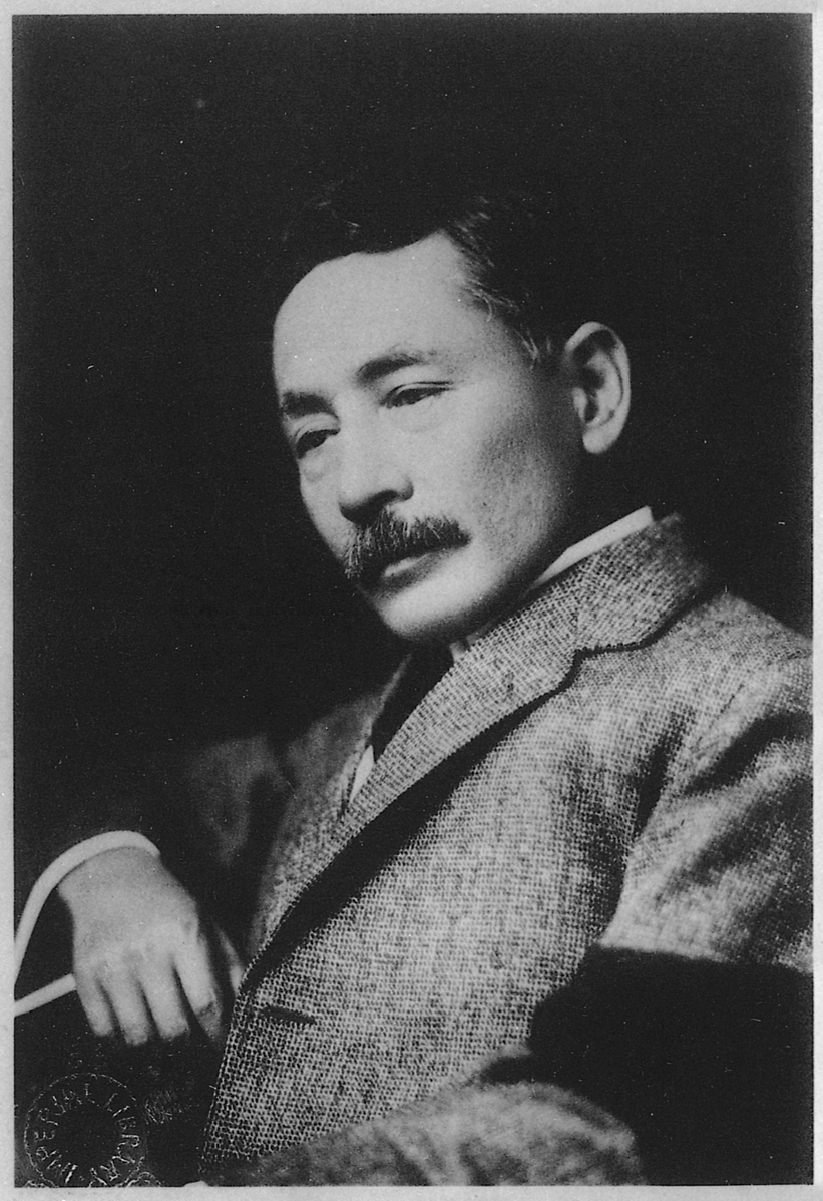
Image context: This is a real archival photograph of Soseki, not a generated author likeness or a generic book still life. The National Diet Library places him between English-literature study, teaching, and the distinct path he cut through modern Japanese fiction. That double life—reader of Western art, maker of Japanese prose—is everywhere inside Kusamakura.[5]
The Road: Distance Is a Moving Position
The title supplies the first motif. Kusamakura—literally a "grass pillow"—is an old poetic expression for being on the road, away from home and dependent on the shelter one finds. The University of Nebraska's annotated edition makes that travel sense explicit.[3] Soseki's painter is therefore not simply going to a place. He is adopting a posture: temporary, observant, and relieved of ordinary claims.
The Japanese text first appeared in Shin Shosetsu in September 1906.[1] In Chapter I, the painter reasons his way from the abrasions of social life toward poetry and painting. If the human world is hard to inhabit and there is nowhere else to move, art can make the stay more bearable. Kazutomo Takahashi's 1927 English version gives the whole book the revealingly blunt title Unhuman Tour.[2] "Unhuman" should not be mistaken for simple cruelty. It names the painter's wish to look without being swept away—to enjoy a quarrel as one might enjoy theater, or a landscape as a scroll, because neither demands intervention.
Yet a road never grants the stillness he wants. The climb keeps delivering bodies and voices: a tea-shop woman, a horse driver, villagers, an abbot, the innkeeper, and finally Nami, the innkeeper's divorced daughter. His supposed exit from society becomes a chain of encounters. The road's first lesson is therefore structural, not scenic. Detachment is something the narrator performs while moving through other people's lives; it is not a country he reaches.
That matters when the book is called "plotless." The plot is the failure of the retreat to remain pure. Soseki begins with a man walking away from the social world and ends with that same man at a railway station, pressed against the machinery of collective history. The mountain road does not erase modernity. It only delays its arrival.
The Mirror: No Image Is Neutral
The second motif enters comically. In Chapter V, a barber's warped mirror makes the painter's face grotesque: turn one way and it "makes all nose of it."[2] The joke looks disposable, but it establishes a rule. A surface that promises faithful reflection can caricature its subject through angle and construction. The mirror does not merely show; it edits.
Later, at Mirror Pond in Chapter X, reflection acquires a darker history. A local story says the pond was named for the mirror carried by a young woman who drowned herself there. The painter surveys pines, rocks, bamboo grass, and the mirror-like water as possible components of a composition.[2] What he sees as pictorial material is already somebody else's remembered catastrophe. Beauty has not removed the human story. It has made the story easier to hold at a distance.
Nami becomes the most difficult mirror of all. The painter repeatedly compares her to figures from Western art, especially Millais's Ophelia. He wants a face that will resolve into a picture, but her expressions change too quickly: amusement, defiance, apparent coldness, alarm. Ann-Marie Dunbar's study of Soseki's London writings helps name the imbalance. The narrator may feel like an outsider, yet with Nami he retains what Dunbar calls a "hegemonic role in terms of class and gender"; she finally facilitates his art rather than sharing his authority over the frame.[4]
The novel does not need the painter to announce that problem for readers to feel it. This is an inference from Soseki's patterning: the bad barber's mirror has already taught us to distrust anyone who calls a distortion a likeness. The painter's eye may be cultivated, but cultivation does not make it innocent.
Nami Refuses the Still Picture
The painter carries a sketchbook, sets up a tripod, composes scenes in his head, and produces almost no finished painting. That creative block is more than a joke about an overthinking artist. It keeps the distance between looking and knowing visible. He can arrange scenery. He cannot make Nami stay arranged.
In Chapter XIII, she asks for a real portrait—one "giving expression to my spirit and character."[2] Here she asks for more than the drowned, Ophelia-like image she had proposed earlier: the picture must answer to an interior life. The request quietly reverses the direction of the gaze. He replies that something is missing from her face and imagines that the right expression will complete his conception.
Here the motif map doubles back. The road let him believe he could suspend ordinary feeling. The mirror showed that every representation bends what it catches. Nami now tests whether his projected image can survive a subject who talks back. Her volatility is not merely an obstacle to portraiture; it is evidence that a person exceeds the pose selected for her.
Even the novel's form takes Nami's side more than the painter realizes. Kusamakura moves among prose meditation, dialogue, haiku, Chinese verse, visual-art criticism, comic anecdote, and local legend. The University of Nebraska edition describes its central question as the relation between experiencing life and representing it.[3] No single genre contains the book, just as no single expression contains Nami. The painter wants a final touch. Soseki keeps changing the medium.
The Train: History Enters the Frame
The last motif is the opposite of a grass pillow. A road allows the traveler to choose a pace and pause. The railway moves many bodies at one speed, on a fixed line. As the group approaches the station in Chapter XIII, the painter says he has been "dragged back into the living world."[2] He treats the train as the emblem of a civilization that celebrates individuality while packing people into uniform compartments.
That complaint would remain another elegant paradox if the train did not carry particular people. The novel's action is set against the Russo-Japanese War. Young Kyuichi is departing toward Manchuria, while Nami's impoverished former husband also appears at a carriage window; the Nebraska edition identifies the war as the pressure behind this apparently idyllic interval.[3] The machinery is therefore not a generic symbol of modern life. It gathers the consequences of conscription, migration, economic failure, and separation into one scene.
As the train starts, Nami's eyes meet her former husband's. The painter finally sees "compassion and pity" in her face.[2] This is the expression he has been waiting for, and in his mind the portrait becomes possible.
The ending is moving because human feeling breaks through Nami's performed hardness. It is troubling because the painter receives her feeling as an artistic solution. Dunbar reads the moment as Nami becoming the muse who stabilizes the male artist's project.[4] The novel lets both truths remain present. Compassion defeats the fantasy of a purely unhuman gaze, yet the gaze immediately tries to possess compassion as its final brushstroke.
What The Three Motifs Reveal
Road, mirror, train: each changes the terms of sight. The road makes distance feel voluntary. The mirror exposes distance as distortion. The train shows that no aesthetic refuge can remain outside shared history.
Their sequence also explains why the novel's ending should not be reduced to the painter's enlightenment. He has learned that a face needs human feeling, but he has not necessarily learned to stop treating a woman's feeling as his medium. The picture is complete in his mind; the ethical relation is not.
That unfinished relation is the book's durable pleasure. Soseki, whom the National Diet Library describes as a writer whose mode diverged from the naturalism dominant in his moment, built a novel capacious enough to argue with its own narrator.[5] Kusamakura offers the dream of stepping outside the dust of ordinary life, then plants a road, a mirror, and a train along the route back. Art may make the human world inhabitable. It cannot make the artist unaccountable to it.
Sources
- Aozora Bunko, Kusamakura bibliographic card, including original publication information and a link to the complete Japanese text.
- Project Gutenberg, Natsume Soseki, Unhuman Tour (Kusamakura), translated by Kazutomo Takahashi (1927), complete English text used for chapter references and short quotations.
- University of Nebraska-Lincoln, Natsume Soseki, Kusamakura and Buncho (Zea Books, 2025), annotated open edition with publication, travel-term, art, and war context.
- Ann-Marie Dunbar, "Three Leagues Away from a Human Colour: Natsume Soseki in Late-Victorian London," Victorian Literature and Culture 46, no. 1 (2018), including analysis of the painter, Nami, and the novel's final image.
- National Diet Library, Japan, "NATSUME Soseki," biographical record and archival portrait collection.