W. W. Jacobs's "The Monkey's Paw" is often remembered as a tale about a cursed object. That is accurate, but too small. The story works because the paw is only one item in a carefully arranged set of household signs: a chessboard, a fire, a road, a sum of money, a door, and a series of knocks. Each object is ordinary enough to belong in a family sitting room. Each becomes more frightening when the wish teaches the family, and the reader, to read the house symbolically.[1]
The story first appeared in Jacobs's 1902 collection The Lady of the Barge, a book whose title and contents still point toward the author's comic and maritime reputation.[2] That reputation matters. Brigham Young University's Modernist Short Story Project notes that Jacobs wrote many stories connected to sailors, docks, and practical jokers, even though his most famous work is this compact horror story.[3] "The Monkey's Paw" keeps some of that comic machinery. Its terror does not arrive in a Gothic castle. It starts as family banter, a visitor's anecdote, and a small gamble at the fireside.
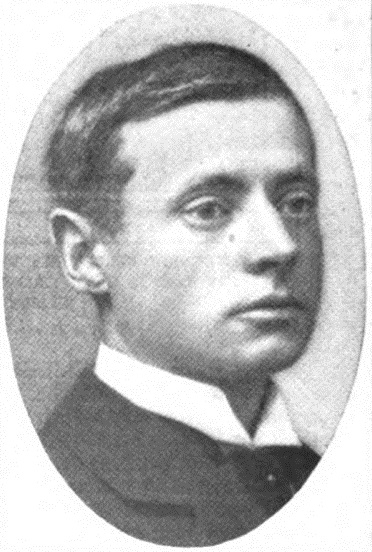
The portrait used with this article is useful for the same reason. It is not a scene from the story or a later horror illustration; it is an archival photograph of Jacobs himself, made by Elliott and Fry and published no later than 1903.[4] The image keeps the reading anchored in literary craft rather than in modern franchise imagery. The story's symbols belong to a writer who knew how to make a plain room do the work of a haunted landscape.
The game teaches the house to accept risk
The opening chess game is the story's first map of danger. Mr. White plays with "sharp and unnecessary perils," and the phrase quietly previews his later wish.[1] He is not presented as wicked. He is playful, impulsive, and pleased by risk when risk still looks reversible. That distinction matters because the story's horror depends on a wish that feels like a continuation of a habit, not a sudden moral collapse.
Chess also gives the story a symbolic grammar of moves and consequences. A player can imagine that a bold move is clever until the board answers it. The wish works the same way, except that the answering move comes from outside the visible board. Jacobs lets the family begin in a room where risk is familiar, measured, and entertaining. The paw then enlarges the same pattern until the cost can no longer be treated as a game.
Herbert's teasing is part of this motif. He treats the paw as an absurd prop and his father's uncertainty as domestic comedy. Mrs. White joins the practical joking tone, too. Before the wish, the family can laugh because the symbols have not yet hardened. A game is only a game; a visitor's tale is only a tale; a dried paw is only a grotesque curiosity. The story's pressure comes from watching those categories fail one by one.
The paw is small because the temptation is small
The paw itself is not impressive. Jacobs does not make it jewel-like, luminous, or formally ceremonial. Its power is out of proportion to its appearance, which is why Sergeant-Major Morris's alarm has to do so much work. He has seen the object translated into consequence. The Whites have only seen it translated into story.
That gap between experience and anecdote is one of the story's most important symbolic structures. Morris tries to move the paw from curiosity to warning. Mr. White pulls it back toward experiment. The fire, where Morris throws the paw, briefly offers a moral solution: destroy the symbol before it becomes a tool. Mr. White's retrieval reverses that solution. He chooses possession over warning, but the choice still looks almost comic because the object is so small.
The modesty of the first wish sharpens the trap. Mr. White does not ask for empire, youth, revenge, or impossible power. He asks for "two hundred pounds," enough to clear a domestic problem.[1] That is why the paw is so cruel as a symbol. It does not need to expose grand ambition. It exposes the wish hidden inside ordinary financial pressure. The supernatural enters through a need that the reader can understand.
Jacobs's authorial background helps explain the precision. The Modernist Short Story Project emphasizes his interest in closed episodes, practical jokes, sailors' stories, and recurring concerns with greed and material desire.[3] "The Monkey's Paw" compresses those interests into a single mechanism. The paw is a joke object until it is not. The wish is practical until its payment arrives. The story turns a comic setup into moral accounting.
Two hundred pounds is the cruelest symbol
Money is the story's most devastating symbol because it is both exact and insufficient. The sum is not abstract treasure. It is a figure that can be named, imagined, spent, and connected to household security. It belongs to mortgages and wages, not myth. That exactness allows the story to make fate feel bureaucratic.
The compensation payment from Maw and Meggins completes the symbol's transformation. Money no longer means relief; it means conversion. Herbert's body has been turned into a sum. The wish has been granted in the narrowest possible sense, and that narrowness is the horror. The world has obeyed the words while violating the human meaning behind them.
This is where the story's symbolic economy becomes harsher than simple punishment. If Mr. White had made a grotesque wish, the result could be read as moral fable: greed earns ruin. Jacobs writes something more unsettling. A reasonable wish is answered by an unreasonable universe. The point is not that desire is always monstrous. It is that desire, once treated as a transaction with unknown powers, can be fulfilled without mercy.
The money also changes how the family reads the room. Before the payment, the paw is an uncanny relic. After the payment, it becomes evidence. The family does not need to see magic happen. They can count. The story makes arithmetic a horror device: the exact sum proves that the impossible has found a way to pass through ordinary institutions.
The road turns fate into an errand
The road outside the Whites' house is one of the story's quietest symbols. At first it marks isolation. The family is indoors, sheltered from weather, distance, and darkness. Sergeant-Major Morris arrives from the road carrying India, war, empire, and strange experience into the domestic room. Later, the same outside world sends the company's representative to the door with polished reluctance and fatal news.[1]
That movement matters because fate in the story does not descend as lightning. It comes as an errand. A man from the factory walks to the house. He apologizes. He offers a payment. The terror is not merely that Herbert dies at Maw and Meggins. It is that the machinery of death can return home in correct social form, with compensation language and a visitor trying not to say too much.
The road therefore connects the intimate and the industrial. Herbert leaves home as a son and worker. News comes back as message and money. The family room cannot remain separate from the factory world that supports it. Jacobs does not need to describe the accident in detail; the symbolic circuit is enough. Work, wages, injury, and grief all travel the same route.
By the end, the road has become emptiness. Mr. White's final wish is followed by the image of a "quiet and deserted road."[1] That quiet is not comfort. It is erasure. The outside world, which had seemed too powerful and too responsive, suddenly withholds the impossible return that Mrs. White demands. The road has delivered consequence, but it will not deliver consolation.
The door turns hope into sound
The door is the story's most theatrical symbol because it divides belief from sight. The family hears before it sees. Mrs. White turns sound into hope; Mr. White turns sound into dread. The reader is forced to occupy the space between them. What is knocking? A son, a corpse, a consequence, a mercy refused?
Jacobs intensifies that uncertainty by making the knocking excessive: "a perfect fusillade of knocks."[1] The phrase turns a domestic sound into assault. The door, which usually protects the home, now becomes the surface on which the wish announces itself. It is not a monster entering by force. It is a claim waiting to be admitted.
Mrs. White's struggle with the bolt and Mr. White's search for the paw create the story's final symbolic contest. She wants the door opened because she reads the knock as restoration. He wants the wish undone because he reads the knock as the exact cost of restoration. Neither has proof in the moment. Both are interpreting signs under intolerable pressure.
That is why the ending remains powerful without showing Herbert. A visible corpse would solve the door's ambiguity too neatly. Jacobs instead lets the door remain a symbolic threshold. Behind it may be the son, or what the wish has made of the son, or nothing at all after the final wish intervenes. The story closes on absence because absence is the only ending that preserves both terror and pity.
Mapped this way, "The Monkey's Paw" is not simply a story about being careful what one wishes for. It is a story about how ordinary objects become readable after disaster. The chessboard teaches risk; the paw gives risk a handle; the money turns desire into accounting; the road carries the industrial world home; the door makes hope and horror sound the same. Jacobs's genius is to keep every symbol small enough to touch. The result is horror built not from spectacle, but from the awful suspicion that the house has been meaningful all along.
Sources
- W. W. Jacobs, "The Monkey's Paw," Project Gutenberg HTML text of the public-domain story.
- Wikisource, The Lady of the Barge (1902), collection page with first-edition and contents context.
- Modernist Short Story Project, Brigham Young University, "W. W. Jacobs," author profile and genre context.
- Wikimedia Commons, "File:Picture of W. W. Jacobs.jpg," archival Elliott and Fry portrait source page.