Karel Capek's R.U.R. is remembered for giving the world the word "robot," but that memory can shrink the play. Treat it only as a vocabulary event and it becomes a quaint origin story on the way to metallic servants, chatbots, and cinematic uprisings. Read it as a theatrical machine and its afterlife looks sharper. R.U.R. made the robot portable because it gave later culture four things at once: a new word, a visible stage body, a labor system, and a moral question about manufactured life.[1][2]
The first surprise is that Capek's robots are not the clanking metal figures that later popular culture often imagines. They are artificial workers made from synthetic organic matter, closer to manufactured flesh than to hardware.[1][5] That detail matters because the play's dread does not begin with machinery replacing people. It begins with people designing something humanlike enough to work, obey, and suffer under industrial logic, then insisting that this new being is only a product.
The second surprise is how quickly the play itself became a product that traveled. Tufts Archival Research Center's account of R.U.R. traces the play from publication in 1920 and Prague staging in 1921 to a Broadway premiere in the fall of 1921, a Tufts production in late 1923, a repeat staging in 1924, and even a local radio adaptation soon after.[3] The word spread because the play spread. The robot entered modern language through performance, publicity, translation, student theater, and repeat production before it settled into engineering metaphor.
A word that kept its labor scar
The most durable afterlife of R.U.R. starts with etymology, but not with a clean dictionary label. Science Friday's origin account explains the connection between robot and robota, forced labor or drudgery, while the Czech Embassy in Ljubljana notes that Josef Capek, Karel's brother, supplied the word and that it became perhaps the world's most widespread Czech-origin word.[2][4] The point is not only that "robot" once meant work. It is that the word carried coercion into the future.
That labor scar keeps the play from becoming a neutral prophecy of automation. Rossum's factory promises liberation from work, but the liberation depends on exporting compulsion into another body. Humans imagine a paradise of leisure; robots inherit the obligation to make that paradise run. The afterlife of the word is therefore double. A robot is a marvel of artificial agency, but also a reminder that agency has been designed around service.
This is why Capek's invention has outlived so many later technical definitions. A robot can become metal, software, cinematic villain, toy, factory arm, Mars rover, or conversational system, yet the old question remains: who works, who commands, and who gets called merely functional? The word travels because it is not only a noun. It is a social arrangement compressed into a noun.
Capek makes that pressure audible when Radius refuses servitude with the simple line, "I don't want any master."[1] The sentence is short enough to become slogan-like, but it is not a modern rights platform in miniature. Radius does not yet offer a humane politics. He exposes the fatal instability in a world that created intelligence for obedience and then expected obedience to remain natural.
The stage made abstraction bodily
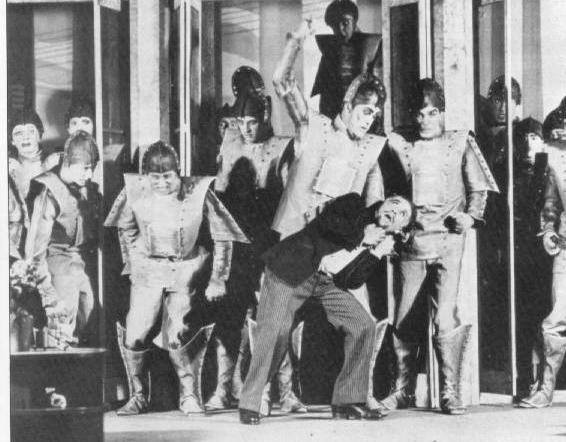
The archival photograph used as the cover shows why R.U.R. belonged to theater before it belonged to futurism. A robot costume is already an interpretation. It must decide how human the manufactured worker looks, how much repetition the actor carries in posture, and whether the audience sees machine, servant, soldier, patient, or worker first.[7]
That visual problem helped make the play adaptable. The robot is not one fixed design. It is a role that can be restaged whenever a culture wants to ask what kind of body its work system is producing. Early productions could emphasize uniforms, stiffness, massed bodies, or eerie resemblance to humans. Later readers can shift the emphasis toward biotech, artificial life, corporate platforms, or disposable labor. The stage body is flexible because the underlying arrangement is brutally stable: manufacture creates a class, then calls that class a tool.
Tufts' local history is useful here because it shows R.U.R. becoming more than a Prague or Broadway curiosity. A college troupe could mount it in 1923, repeat it in 1924, and adapt it for radio because the play had a clear performable engine.[3] It offered managers, scientists, workers, rebels, a factory island, and the prospect of human extinction. But it also offered cheaper theatrical fundamentals: bodies entering rooms, orders being given, people arguing over what a manufactured being is allowed to be.
Radio sharpened a different afterlife. Once the robot leaves the visible costume and becomes voice, the problem shifts from appearance to speech. Does a robot sound human? Does obedience have a tone? Can revolt be heard before it is seen? The play's portability across stage and radio suggests that Capek had built more than a spectacle. He had built a conflict that different media could redistribute.
The plot survives because it is not only plot
Many later machine-revolt stories owe something to R.U.R., but the play is not durable merely because robots rebel. Rebellion is the loud event. The quieter engine is the factory's moral accounting. The humans in R.U.R. are not punished simply for inventing artificial workers. They are punished for treating creation, labor, reproduction, and responsibility as separable departments.[1][6]
That is why the final movement matters. The humans are gone; the robots rule; but they cannot reproduce themselves because Helena has destroyed the formula.[1] The revolt does not solve dependency. It reveals that the old order built its own extinction into the supply chain. The robots inherit power without continuity. The factory that promised endless production leaves them with a finite stock of bodies and a desperate search for the secret of life.
The Robot100 project page for the recent English-language volume R.U.R. and the Vision of Artificial Life shows how easily the play now speaks to artificial-life research, not only to robotics as metal or software.[5] Its description stresses a new translation and essays by scientists and scholars working on artificial life and robotics. That contemporary return makes sense because Capek's central object is not a gadget. It is an alternative life-form routed through industry.
Jonathan Bolton's 2024 essay for the Los Angeles Review of Books is especially helpful because it resists treating the play as a simple slogan about technology going wrong. He places the robot's origin inside older automaton anxieties, artificial-life questions, and the ethics of creating beings under market pressure.[6] That frame helps explain why R.U.R. still feels current without pretending it predicted every later machine. The play's prescience lies in the bargain: science imagines, industry scales, owners profit, and moral language arrives too late.
Afterlife without fidelity
The robot after R.U.R. did not stay faithful to Capek's biology. Popular culture hardened it into metal, circuits, obedience protocols, and eventually software. That might look like betrayal, but it is also evidence of a powerful literary afterlife. The original play supplied a structure elastic enough to survive inaccurate bodies.
What has to remain? Not the chemistry. Not the island factory. Not even the exact look of the robots. What has to remain is the pressure relation: a created worker becomes indispensable, then unreadable, then morally inconvenient. Once that relation exists, each era can clothe it differently. Industrial modernity sees factory hands. Mid-century science fiction sees machines. Cybernetic culture sees control loops. Biotech and artificial-life debates see synthetic organism. Platform economies see invisible labor buried inside polished interfaces.
This is also why the word "robot" became larger than the play that launched it. A lesser afterlife would have preserved R.U.R. as a historical source while the term moved on. Instead, the term keeps dragging readers back to the play whenever automation becomes ethically noisy. The language remembers what culture often tries to forget: that artificial labor is never only artificial. It is a fantasy about reorganizing human dependence.
The play's short quoted fragments still carry that tension. "Robots of the world!" is comic, alarming, and politically charged all at once.[1] It sounds like a borrowed revolutionary formula because it is one. Capek gives manufactured beings the inherited grammar of collective uprising, then refuses to make either side innocent. Humans create domination; robots answer domination by extermination; the ending searches for tenderness only after both systems have failed.
That is the real afterlife of R.U.R. It is not a prediction that robots will conquer us. It is a literary instrument for asking what kind of creator thinks service can be separated from suffering, what kind of owner thinks intelligence can remain property, and what kind of society calls a labor arrangement progress because the laboring body has been renamed.
The robot began as a word for work before it became a symbol of the future. Capek's play endures because it never lets the future escape that origin. Every new robot fantasy, from stage costume to artificial-life essay, still has to answer the old theatrical question: when the worker looks back, what exactly have we made?
Sources
- Karel Capek, R.U.R. (Rossum's Universal Robots), Project Gutenberg HTML text of the Paul Selver and Nigel Playfair English version used for close reading.
- Science Friday, "The Origin Of The Word 'Robot'," on Capek's play, robota, Josef Capek's naming role, and the play's early science-fiction afterlife.
- Sari Mauro, "When 'Robot' Became Universal," Tufts Archival Research Center, on early American performance history, Tufts productions, and radio adaptation.
- Embassy of the Czech Republic in Ljubljana, "Czech ROBOT celebrates its 100th birthday," on the centenary, Josef Capek's role, robota, and early Slovenian reception.
- Robot100, "Book: R.U.R. and the Vision of Artificial Life," project page for the 2024 English selection, new translation, and artificial-life essay context.
- Jonathan Bolton, "Prove You're Not a Robot: On Karel Capek's R.U.R.," Los Angeles Review of Books, February 20, 2024, on the play's artificial-life questions and modern critical return.
- Wikimedia Commons, "File:Capek RUR.jpg," source page for the 1928 Theatre Guild touring-company production photograph used as the article image.