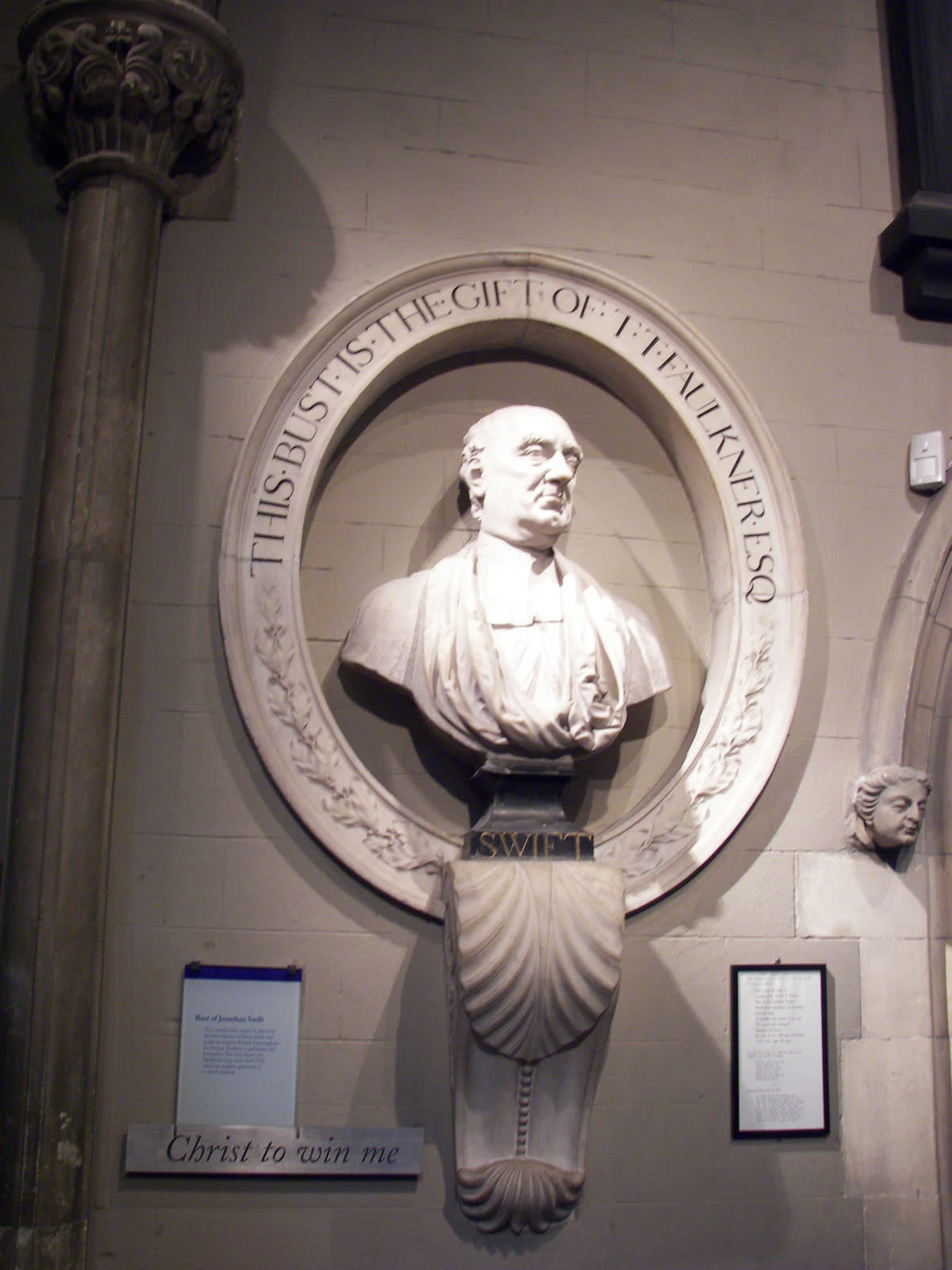
The shock of A Modest Proposal is not that Jonathan Swift imagines an atrocity. The shock is that he lets atrocity speak in a voice of public usefulness. Published in 1729, the pamphlet offers itself as a remedy for Irish poverty, then turns children into saleable bodies with the same composure a policy writer might bring to rents, trade, or agricultural yield.[1][2] Its horror arrives through style: no scream, no gothic excess, no villain's laugh. Just a careful speaker who has learned to make arithmetic sound like compassion.
That is why the essay still feels modern. It does not merely say that the powerful exploit the poor. It shows how exploitation can borrow the grammar of reason. Britannica's summary catches the basic formal trap: the piece is presented as an economic treatise whose rational deliberation ends in an unthinkable conclusion.[2] But the style is sharper than a one-joke reversal. Swift's speaker keeps arranging moral catastrophe into tables of usefulness, so the reader has to hear how a humane vocabulary can become inhuman when its unit of measurement is wrong.
The opening establishes the problem in social space before the monstrous solution appears. The speaker begins with a "melancholy object": mothers and children visible in Dublin streets and at cabin doors.[1] That phrase matters because it looks sympathetic without becoming intimate. The poor are an object of sight and administration before they are people in relation. Swift's speaker does not linger with one mother or one child; he scales immediately from scene to population, from suffering to burden.
From there, the syntax tightens into managerial confidence. The speaker wants a "fair, cheap and easy method."[1] The adjectives are lethal because they sound so ordinary. They belong to a world of schemes, efficiencies, and proposals. In another document, they might describe road repair or tax collection. Here they prepare the reader to see a child as an input. Swift's genius is to make the style do the crime before the proposal fully names it.
Arithmetic supplies the mask. The speaker counts population, subtracts those who can maintain their children, estimates mortality, prices nursing, calculates returns, and assigns a market for infant flesh.[1] The numbers are not there to make the plan plausible in any real ethical sense. They are there to create a tone of command. Once the sentence has begun to compute, it becomes harder for the speaker to recognize the thing being computed. People become breeders, mouths, carcasses, commodities, and stock. The horror is not hidden beneath the math; it is produced by the math's false authority.
This is also why the pamphlet's voice is not simply mad. It is socially legible. JSTOR Daily's account of Ian McBride's work places the essay amid the Irish crisis of the late 1720s, including harvest failures, hunger, emigration, and bitter anger at landlords and graziers.[3] McBride's scholarly article argues that the political context has often been underexplored and reads the pamphlet through Ireland's late-1720s crisis and Anglican critique of landlord behavior.[4] That context makes the speaker's calm more vicious. He sounds like the kind of improver who can look at devastation and ask only whether the numbers can be made to clear.
Swift's most dangerous stylistic move is that the invented speaker never sounds as though he enjoys cruelty. He sounds responsible. He anticipates objections, distinguishes age groups, refines categories, and describes public advantages. The prose keeps saying, in effect: let us be practical. That is the satiric trap. A reader who rejects the cannibalism must also ask why the earlier forms of practical thinking seemed acceptable. If children cannot be priced, why had tenants, beggars, laborers, and mothers already been treated as economic residue?
The essay's famous deadpan therefore depends on distance. Swift does not write in the voice of the starving, and he does not write in his own pulpit voice. He invents an intermediary: a projector, a scheme-maker, someone educated enough to sound public-spirited and spiritually deformed enough to see misery as material. Britannica's biography places Swift's major Irish writings in the period after he became Dean of St. Patrick's Cathedral in Dublin.[5] The clerical position matters here because A Modest Proposal is not just clever cruelty on the page. It is a moral exposure of language that has lost the ability to know what a neighbor is.
The voice keeps betraying itself through excess precision. It is one thing to say the poor are treated badly. It is another to watch a speaker estimate how much a mother might profit, how many bodies Dublin might consume, and which consumers would benefit most.[1] Precision becomes obscene because the premise is obscene. The more carefully he reasons, the more fully the reader sees the ethical collapse inside the reasoning.
The ending tightens the satire by refusing cheap escape. The speaker dismisses other remedies: taxing absentees, buying native goods, rejecting foreign luxury, showing mercy to tenants, and practicing public honesty.[1] These are the proposals the pamphlet pretends to exclude as unrealistic. That reversal is crucial. The cannibal scheme is absurd, but the rejected alternatives are the moral center of the essay. Swift's style makes the sane options appear only after the insane one has exposed the society that will not attempt them.
So the durable lesson of A Modest Proposal is not simply "satire can shock." It is that style can reveal a political disease by imitating its cleanest voice. Swift makes horror sound reasonable because he wants readers to distrust reason when it has been severed from mercy, embodiment, and responsibility. The arithmetic talks smoothly. The essay teaches us to hear what that smoothness costs.
Sources
- Jonathan Swift, A Modest Proposal, Project Gutenberg full text of the 1729 pamphlet.
- Encyclopaedia Britannica, "A Modest Proposal" - publication form, premise, and satire overview.
- Matthew Wills, "What Was Behind Jonathan Swift's Modest Proposal?", JSTOR Daily, September 30, 2025 - accessible summary of McBride's historical framing.
- Oxford University Research Archive, Ian McBride, "The Politics of A Modest Proposal: Swift and the Irish Crisis of the Late 1720s," Past & Present, 2019 - scholarly context and open repository record.
- Encyclopaedia Britannica, "Jonathan Swift" - biographical overview of Swift's Dublin deanery, Irish writings, and major works.
- Wikimedia Commons, "File:St. Patrick's Cathedral Swift bust.jpg" - source page for the real photograph used as the article image.