
Aldous Huxley's May 18, 1958 appearance on The Mike Wallace Interview is usually circulated as prophecy. That is understandable. The program presents Huxley as the author of Brave New World, then asks him to explain why threats to freedom no longer look only like jackboots, open terror, or a single visible tyrant.[1][2] In a television studio built for midcentury interview clarity, Huxley describes softer dangers: overpopulation, bureaucracy, propaganda, advertising, drugs, television, and the technical ability to bypass rational judgment.[2] The clip has the eerie shape of a warning that kept acquiring new examples after it was recorded.
But the interview is more interesting as a literature object than as a prediction reel. Huxley was not simply giving a list of future anxieties. He was restaging the central formal problem of his fiction and essays: how does a society make people accept a diminished life while teaching them to call that diminishment comfort, efficiency, or order?[3][4][5] The 1958 broadcast matters because it lets us hear a novelist thinking in public about mechanism. He is less interested in the spectacular dictator than in the ordinary systems that train desire, attention, and language before citizens recognize that politics has already entered the room.
That is why this archival footage belongs beside the novels rather than beneath them. Brave New World, published in 1932, is not merely a dystopian setting with futuristic furniture. Britannica describes it as a satiric future society whose stability depends on engineered hierarchy, conditioning, pleasure, and the suppression of genuine individuality.[5] Huxley's later nonfiction, especially Brave New World Revisited in 1958, returns to the question of whether the real world had moved toward the fictional model.[3] The Wallace interview sits directly in that later moment. It is a broadcast bridge between the 1932 imaginative design and the 1958 public argument.
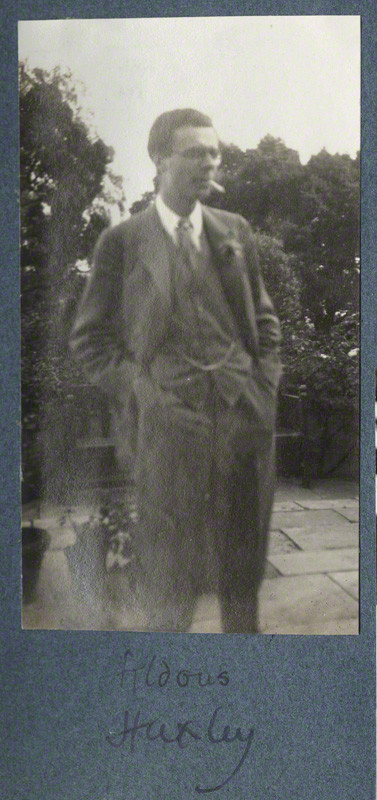
Image context: the cover portrait predates the television interview by more than three decades, but that distance is useful. It shows Huxley before he became a circulating media oracle. The article's focus is not celebrity prophecy; it is the continuity between the young novelist's satiric intelligence and the older writer's public explanation of freedom under pressure.[4][5][6]
Historical context: a dystopia revisited on television
The date matters. In 1958, Huxley was speaking twenty-six years after Brave New World appeared and in the same year as Brave New World Revisited.[2][3][5] The Cold War had made dictatorship a familiar public topic, but Huxley's emphasis cuts away from the easiest binary. He does not treat freedom as a simple contest between democratic virtue and foreign totalitarianism. He keeps asking how modern mass society can become governable through scale, organization, communication, and appetite.[2]
The Harry Ransom Center's digital record identifies the Wallace program as a 28-minute interview from The Mike Wallace Interview Collection, preserved as a moving-image item and accompanied by a transcript.[2] The item description is unusually helpful because it names the interview's operating subjects: threats to freedom in the United States, overpopulation, bureaucracy, propaganda, drugs, advertising, and television.[2] Those subjects are not random. They are the same family of pressures that make Huxley's fiction feel less like a gadget future and more like a study of managed consent.
Wallace's format also matters. The program was not a lecture hall. It was a commercially familiar television interview: host, guest, sponsor breaks, direct questions, visible civility. The form gives Huxley's warning an additional layer of irony. He is using television to talk about television as a technology of persuasion.[1][2] He does not reject the medium by refusing to appear. He enters it, sits inside its frame, and tries to make the frame legible.
That gesture belongs to Huxley the satirist. Britannica's biography emphasizes the wit, pessimistic satire, and distrust of twentieth-century political and technological trends that run through his major work.[4] The interview translates that literary temperament into public speech. Huxley sounds calm, almost mild, but his calm is structural. He speaks as if the danger is most serious when it no longer needs melodrama.
The archival recording
The video below embeds the public YouTube upload of the 1958 Wallace interview. The underlying archival provenance is the Harry Ransom Center's Mike Wallace collection; the YouTube version is used here as an accessible viewing copy, while the Ransom Center record supplies the date, collection context, transcript, duration, and subject description.[1][2]
What the footage makes visible
The first thing the video preserves is Huxley's refusal of theatrical apocalypse. Wallace introduces him through the dramatic public image of the man haunted by a vision of dictatorship, but Huxley's answers move toward systems rather than scenes.[1][2] He is not warning that one villain will suddenly switch off liberty. He is describing impersonal pressures that can narrow freedom gradually, especially when technical devices make persuasion easier and social scale makes administration more tempting.[2]
That distinction is literary as well as political. Brave New World is frightening because its world has learned to make coercion feel unnecessary. The state's violence is partly hidden behind conditioning, pleasure, consumption, and rank.[5] In the interview, Huxley keeps returning to that kind of indirect control. The danger is not only that people may be forced to obey. It is that they may be trained to experience obedience as satisfaction, convenience, or common sense.[2][5]
The second thing to notice is Huxley's syntax. He talks in balanced explanatory movements, often building from a general pressure to a specific mechanism. That style can sound old-fashioned beside modern television speed, but it is central to the archive's value. His sentences make causality visible. They ask the listener to follow a chain: population pressure creates administrative pressure; administrative pressure encourages centralization; centralized communication can intensify propaganda; advertising and entertainment can shape desire below the level of explicit argument.[2] Whether every link convinces equally is less important than the method. Huxley makes freedom a problem of sequence.
The third preserved detail is Wallace's role. He presses, clarifies, and sometimes frames Huxley in the language of American reassurance.[1][2] That exchange prevents the recording from becoming a sermon. Huxley has to keep translating his warning into terms a prime-time audience can follow. The result is a compact public performance of the essayist's burden: not merely to possess a thought, but to make its mechanism audible without turning it into a slogan.
Why this is literature on television
The interview's literary force comes from the way Huxley converts political fear into a question of form. His central concern is not only who rules. It is how a society arranges perception. Who controls the words by which people describe comfort? Who designs the habits that make dissent feel strange? Who benefits when pleasure, distraction, and bureaucratic order become substitutes for judgment?[2][3][5] These are novelistic questions because they concern consciousness under design.
That is also why the interview should not be read as a simple victory lap for Brave New World. Huxley is not saying that every detail of the 1932 novel has arrived. He is asking whether the principles behind the fiction have become more plausible: conditioning over argument, stability over inner freedom, managed appetite over difficult choice.[3][5] The archival value of the Wallace footage is that it catches him making that translation in public, with the novel's imaginary world behind him and the nonfiction warning newly present.
The recording also helps correct a common mistake about dystopian literature. Readers often reduce dystopias to forecasts and then grade them by accuracy. Huxley's better value is diagnostic. Brave New World does not matter because it predicted a checklist of devices. It matters because it gave modern readers a grammar for recognizing a political order that does not always announce itself as political.[5] The Wallace interview performs that grammar aloud. Huxley keeps naming the routes by which freedom can be narrowed before anyone says, plainly, that freedom has been abolished.[2]
That makes the 1958 footage newly useful without making it timeless in a lazy way. Its historical conditions remain specific: postwar television, Cold War anxieties, midcentury population debates, the prestige of expert interview programs, and Huxley's own late-career return to his most famous fiction.[2][3][4] Yet the archive still teaches because it preserves a mode of attention. Huxley watches for the moment when language, pleasure, technology, and administration begin to cooperate.
The final lesson is tonal. Huxley does not sound triumphant about being right. He sounds worried by how easy it is for sophisticated societies to mistake management for freedom. That restraint gives the interview its literary seriousness. It is not a spectacle of prediction. It is a writer's close reading of modern power, delivered inside the very medium he was trying to make readers and viewers examine.[1][2][5]
Sources
- Levan Ramishvili, "Aldous Huxley full interview 1958: The Problems of Survival and Freedom in America," YouTube video.
- Harry Ransom Center Digital Collections, "Interview with Aldous Huxley" from The Mike Wallace Interview, May 18, 1958; transcript, item description, duration, and provenance.
- Faded Page, Brave New World Revisited by Aldous Huxley; public online text and publication context.
- Encyclopaedia Britannica, "Aldous Huxley" (biographical overview and literary context).
- Encyclopaedia Britannica, "Brave New World" (summary, context, and reception of Huxley's 1932 novel).
- Wikimedia Commons, "File:Huxley 1926.jpg" (source page for the lead photograph).