Aaronna Moncrief arrives carrying a manuscript in a small box. Before she asks a successful writer to read it, she recites one of his own stories. He listens, astonished: this shabby visitor understands shades of feeling that his admirers have missed. Then she explains that most of his other work is less ambitious. Her appeal for help begins with an act of criticism.[1]
That is the delicious difficulty of Constance Fenimore Woolson’s Miss Grief. Aaronna needs the man’s approval desperately, but she has standards of her own. She wants access to the literary world without making its representative the final authority over what she has written. Her combination of dependence and independence makes her much more unsettling than a grateful discovery.
The story appeared in Lippincott’s Magazine in May 1880. As Anne Boyd Rioux stresses, Woolson was already an established short-story writer when she invented this unsuccessful one; she also wrote the story before meeting Henry James. Reading Aaronna simply as Woolson in disguise would flatten a deliberately constructed character into a biographical symptom.[2]
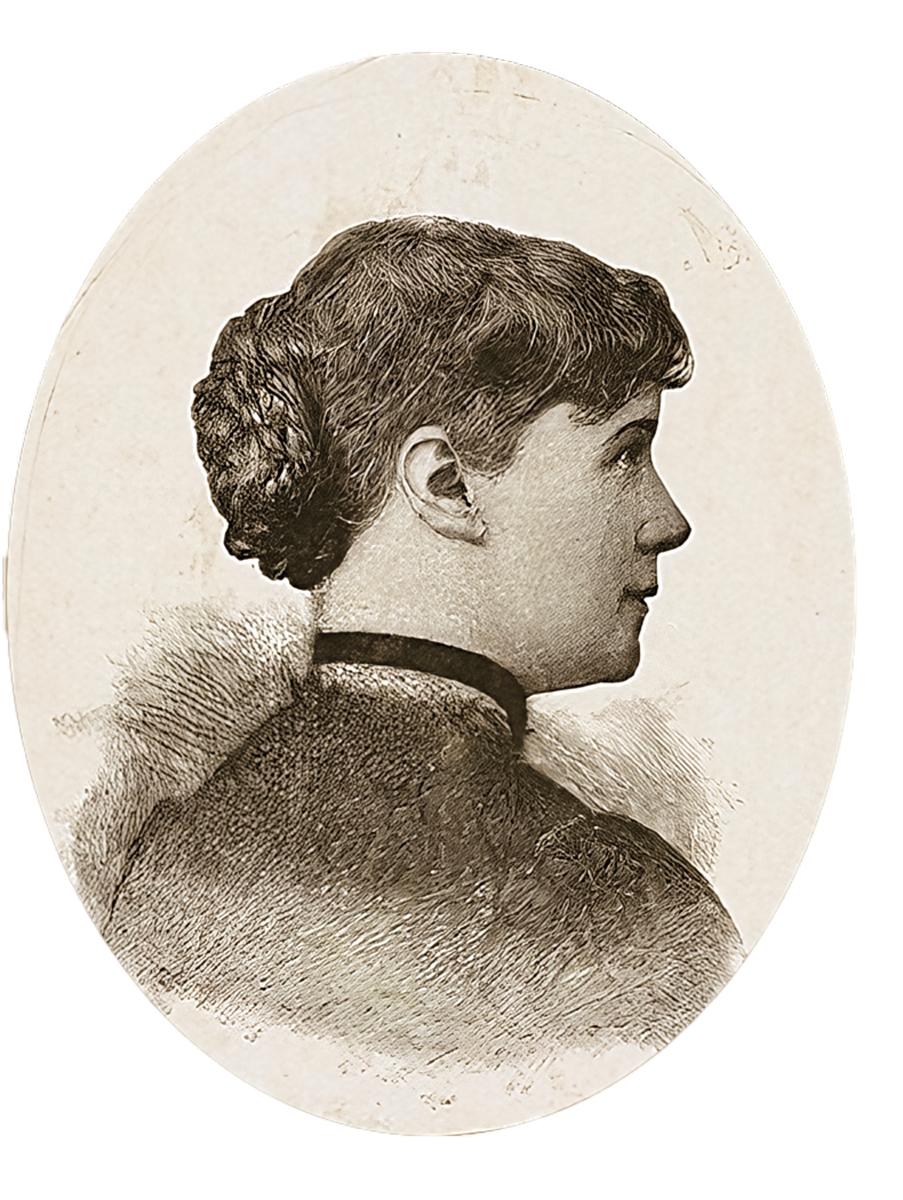
An admirer with a judgment of her own
We meet Aaronna through the man she has approached. He calls her Miss Grief even after she corrects the name. Her persistence at his door seems to him evidence of eccentricity; her clothes, age, and poverty arrive in his account before her abilities do. The character we are trying to understand is therefore someone already being interpreted, and often misinterpreted, by her prospective helper.[1]
Her recitation interrupts that arrangement. She can distinguish between voices, recover an unstated emphasis, and recognize the reach of a work the public has undervalued. For a moment, the celebrated author becomes the person waiting to discover what another reader can make of him.
Her admiration is also selective. She sought him because this particular story suggested a capacity absent from his more polished social sketches. On my reading, she is choosing a possible colleague as well as a patron. She has found evidence that he might understand the kind of literary ambition she possesses.
This makes her miscalculation painful. He enjoys being understood, but the experience does not immediately teach him how to understand her. When he finally reads her drama, Armor, he recognizes extraordinary power. When she returns, the sight of her worn appearance turns his intended deference into pity. Recognition has occurred; equality has not followed.[1]
The comma she will not surrender
Aaronna’s response to criticism is awkward even for a sympathetic reader. She seems unable to recognize faults the narrator considers obvious. She insists on reciting the drama when he wants to inspect it. Finally, offered his unrestricted editorial help, she replies: “There shall not be so much as a comma altered.”[1]
It is a magnificent refusal and a worrying one. A writer who cannot hear criticism may indeed make publication harder. Woolson does not give us the full manuscript, so we cannot independently judge every complaint about its construction. Sympathy for Aaronna need not turn into a verdict that all her sentences are perfect.
But watch what her performance accomplishes. Speaking the drama aloud, she makes its force felt again; the faults temporarily lose their importance even for her listener. She understands her work as something that moves through an audience. He wants to isolate defects. The scene lets us experience the conflict between those approaches without furnishing a tidy editorial ruling.[1]
Her prose story brings the disagreement into sharper focus. The narrator objects to a physician whose mercy includes killing, and demands the character’s removal. Aaronna first refuses, then says she is willing but cannot see how to do it: the doctor belongs too closely to everything else. Her position has become more complicated than an absolute ban on changes. She can entertain the request while remaining unable to imagine the story it would leave behind.[1]
After a magazine editor makes the same objection, the narrator secretly attempts the revision himself. He discovers that removing the doctor means unraveling the whole. His replacement is “weak, and mine.”[1]
That admission gives Aaronna’s resistance evidence beyond her own conviction. She has identified a structural relationship her adviser could not initially see. The proposed correction would transfer authorship while diminishing the work. Her difficulty explaining how the story holds together does not mean she is wrong about what holds it together.
Hunger has been present all along
Aaronna’s independence has a bodily cost. After dinner at the narrator’s rooms, she falls asleep while he reads. She is mortified on waking. Later, near death, she explains that a substantial meal was an unfamiliar luxury. She also explains why she and her companion had tried learning to smoke: she had heard that tobacco could quiet hunger and exhaustion. He had found the experiment comical.[1]
These delayed explanations change the meaning of earlier scenes. What looked like odd behavior becomes an attempt to manage deprivation. Aaronna has been protecting her dignity so effectively that her helper can admire her writing without grasping how urgently she needs money.
That concealment also complicates the idea of the solitary genius. The supposed maid is actually her aunt, who has been selling their possessions. Aaronna’s literary effort depends on another woman’s material sacrifices. Her final concern for her aunt’s return to America shows that publication means more than vindication: she imagines the drama earning the fare.[1]
Woolson makes it impossible to separate the artistic and practical desires neatly. Aaronna wants her work read because she believes in it. She also wants the work to support the life around it. The narrator can put her manuscripts aside while attending to his own engagements; she cannot put hunger aside on the same terms.
A last request, then another decision made for her
At Aaronna’s bedside, the narrator invents good news: the drama will be published. She believes him. She appoints him its executor, while asking that her other manuscripts be buried with her, “unread, as I have been.”[1]
The phrase makes reading an encounter with a person as well as a page. Yet her instructions distinguish among the works. She gives up some and entrusts one to a future audience. Even at the end, she is making decisions about her writing.
The narrator subsequently admits that he could have paid to publish Armor. Instead, he imagines that Aaronna, now dead, must understand its faults and would prefer silence. He keeps it privately and orders its destruction after his own death. His claim to protect her from ridicule overrides the wish she actually expressed.[1]
Rioux’s account emphasizes how Woolson lets readers perceive more than her self-assured narrator does.[2] Here that gap is especially sharp. His tenderness can be sincere while his custodianship defeats its supposed purpose. Aaronna has gained a devoted reader who reserves the right to prevent any others.
The story’s own survival offers a different outcome. Library of America includes Miss Grief in its collection edited by Rioux, placing it among the varied work of a writer whose twentieth-century reputation had narrowed around her connection to James.[3] That recovery encourages us to give Aaronna the attention her fictional custodian restricts: to notice her judgments, her stubbornness, her need, and her care for someone else. She wanted help reaching readers. She never agreed that being helped meant ceasing to be the author.
Sources
- Constance Fenimore Woolson, “Miss Grief,” in Stories by American Authors, volume IV (Scribner’s, 1897; collection copyright 1884), Project Gutenberg; primary text for the visits, recitations, editorial dispute, and final instructions.
- Anne Boyd Rioux, “On ‘Miss Grief’ by Constance Fenimore Woolson,” The Center for Fiction; introduction discussing the May 1880 publication, Woolson’s established career, narrative perspective, and literary value.
- Library of America, Constance Fenimore Woolson: Collected Stories, edited by Anne Boyd Rioux; contents and account of Woolson’s reputation and literary recovery.
- National Endowment for the Humanities, “Portrait of Constance Fenimore Woolson,” Humanities (Winter 2025); source of the archival portrait credited to the New York Public Library Digital Collections.