Lady Mary Wroth's Pamphilia to Amphilanthus is often introduced through its historical firsts: a Jacobean woman writing a sonnet sequence, appending it to the 1621 Countess of Montgomery's Urania, and taking up a genre made famous in English by male Sidneian precedent.[1][2] Those facts matter, but they can make the poem cycle sound as if its importance were mainly a matter of entry into a closed room. The deeper force is stylistic. Wroth does not simply reverse the old love-sonnet arrangement by letting a woman suffer in the speaker's place. She changes the sound of suffering until constancy becomes a way of thinking.
That distinction is crucial. A passive speaker would only endure. Pamphilia endures, but she also sorts, addresses, rebukes, reasons, and binds herself to a standard that exposes the beloved's failure. The beloved's name, Amphilanthus, carries the idea of divided love; Pamphilia's name carries the pressure of loving fully.[1] The sequence therefore begins with an imbalance already built into its grammar. One figure is whole by excess. The other is split by appetite. Wroth's voice has to make that imbalance audible without turning Pamphilia into a decorative victim.
The opening dream vision gives her the old machinery of love poetry: Venus, Cupid, night, sleep, fire, wounds, eyes, and the heart. Yet the poem's movement is not merely ornamental. The speaker wakes into a vocabulary that has already captured her, and the rest of the sequence keeps testing whether that vocabulary can be made morally intelligent.[1] In other sonnet cycles, love's wounds often become proof of the male speaker's sophistication. In Wroth, the wound becomes evidence in an argument about reciprocity.
The voice works by address, but not by pleading alone. Pamphilia speaks to Cupid, night, grief, fortune, time, and the condition of love itself. That indirectness matters. In the sequence as printed in the Oregon text, the speaker keeps turning away from Amphilanthus as direct addressee and toward the forces that organize love's injury.[1] The effect is a pressure chamber. Amphilanthus is everywhere implicated, but he is not allowed to dominate the speaking space. Pamphilia's mind moves through the grammar of love and keeps finding a court of appeal beyond him.
That is why the recurrent language of constancy is not as simple as loyalty. It is not the obedience of a wife waiting under household law. It is a standard by which love can be judged. The University of Oregon edition's introduction rightly emphasizes that Wroth makes constancy a universal virtue rather than a gendered burden.[1] In the poems themselves, this claim is not announced as doctrine. It emerges through style. Pamphilia's repeated turns of thought ask the same question in different registers: what would love sound like if steadiness were demanded of both lover and beloved?
One brief line gives the mechanism: "Who wears Love's Crown" must answer for the force love exercises.[1] The metaphor is courtly, but the logic is ethical. A crown is not only ornament; it is responsibility. Wroth takes a lyric emblem that could have floated as decoration and makes it carry political weight. If love claims sovereignty over the speaker, then love also has duties. If Amphilanthus benefits from Pamphilia's devotion, he cannot treat inconstancy as masculine privilege or charming restlessness. The style turns complaint into jurisdiction.
The most powerful moments come when Pamphilia appears to narrow her own freedom and, in doing so, clarifies the argument. "Yet love I will" can sound at first like surrender.[1] In context, it is stranger and harder. The phrase is not cheerful compliance. It is self-command. Pamphilia refuses to let Amphilanthus's dividedness dictate the moral quality of her own action. Her constancy is painful because it is not rewarded, but it is also active because it chooses its own measure. She will not become false merely because falsehood has injured her.
This is where Wroth's voice separates itself from simple Petrarchan inheritance. The old convention often makes the beloved's refusal into a stage on which the lover displays wit, anguish, and verbal skill. Wroth keeps the skill, but changes the moral temperature. Pamphilia's anguish is not a performance designed to win access. It is a disciplined record of what divided love does to the person who remains whole. Her syntax often folds back on itself, circling through accusation, shame, vow, and recognition. The turns are not decorative difficulty. They imitate the work of keeping thought intact under emotional pressure.
The sonnet crown intensifies that work. A crown traditionally links poems through repeated lines, making each ending reopen as the next beginning. In Wroth's hands, the form is perfect for a speaker trapped in recurrence but unwilling to call recurrence mere defeat. The famous question "In this strange labyrinth" announces more than confusion.[1] A labyrinth is a structure, not a void. Pamphilia is lost inside a made pattern: convention, desire, reputation, courtly language, gendered expectation, and personal memory. The crown's linked form lets the reader feel how circular suffering can still produce ordered thought.
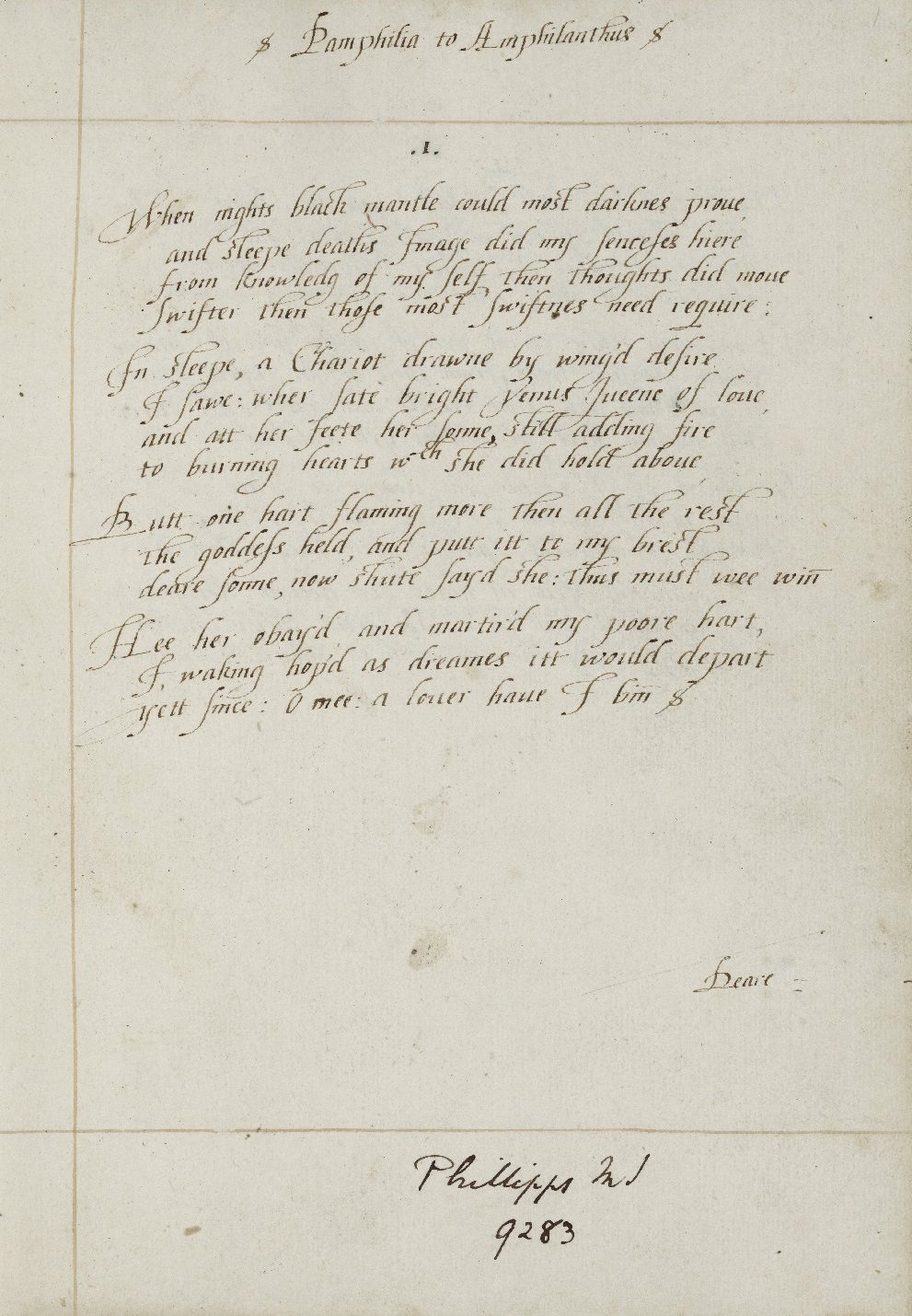
The manuscript and print history sharpen the point. Folger notes that an early version of the sequence survives in Wroth's own hand, while the printed 1621 Urania includes a revised song-and-sonnet sequence at its end.[2] The Early Modern Women Research Network's textual history further stresses Wroth's habit of revising, relocating, and integrating poems within the romance world.[3] That matters because the poems do not belong to a simple category of private outpouring. They are crafted, moved, and re-situated. The voice sounds intimate, but its intimacy has architecture.
The cover image makes that architecture visible: a manuscript page, not a generalized portrait of "women's writing."[4] The page's documentary value is that it returns the sequence to the labor of inscription. We can see the poem as a made object, which is the right way to read Wroth. Her importance is not only that she had feelings a male tradition had ignored. It is that she found a form in which feeling could become intellectual pressure.
The result is a voice that refuses two weak readings at once. Pamphilia is not merely submissive, because her constancy judges the world that wounds her. She is not merely liberated in a modern slogan sense either, because the poems do not pretend that desire can be escaped by naming its injustice. Wroth's achievement lies in the tension. The speaker remains bound to love, yet she insists that love be answerable to truth, reciprocity, and self-knowledge.
That is why Pamphilia to Amphilanthus still reads as more than a historical landmark. Its style makes a severe claim: constancy is not valuable because a woman is expected to bear pain quietly. It is valuable only when it becomes a human discipline, a way of refusing to let another person's inconstancy define the shape of one's own soul. Wroth gives that discipline a voice at once wounded and exact. The poems hurt, but they do not drift. They think.
Sources
- Risa S. Bear and Micah Bear, eds., "Pamphilia to Amphilanthus," University of Oregon Renascence Editions, 1992/1996 - text, introduction, and notes based on the 1621 printing.
- Folger Shakespeare Library, "Lady Mary Wroth and 'The Countess of Montgomery's Urania'" - biographical and manuscript context for Wroth's romance and sonnet sequence.
- Early Modern Women Research Network, "Poems from the Urania Manuscript: Introduction and Textual History" - manuscript continuation, revision, and editorial context.
- Wikimedia Commons, "File:Pamphilia to Amphilanthus, Sonnet 1 (Wroth, c. 1620).jpg" - source page for the archival manuscript image used as the article image.