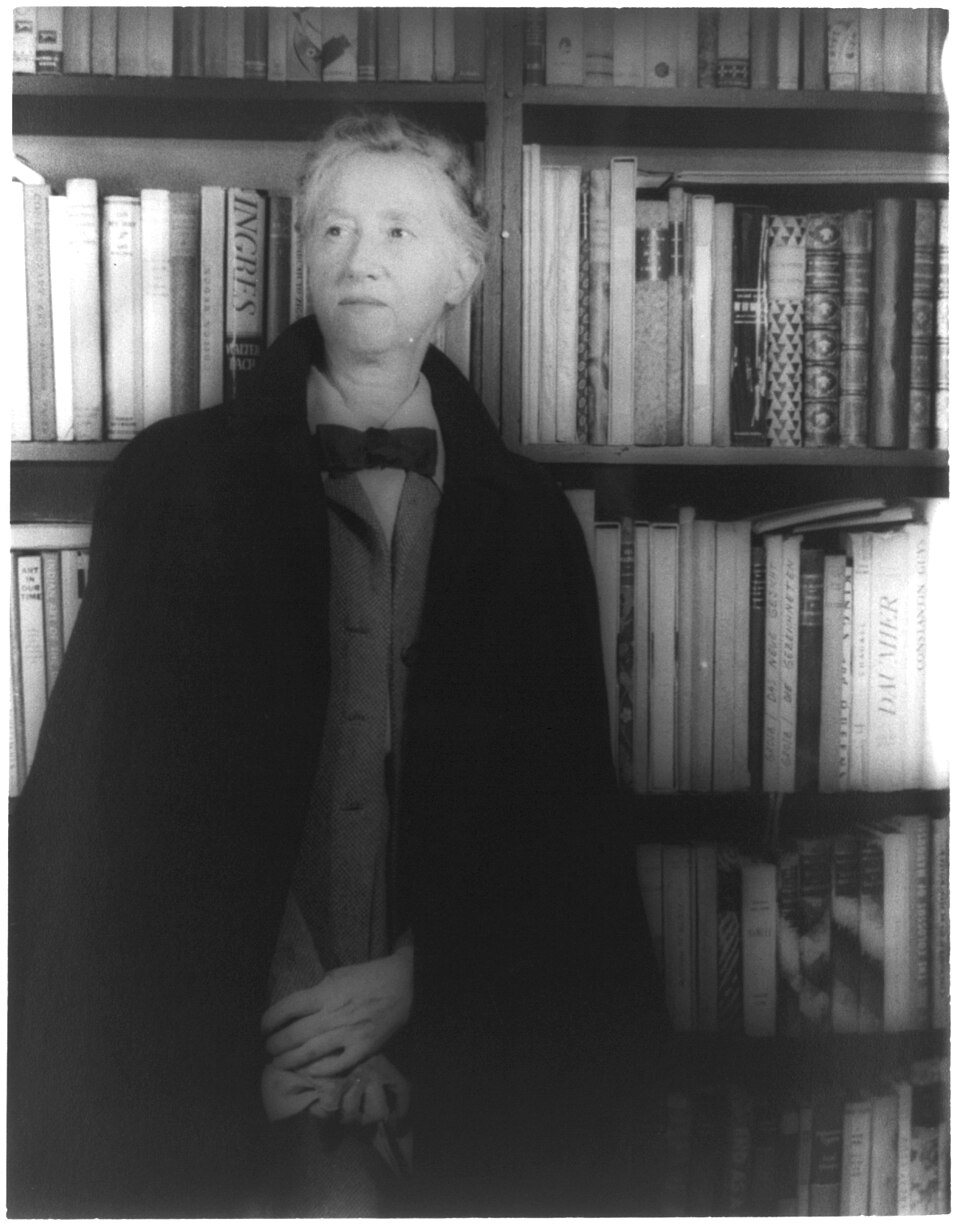
Marianne Moore can sound forbidding if she is introduced as a poet of precision. The word is accurate, but it risks making her poems seem cold before anyone has actually entered them. Moore's precision is stranger and warmer than that. It is a way of managing pressure. Her poems watch animals, shells, mountains, athletes, critics, and fragments of other people's prose with microscopic attention, but the point is not merely exact description. Exactness becomes a social performance: a mask that lets feeling appear without becoming confession.
That is the useful way into a work-centered profile of Moore. Born in 1887, educated at Bryn Mawr, employed at the Carlisle Indian School and later the New York Public Library, she entered modernist literary culture not as a manifesto writer but as an observer with unusually high standards for language.[1][5] She knew the modernist circle: H.D., T. S. Eliot, William Carlos Williams, Wallace Stevens, Ezra Pound, and Elizabeth Bishop all belong to the field around her.[1] Yet her best poems do not feel like club membership. They feel like instruments built to test whether a sentence can be accurate and evasive at the same time.
The Genuine Is Not The Raw
Moore's "Poetry" is the obvious starting point because it stages its own suspicion of the art. The poem opens with the famous recoil, "I too, dislike it," then works toward a demand for the genuine rather than the merely decorative.[2] The useful surprise is that Moore does not define the genuine as unfiltered emotion. She moves through bodies, animals, documents, school-books, critics, and a strange formula for "imaginary gardens with real toads."[2] The genuine is made, inspected, and arranged. It is not the same as the raw.
That distinction helps explain why Moore can be both severe and playful. She is against inflation: high-sounding interpretation, derivative grandeur, poetic fog that asks to be admired because it looks like poetry.[2] But she is not against artifice. A real toad in an imaginary garden is still in an imaginary garden. Moore's realism depends on construction. Her poems ask the reader to respect surfaces because surfaces are where discipline, appetite, danger, and humor leave marks.
This is also why the word "mask" matters. Moore's public persona later became famous: cape, tricorne hat, baseball enthusiasm, television appearances, and a deliberately memorable old-age image.[1][5] It can be tempting to treat that as eccentric biographical color, separate from the poems. It is more revealing to read it as continuous with the work. Moore understood that a surface could be theatrical without being false. A mask can hide, but it can also make attention possible.
Animals As Ethical Machines
The Academy of American Poets biography notes Moore's fondness for animals and her dense, precise language.[1] That summary points toward one of her central techniques. Animals in Moore are rarely soft symbols. They are ethical machines: forms of behavior that expose the failure of human generalization.
In "The Fish," for instance, the sea is not a decorative blue backdrop. It is mineral, muscular, and abrasive. Mussel shells, barnacles, sun shafts, cliff edge, and water pressure make the poem feel carved rather than poured.[3] The fish are almost displaced by the physical intelligence of the environment. Moore's attention refuses to turn nature into a pretty lesson. The poem's power comes from how stubbornly it keeps looking.
That stubbornness is moral without becoming sermon. Moore's animals often shame human vanity because they are not trying to be meaningful for us. The bat, elephant, wild horse, wolf, critic, baseball fan, and statistician in "Poetry" sit together in a comic list, but the list is not random.[2] It makes value depend on useful presence rather than cultural rank. Business documents and school-books can belong near poetry if they are part of the real pressure of life. The poem's democracy is not sentimental. It is exacting.
The Editor Who Would Not Leave The Poem Alone
Moore's career is also a story about revision as temperament. Her first book, Poems, appeared in 1921 without her permission; Observations followed in 1924 and established the range of her early modernism.[1][4] Later, Moore became famous for cutting, retitling, and reshaping her own work. The dedication to Complete Poems, "Omissions are not accidents," has become the miniature doctrine of that habit.[4]
The revision history of "Poetry" is the sharpest case. The New Yorker summarizes the poem's strange publication life: long in early forms, expanded in one later setting, then cut to three lines in Complete Poems.[4] The point is not only that Moore edited heavily. Many writers do. Moore made revision part of the poem's afterlife. She forced readers to ask where the work lives: in the first publication, the authorized late cut, the scholarly reconstruction, or the friction among versions.
That friction suits her imagination. Moore's poems often work by assembling quotation, observation, and borrowed phrasing into a surface that feels both impersonal and unmistakably hers.[1][4] Revision intensifies that method. If language is a collected surface, then to revise is not to betray the poem's essence. It is to test which surfaces still hold.
This can frustrate readers. It should. Moore's edits sometimes remove what later readers love, and her appetite for control can feel almost punitive.[4] But frustration is part of her importance. She refuses the comforting idea that a poem is a sealed emotional event. A Moore poem is closer to an object under conservation: cleaned, reduced, over-cleaned, re-lit, disputed, and still not exhausted.
Celebrity Without Simplicity
Moore's late fame seems improbable if the poems are described only as difficult modernist artifacts. She won major prizes, became a recognizable public figure, appeared in mass-media settings, loved baseball, and even entered odd corners of American publicity culture.[1][5] The National Endowment for the Humanities profile is useful here because it keeps the biographical Moore close to the performing Moore: a disciplined writer whose habits of dress, speech, affiliation, and reticence became part of how the public encountered her.[5]
The danger is to let the late persona flatten the work into charming eccentricity. Moore is charming, but charm is not the core. Her poems are full of withheld force. They often turn away from direct personal disclosure, then smuggle intensity into description, syntax, quotation, or an animal's posture. That is why her restraint should not be mistaken for emotional thinness. Restraint is the pressure system.
Read this way, Moore's modernism is not only about innovation in line, diction, or citation. It is about conduct. How should intelligence behave in public? How can feeling avoid theatrical falseness without disappearing? What kind of poem can honor both "rawness" and the made thing?[2] Moore's answer is not a theory but a practice: look harder, quote carefully, cut suspiciously, let humor keep dignity from stiffening into self-importance.
Why Moore Still Feels Current
Moore's relevance in 2026 does not depend on turning her into a prophet of the internet, though her unstable texts and collage habits make that comparison tempting.[4] She matters because she understood a problem that has become more visible: surfaces are not shallow when everyone is performing through them. A profile, a revision trail, a public costume, a quotation, a caption, a poem's line break: each can conceal and disclose at once.
That is why "Poetry" remains more than an anthology piece. Its argument is not simply that poetry should include real things. Its argument is that the real requires form strong enough to withstand inspection.[2] Moore's animals, documents, mountains, hats, edits, and odd lists all belong to that discipline. They make a poetry where accuracy is never merely technical. It is a way of refusing both sloppy feeling and lifeless correctness.
The Van Vechten portrait used here can look at first like pure composure: Moore in black and white, controlled by the camera's formal light.[6] The poems teach us to distrust that simplicity. Composure, for Moore, is not the absence of drama. It is drama held to a line. Her precision still feels alive because it lets the mask remain visible, then makes the mask do serious work.
Sources
- Academy of American Poets, "Marianne Moore" (biography, modernist context, animal imagery, publications, and honors).
- Academy of American Poets, "Poetry" by Marianne Moore (public-domain text and publication note for Others for 1919).
- Academy of American Poets, "The Fish" by Marianne Moore (poem text used for the passage discussion).
- The New Yorker, "The Marianne Moore Revival" (2016; Observations, revision history, and Moore's changing textual afterlife).
- Danny Heitman, "Moore or Less," National Endowment for the Humanities (2016; biographical profile and public persona context).
- Wikimedia Commons, "File:Marianne Moore 1948 hires.jpg" (Carl Van Vechten portrait from the Library of Congress collection; image source for the article cover).