The Book of Margery Kempe is noisy in a way that still feels difficult to file. It is often introduced as the earliest surviving autobiography in English, but that label can make the book sound smoother than it is. The voice does not simply say "I was there." It says, again and again, that "this creatur" was seen, doubted, scolded, examined, moved, and heard.[1] Autobiography arrives by indirection.
That indirection is the first secret of the style. Margery Kempe's book depends on a public woman who cannot calmly own the page in the ordinary first person. The British Library catalogue describes a fifteenth-century manuscript copied around 1445-1450 from a text Kempe had dictated in the 1430s; it also records the book's East Anglian setting, its scribal mediation, its later Mount Grace ownership, and its dense marginal annotation.[3] The voice, then, is never solitary. It is a life spoken to a scribe, copied by another hand, corrected by readers, and later recovered as a manuscript object.
The result is not weakness. It is the book's main literary engine. Kempe's style turns disputed feeling into a record of pressure. Her tears, cries, pilgrimages, business failures, marital negotiations, spiritual conversations, and public interrogations are not arranged as private confession alone. They are staged as scenes in which a community keeps asking whether a woman's devotion is grace, disorder, fraud, heresy, or sanctity.
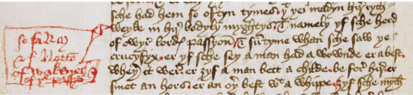
Image context: the lead image is a real archival manuscript detail from British Library Additional MS 61823, reproduced in a University of Surrey medieval-women project post. It is not a diagram or generated illustration; it shows the physical afterlife of the text as a marked devotional manuscript.[5]
The Third Person Is A Defense Mechanism
Modern readers often expect autobiography to build intimacy through first-person continuity: I was born, I suffered, I learned, I remember. Kempe's book refuses that steady possession. The narrator repeatedly calls her "this creature," a phrase that lowers the self and exposes it. The voice is intimate because it keeps backing away from direct self-assertion.
That distance suits a woman writing under conditions of suspicion. The opening prose frames the work as a "schort tretys" for sinful readers, not as a self-celebrating memoir.[1] Before the book can tell a life, it has to justify the usefulness of telling one. The humble third person performs submission, but it also gives the narrative a curious courtroom force. The text can say: look at what happened to this woman; judge the signs; consider the witnesses.
The Southeastern Louisiana University project emphasizes that the book survives in a single British Library manuscript and that its digital edition lets readers see the text with and without annotating hands.[4] That matters for style because the third person is already a kind of annotation inside the prose. Kempe is present as speaker, subject, case file, scandal, and holy example at once.
Weeping Becomes Syntax
The book's most famous sound is not eloquence but crying. Kempe's "plentyuows teerys of contricyon" are introduced early as both gift and public problem.[1] People accuse her of performing grief on command; she understands the tears as grace; irritated observers hear disruption.
The prose makes that conflict audible by repetition. Weeping does not appear once as a symbolic episode and then vanish. It returns as rhythm, interruption, social embarrassment, bodily exhaustion, and devotional proof. The style asks the reader to live with recurrence. Kempe cries at sermons, at the Passion, during prayer, in public worship, on pilgrimage, in fields, in conversation. Her body keeps producing an argument before any formal defense can stabilize it.
This is why the book's voice is more sophisticated than caricature makes it sound. A hostile summary can reduce Kempe to excessive emotion. The prose does something harder: it shows how a feeling becomes legible or illegible depending on who is watching. When divine speech in the text tells her that the devil is tormented by her weeping, the claim is not merely devotional consolation.[2] It turns the very behavior that scandalizes bystanders into spiritual action. The sound others want stopped is reclassified as work.
Dictation Makes The Book Uneven On Purpose
Kempe's book is also blunt about its own making. The proem explains that the first written version was difficult to read, that a priest delayed, that another man tried and failed, and that the surviving arrangement does not follow strict chronology.[1] The sentence "this boke is not wretyn in ordyr" is not an apology to skip past.[1] It is a reading instruction.
The book's broken order fits the kind of memory it preserves. Kempe is not building a ruler-straight life from birth to death. She is gathering episodes of trial, movement, revelation, and recognition after a long delay. What matters is not sequence alone, but recurrence: shame followed by defense; tears followed by slander; travel followed by examination; fear followed by speech.
That pattern gives the style its forward motion even when chronology loosens. The reader learns to follow pressure rather than calendar. A scene in a church, a confrontation with clerics, a remembered conversation with Christ, and a practical note about scribes can sit near each other because the book's real structure is evidentiary. Each episode asks whether Kempe's voice can survive another test.
The Public Voice Is Never Purely Private
Kempe's style is devotional, but it is also social. The book is full of people who react: priests, husbands, fellow pilgrims, townspeople, bishops, clerks, detractors, sympathizers, scribes. A quieter mystical text might pull inward toward contemplation. Kempe's book keeps throwing contemplation into rooms, roads, churches, ships, and courts.
That publicness changes the texture of the voice. Her spiritual life is not sealed away as interior experience. It must pass through permission, rumor, mockery, travel logistics, bodily weakness, and institutional scrutiny. The British Library record notes that the manuscript itself contains later marginal notes, rubrication, red drawings, and ownership evidence linking it to Mount Grace Priory.[3] Even after composition, the book remains social: handled, glossed, corrected, and made usable by readers who thought its difficult voice mattered.
Samira Lindstedt's discussion of Additional MS 61823 is especially helpful here. She argues that the manuscript's annotations provide evidence that at least some fifteenth-century readers treated Kempe as spiritually authoritative rather than merely strange.[5] That does not settle every modern question about the book, but it sharply complicates the lazy picture of Kempe as an embarrassment rescued only by recent criticism.
The Afterlife Begins In The Margins
The strongest reason to read The Book of Margery Kempe as literature is that its form and its survival tell the same story. A contested woman dictates a book. The book admits the fragility of its production. A manuscript copy preserves the voice. Later readers mark it, compare it, punctuate it, defend it, and make it available for devotional use.[3][5] The afterlife is not a footnote to the style. It is where the style proves what it was built to do.
That is why the crying matters. Kempe's tears are not simply a motif of excess. They are the pressure point at which voice, body, gender, sanctity, and public judgment meet. The prose repeats them because the culture around her keeps disputing their meaning. Are they performance? Illness? Grace? Authority? The book refuses to answer by becoming calm. It answers by making the disturbance durable.
Read this way, Kempe is not interesting only because she is early, female, mystical, or odd. She is interesting because she makes a formally risky solution to a social problem. The self cannot speak as a settled "I," so it speaks as "this creature." Memory cannot march in order, so it gathers proofs. Weeping cannot be translated into doctrine, so it becomes syntax. The book's voice is not polished despite its interruptions. It is made out of them.
Sources
- College of the Holy Cross, The Book of Margery Kempe, Book 1, Part 1, edited by Lynn Staley; source for the proem, scribal account, third-person phrasing, and quoted Middle English passages.
- College of the Holy Cross, The Book of Margery Kempe, Book 1, Part 2, edited by Lynn Staley; source for the chapter 22 passage on weeping and divine reassurance.
- British Library Archives and Manuscripts Catalogue, "Add MS 61823"; manuscript description, dating, contents, physical features, provenance, and scribal context.
- Southeastern Louisiana University / Humanities Online, "The Book of Margery Kempe"; project page for the digital facsimile, documentary edition, annotating hands, and reader's edition.
- Samira Lindstedt, "Margery Kempe's examinacio dura: Annotation as Authentication in Additional MS 61823," University of Surrey Women's Literary Culture and the Medieval Canon, July 24, 2017; source for manuscript annotation context and the archival image detail used here.