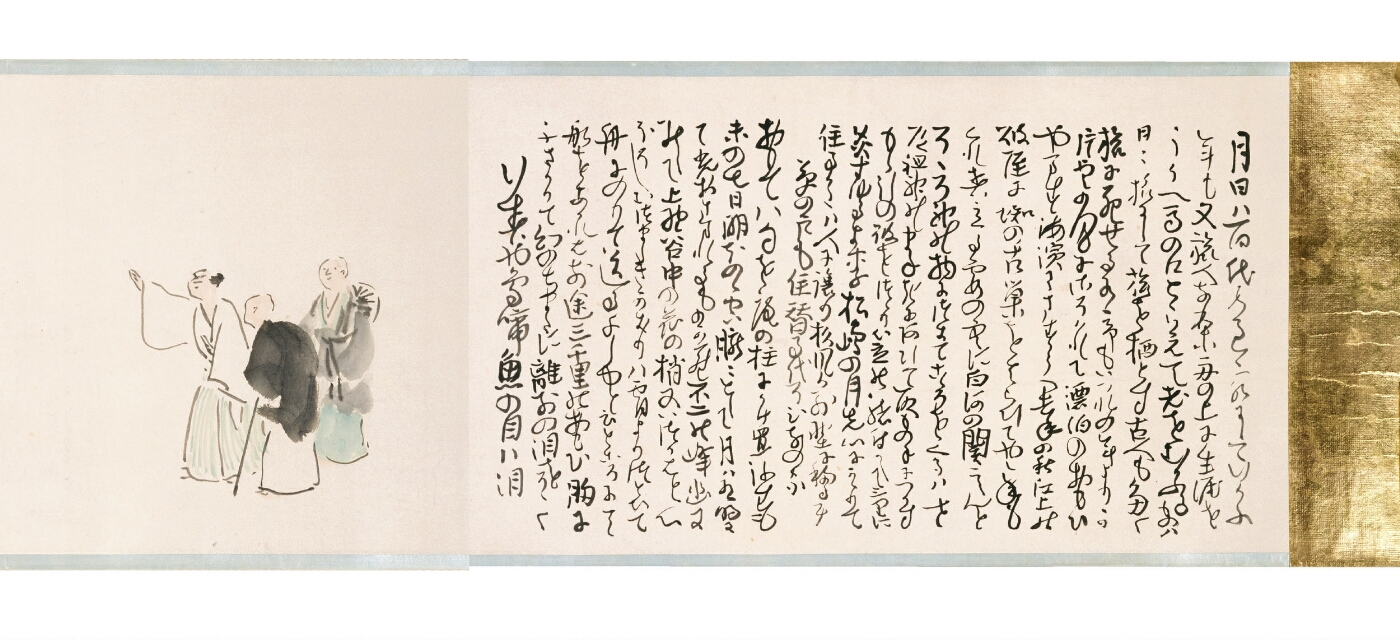
Basho's Oku no Hosomichi begins before it begins. The famous opening does not first give us a destination, a map, or even the poet's mood. It gives us time itself as movement: months and days are travelers, years come and go as travelers too.[1][2] Translation has to decide, immediately, whether this is a grand metaphor, a practical travel preface, or the book's governing grammar.
The strongest answer is all three. Oku no Hosomichi is a 1689 northern journey written into a poetic travelogue and published posthumously; Britannica describes it as prose joined to historical memory, literary allusion, emotion, and haiku.[3] But the work's opening is not a decorative flourish before the itinerary. It teaches the reader how to read the road. Time passes like a traveler; the human traveler becomes one more passing thing; then the road stops being a line between places and becomes a temporary dwelling.
That is why English titles matter. "The Narrow Road to the Deep North" gives the work a cold, almost epic distance. "The Narrow Road of Oku" keeps the Japanese place-name and lets the strangeness remain. "Narrow Road to the Interior," one of the modern title traditions noted by Britannica, shifts the stress inward.[3] None is simply wrong. Each chooses a different pressure inside oku: a remote region, a depth, an interior, a place whose distance is also a reading method.
Time As A Traveler, Not A Backdrop
The Japanese Text Initiative's text opens with tsukihi, "months and days," followed by the striking image of hiyakudai no kakaku, travelers across generations or ages.[1] Keene's English version at Wikisource gives the first sentence as "The months and days are the travelers of eternity."[2] That is elegant because it keeps the sentence from becoming only calendar language. Time is not the measure beside the journey. Time is already on the road.
A flatter translation would say something like "time passes." Accurate enough, but dead on arrival. Basho's opening does not merely announce impermanence; it personifies time as a company already moving before the poet packs his bag. This matters because it reduces the ego of travel. The journey is not heroic self-discovery first. The speaker is joining a motion that was already underway.
The next turn tightens the idea. People who live on boats or grow old leading horses are described as spending their days in travel and making travel their dwelling.[1][2] That last pressure is the real crux. English can say "home," "dwelling," "abode," or "residence," but each word shifts the tone. "Home" is warm and modern; "dwelling" is stranger and more provisional; "abode" sounds archaic but keeps spiritual weight. The Japanese sumika asks for a word that is both shelter and condition.
The Road Becomes A Dwelling
The ordinary travel book separates home and road. You leave one to enter the other, then return changed. Basho collapses that geometry. If the road can become sumika, then travel is not an interruption of life. It is one way life reveals its true arrangement.[1]
That does not mean the prose is weightless or abstract. The opening quickly moves into patched trousers, a repaired hat cord, moxa burned on the legs, and the tug of Matsushima's moon.[1][2] The sublime statement about time is followed by practical discomfort. This is one reason the work remains readable rather than merely venerable. It lets cosmic motion and small preparations occupy the same sentence-world.
The Academy of American Poets' biography is useful here because it defines the book's afterlife through form: The Narrow Road to the Deep North helped establish haibun as a major mode linking haiku with narrative prose.[4] That formal label helps, but it can also mislead if it sounds too tidy. The opening is not impressive because prose and poem alternate neatly. It is impressive because the text converts distance into form. Prose carries movement; haiku condenses moments; allusion makes each place crowded with earlier poems and histories.[3][4]
"Oku" Should Not Be Solved Too Quickly
The hardest word in the title may be the one English often tries to finish for us. Oku can point toward the northern interior, the far reaches, the back country, the depth behind the visible surface. If a title over-translates it as "Deep North," the work gains atmosphere but risks becoming a regional adventure. If it keeps "Oku," the reader must carry a foreign place-name that refuses quick metaphor. If it says "Interior," the journey becomes psychological before the geography has had its say.[3]
The right reading needs all those meanings held in tension. Basho is traveling through named places, not wandering through an allegorical fog. Yet the prose keeps making geography answer to memory, poetic precedent, Buddhist impermanence, and bodily exposure. The interior is not inside the self alone. It is the depth produced when road, weather, old poems, local histories, and a tired body meet.
That is where Buson's 1778 illustrated copy, photographed by e-Museum, becomes more than a beautiful archival object.[5] The scroll shows text and image sharing a long horizontal field: calligraphy advances in columns, while a small group of travelers appears almost lightly beside it. The image understands something the opening says. The road is not just described by the page; the page itself becomes a road for the eye.
Translation Should Preserve The Uneasy Scale
The danger in translating Basho is polish. Too smooth an English version turns the opening into noble travel wisdom. Too antique a version turns it into museum glass. The prose needs an unstable balance: cosmic time, shabby preparation, literary memory, and a body about to leave Edo with no guarantee of return.[1][2][3]
That is why "travel itself is home" is a tempting paraphrase but not quite enough. It catches the slogan and misses the austerity. Basho's road-as-dwelling is not lifestyle advice. It is closer to a discipline of exposure. If time itself travels, then the poet's departure is both chosen and inevitable. If travelers make travel their dwelling, then home is not destroyed, but loosened. If oku is both region and depth, then translation must leave the road narrow enough that the reader still feels the pressure of entering it.
Read this way, Oku no Hosomichi does not ask English to find one perfect title or one perfect first sentence. It asks English to keep several doors open at once. The months pass. The road calls. The hut changes occupants. The traveler patches his clothes and steps into a landscape already thick with older voices. The best translation lets all of that happen before it tries to explain where Basho is going.[1][2][3]
Sources
- University of Virginia Japanese Text Initiative, Matsuo Basho, Oku no Hosomichi; Japanese text checked against Nihon Koten Bungaku Taikei, vol. 46.
- Wikisource, Donald Keene, trans., "The Narrow Road of Oku," from Anthology of Japanese Literature; English translation excerpts and passage structure.
- Encyclopaedia Britannica, "The Narrow Road to the Deep North"; publication context, 1689 journey, prose-haiku structure, and English title/translation history.
- Academy of American Poets, "Matsuo Basho"; biographical context, haibun framing, and the book's modern translation afterlife.
- e-Museum / National Institutes for Cultural Heritage, "Oku no Hosomichi (The Narrow Road to the Deep North)"; Yosa Buson's 1778 illustrated handscroll copy, Kyoto National Museum, source for the article image.