Open the 1903 edition of Paul Laurence Dunbar’s When Malindy Sings and there’s a man playing the fiddle. He sits with one knee out, his left hand curled around the neck of the instrument. The bow makes a bright diagonal against the dark background. Across the gutter, in letters bigger than the poet’s name, the title announces a woman singing. It takes five stanzas of the title poem to discover what the two musicians have to do with each other. As soon as Malindy opens her mouth, the fiddler puts his instrument on a shelf. [1][2]
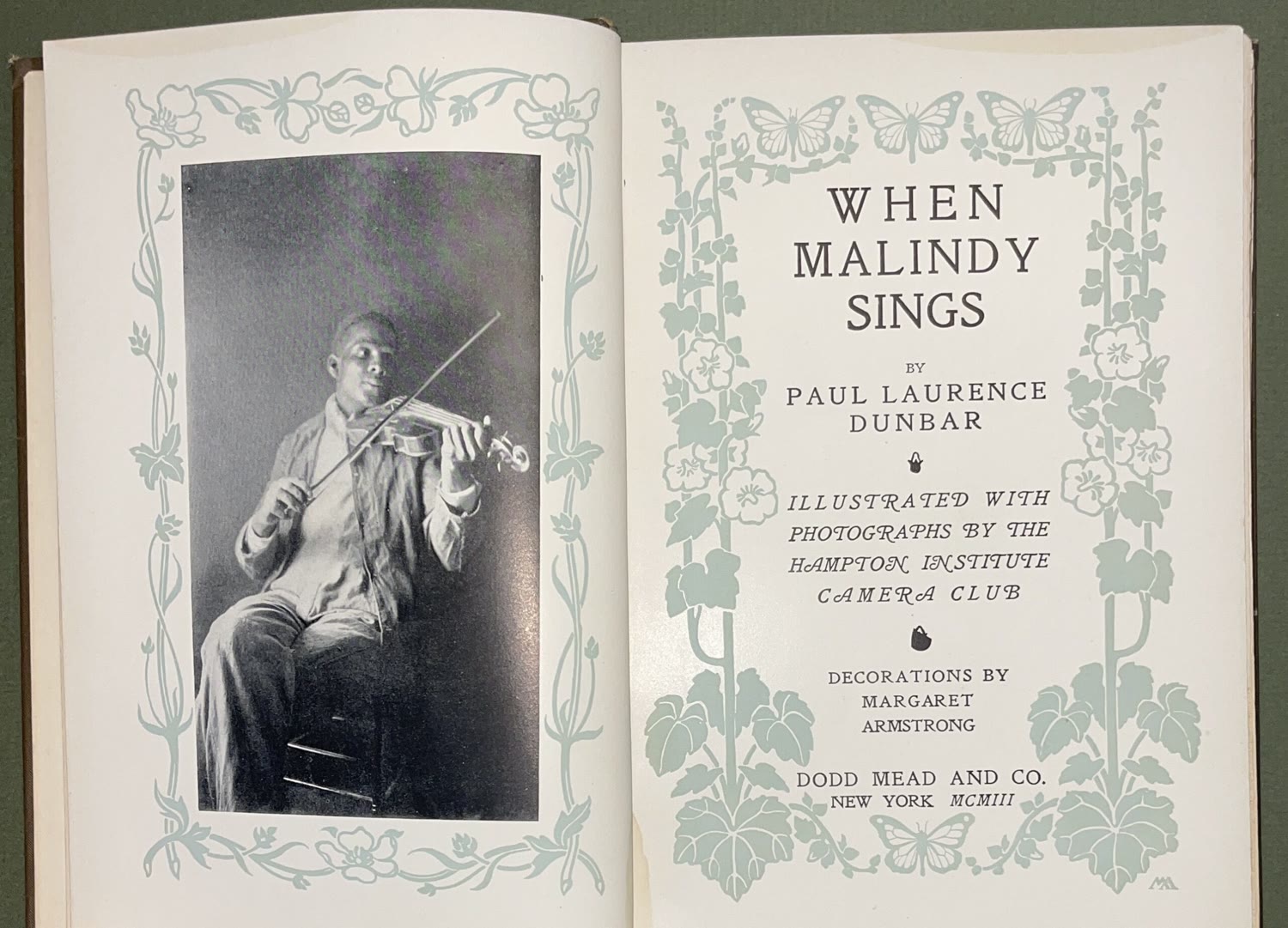
Dunbar had published the poem in 1896. His mother Matilda’s singing as she worked in the kitchen helped inspire it. Seven years later Dodd, Mead gave the poem’s name to a collection, with photographs by the Hampton Institute Camera Club and decorations by Margaret Armstrong. A reader of the earlier poem meets Miss Lucy first. A reader opening this book has already spent a moment with somebody else who knows how to make music. [1][2][3]
Lucy has a music book. The speaker gives her a rough review and some practical advice in the same breath. She can put it away. She could practice into old age and still get only scraps of tune out of those “lines an’ dots.” It’s an awkward joke to come upon in a handsome piece of printing. Here we sit with our own book open, depending on marks on paper to hear the inflection with which one person takes another to pieces. Try saying the opening aloud. The speaker has to sound sufficiently tickled by Lucy’s shortcomings that we’ll stay to hear the rest. By the third stanza the invitation extends even to Lucy. There’s room beside the critic for a second listener. [1]
The fiddler gets kinder treatment. Dunbar gives him a whole line in which to lay the instrument down. The banjo players who follow have an even finer moment. Their fingers drop onto the strings and stay there. Anyone who has put a hand across vibrating strings knows how abruptly the sound can die. Then comes the small delay of the dash, during which the speaker seems to notice something funny about those hands. The players have forgotten to move them. For a beat or two the reader attends quite closely to the sound of a banjo falling silent. That’s how good Malindy is. [1]
Go back to the frontispiece now. The camera has caught precisely the posture the verse will undo. The player still holds the fiddle high enough to tuck it under his chin. You can imagine the distance his arm would travel to set it down. The photograph supplies a little resistance to the poem’s boast, too. This man has a practiced grip and a bow of his own. It costs him something to yield the floor. Armstrong’s vines give him much the same frame they give the title on the facing page. For as long as the book lies open there, the accompanist who never gets to accompany Malindy has equal billing. [1][2]
A performer inherits a different problem. The University of Dayton preserves Herbert Woodward Martin’s recital of the poem from the 1990 video The Eyes of the Poet. Consider the part a single reciter gets to play. The speaker who has just described sitting calmly, listening to a hymn, immediately yells at a barking dog and tells Mandy to quiet the child. Every demand for quiet makes another interruption. Even the reader at home has to raise an inward voice to get that dog’s attention, then lower it enough to catch the last hymn, “Swing Low, Sweet Chariot.” [1][4]
I like the fiddler best on a second look, when the bow can seem poised on the verge of stopping. Dunbar gives Malindy the reach of a voice that carries from a kitchen all the way to heaven. The book gives us a much smaller distance to measure, from a man’s chin to a shelf. You can feel the pull of her singing in the time it takes him to move his hand. [1][2]
Sources
- Paul Laurence Dunbar, “When Malindy Sings.” Academy of American Poets, full text.
- William L. Clements Library, University of Michigan, When Malindy Sings. Photograph of the 1903 frontispiece and title page.
- Wright State University Libraries, When Malindy Sings. Digitized collection and publication history of the title poem.
- Herbert Woodward Martin, “When Malindy Sings,” from The Eyes of the Poet (1990). University of Dayton, English Faculty Performances.