Flynn is on third. Jimmy Blake is on second. Between them they have just done the most difficult thing in Ernest Thayer’s “Casey at the Bat.” With two outs, they have kept the game alive long enough for the man everybody came to see to get his turn. Nobody calls for Flynn to tip his cap. Casey gets applause for wiping his hands on his shirt. A comic actor looking for a part in this poem might well take the fellow with the bat. The bigger part, if he can manage it, is the crowd. [1]
On June 3, 1888, a reader in San Francisco could find Mudville’s game on page four of The Daily Examiner, in the fourth column. By August, the actor DeWolf Hopper was reciting it in New York to a theater audience that included members of the New York Giants and the Chicago White Stockings. Think what those ballplayers got to hear. Here was a man doing an impression of the people who came to watch them work. [2][3][4]
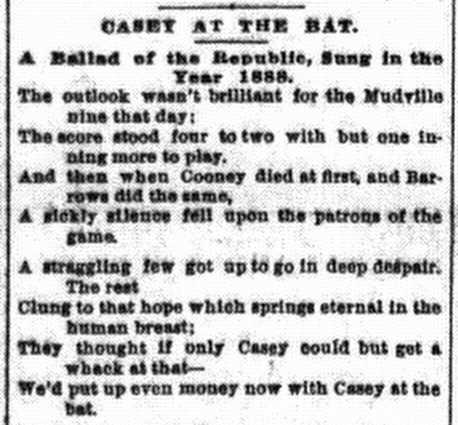
Thayer makes it remarkably easy to slip into the stands. In the second stanza the narrator is still picking out spectators who have given up and started home. He knows what the ones who stay are thinking. Then, halfway through their calculation of the odds, the pronoun changes. Suddenly it is “We’d put up even money.” Read the stanza aloud and hear how little you have to do to become a fan. No announcement, no new speaker clearing his throat. A syllable gets you a seat. [1]
It is a slightly embarrassing seat to occupy. We have just heard what the paying customers think of Flynn and Blake, and we watch both men play better than anyone expects. An audience inclined to smile at the home fans has perhaps three seconds to feel superior. Thayer puts second and third base at the end of a stanza, with two runners waiting to be brought home. Who can help looking past them to see who comes up next? Our attention leaves them at precisely the moment Mudville’s does. [1]
A hand goes up
Of all the things an actor might mime in the poem, try raising one hand after the first called strike. A spectator has just threatened the umpire. Casey quiets the stands with that small gesture, then gives the pitcher leave to continue. A stranger arriving at this moment could reasonably mistake him for the official in charge. The real umpire has two words to say when the next pitch goes by. Those words count, even though Casey commands every eye in the place. For a solo performer there are deliciously incompatible jobs here. One voice begs for blood, one man dispenses mercy, and somebody still has to call balls and strikes. [1]
Hopper carried those jobs with him into the recording studio. The Library of Congress preserves a 1909 recording of his recitation. More than a century later, for the poem’s 125th anniversary, Washington Nationals radio broadcaster Dave Jageler recorded it too. A baseball announcer makes a particularly apt inheritor. His everyday art requires him to see the ball for people who can only hear his voice. Thayer gives him a curious assignment on the final pitch. [2][4]
Follow the ball as far as the words allow. The pitcher releases it. Casey swings hard enough to shatter the air. Then we are somewhere else altogether, listening to a band and to children shouting. A listener who wants to know whether the bat touched the ball has to sit through almost an entire stanza of good cheer in other places. The nearest thing to a score update comes in the last line, and even there the first news concerns the mood in Mudville. By the time we learn what Casey did, we have already heard what his neighbors lost. [1]
That delay survives hearing the poem a second time. The result is settled and the men on base will stay there. What remains open, every time someone gets up to recite it, is how long the speaker can keep a roomful of people listening to that faraway band before bringing them home. [1]
Sources
- Ernest Lawrence Thayer, “Casey at the Bat,” Representative Poetry Online, University of Toronto Libraries. Revised text and line numbers.
- Library of Congress, “The First Publication of ‘Casey at the Bat.’” First-printing facsimile and Dave Jageler’s anniversary reading.
- Library of America, “Casey at the Bat,” from Baseball: A Literary Anthology. Editorial introduction on Hopper and the ballplayers in his audience.
- Library of Congress, “Casey Might Have Struck Out, But Thayer Hit a Home Run.” Hopper’s stage recitation and 1909 recording.