E. M. Forster's "The Machine Stops" is easy to admire for the wrong reason. The 1909 story seems to predict video calls, remote lectures, social isolation, algorithmic convenience, and the strange exhaustion of mediated contact. Britannica frames it as a counterblast to Wellsian technical optimism, and Wired's anniversary note similarly emphasizes the story's networked, information-heavy future.[2][4] Those parallels are real. But the story lasts because it is not simply accurate about devices. It is exact about a spiritual habit: the moment when indirect life becomes so comfortable that direct experience starts to feel like bad manners.
Forster builds that habit as a philosophy before he turns it into a catastrophe. Vashti does not live in a grim prison. She lives in a serviced room that has solved food, music, baths, lectures, temperature, communication, and most forms of inconvenience.[1] The horror is not that the Machine fails at first. The horror is that it succeeds well enough to make the world outside its services seem unnecessary. Kuno's rebellion begins with a simple request: he wants to see his mother "not through the Machine."[1] That is a small sentence, but it cuts through the whole system. The Machine has not merely replaced travel. It has trained its users to confuse contact with availability.
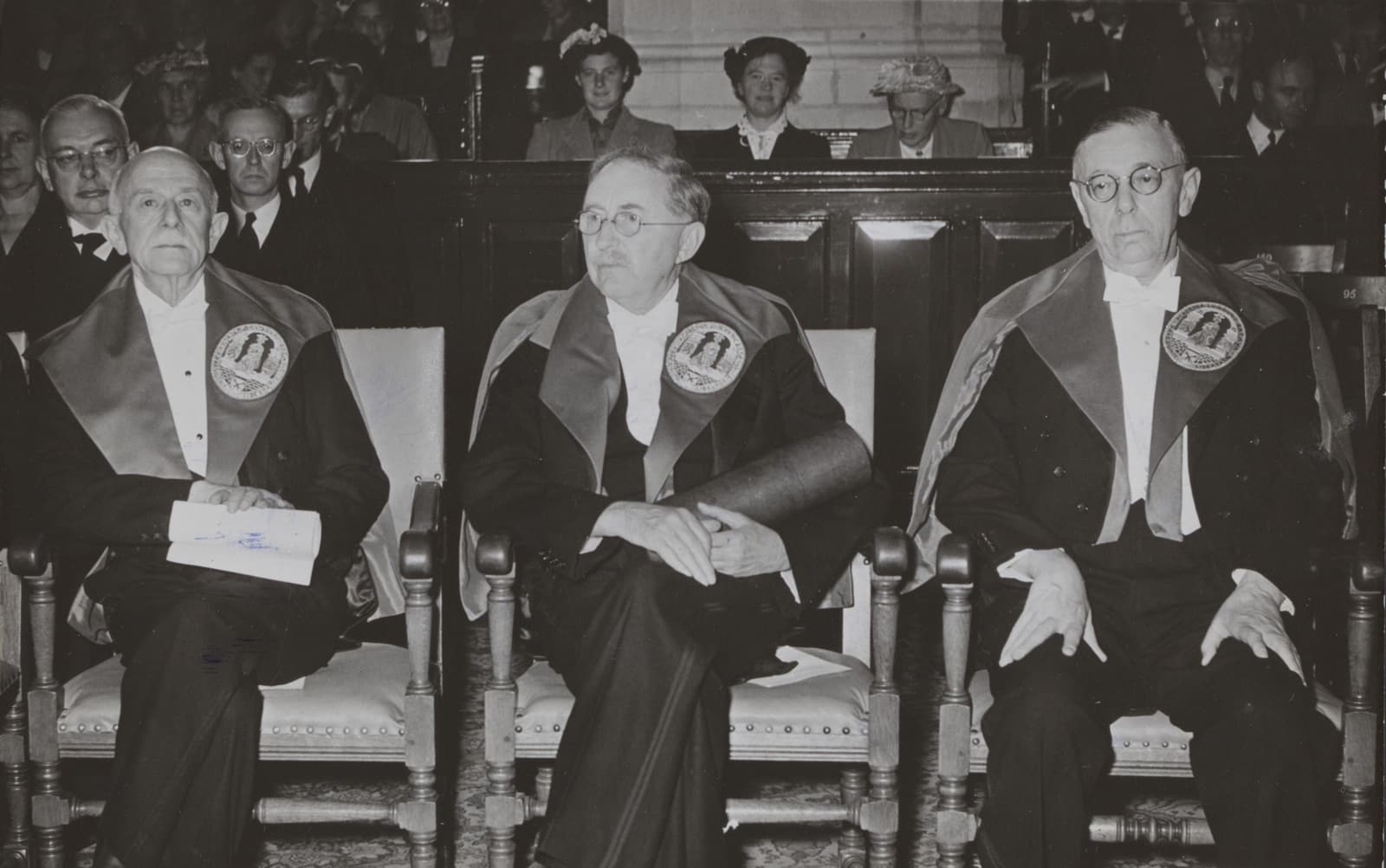
Cover image context: Forster appears here decades after the story's publication, in a 1954 Leiden University photograph from the Dutch National Archives.[5] The late author portrait is intentionally human-scaled. A diagram of networks or a glossy machine visual would overstate the technical surface and understate the story's central pressure: Forster is asking what happens to bodies, attention, and judgment when mediation becomes a way of life.
The room is comfortable because it has removed friction
The famous opening room is almost comic in its efficiency. It is small, hexagonal, windowless, and furnished with little more than an armchair and reading desk.[1] That spareness matters. Forster does not imagine a future of abundant visible luxury. He imagines a future in which luxury has been absorbed into controls. Buttons make the room feel sufficient. The body sits still while services arrive. The room becomes less a dwelling than an interface.
That design makes Vashti's complacency credible. She is not stupid, and Forster does not write her as a crude villain. She has lectures to give, correspondents to manage, intellectual tastes to perform, and opinions about music and ideas.[1] The society around her still values culture, but culture has been thinned into circulation. Ideas travel; bodies do not. The result is not ignorance exactly. It is a knowledge culture that has lost its appetite for first contact.
That is why one of the story's most chilling jokes is the warning against "first-hand ideas."[1] Forster makes the phrase funny because it is absurd, but he also makes it socially plausible. In a world where the archive is total and communication is frictionless, first-hand experience begins to look inefficient, impolite, even vulgar. Why go to the sea when one can hear a lecture compiled from earlier lectures about the sea? Why visit a son when his image can be summoned on a plate? Why look at stars when the act of looking interrupts a schedule?
The story's philosophical target is therefore not machinery by itself. It is second-order living: experiences made from reports, intimacy made from signals, intellectual life made from recombination, and public confidence made from systems no one still knows how to repair.
The Machine becomes sacred because it takes over explanation
Forster's sharpest move is to let technical dependence become religious without needing priests. Vashti owns one physical book, the Book of the Machine, and she handles it with reverence.[1] When anxiety rises, she turns not to another person or to her own judgment, but to instructions. The system comforts because it explains procedure. It tells her what button to press when discomfort appears.
This is where the story differs from a simple anti-technology fable. Forster is not saying tools are bad because they are artificial. He is showing how a system becomes sacred when people stop distinguishing use from submission. The Machine supplies air, food, music, medicine, transport, discourse, and social permission.[1] Once a system governs both material survival and moral vocabulary, dissent begins to sound like blasphemy. Vashti's instinctive "O Machine!" is not a metaphor pasted onto the plot. It is the natural language of a person whose world has narrowed until maintenance and meaning feel identical.[1]
The British Library's Forster profile is useful background here because it places him among writers concerned with connection, perception, and the pressure of modern social forms.[3] "The Machine Stops" may look unusual beside A Room with a View, Howards End, or A Passage to India, but the ethical question is recognizably Forsterian: under what conditions can one person actually reach another? The difference is that here the obstacle is not class convention, property, empire, or tourism. It is an entire civilization optimized to remove the occasions on which relation might become demanding.
Kuno's rebellion is bodily before it is ideological
Kuno matters because he refuses to argue only inside the Machine's terms. He wants the surface, the stars, the risk of air, and the awkwardness of face-to-face speech.[1] His rebellion is not fully programmatic. It is bodily. He senses that the system has not merely made life easier; it has amputated capacities that once helped humans know where they were.
That is why the story's language of space is so important. The citizens say space has been annihilated, but Kuno understands that what has really been damaged is the sense of space.[1] The distinction is central. Technology can compress distance for communication, but if people begin to experience distance itself as an error, they lose more than travel. They lose scale, patience, orientation, and the kind of thought that arrives only when the body has had to go somewhere.
Forster's story therefore resists the lazy reading that Kuno simply wants authenticity while Vashti wants screens. Kuno wants a restored relation between mind and body. His desire to see stars is not sentimental nature worship. It is a demand that thought be answerable to something outside the system that processes thought. Stars do not serve him, flatter him, or adjust to his preferences. Their uselessness is part of their value.
Collapse reveals the maintenance fiction
The title tells us from the start that the system will fail. The deeper question is what the failure reveals. When the Machine begins to malfunction, the citizens do not know how to interpret deterioration because their civilization has converted maintenance into faith.[1] Problems are not first read as evidence of a fragile infrastructure. They are treated as temporary errors within a trusted order.
That gives the ending its force. The disaster is not only mechanical collapse. It is epistemic collapse: a population that has lost practice in direct repair, direct movement, direct touch, and direct judgment suddenly has to live without the mediating system that made those practices seem obsolete. Britannica's note that the story became a model for later science-fiction collapse plots is right, but Forster's version remains unusually intimate.[2] The end of civilization is felt through rooms, buttons, passages, bodies, and the terror of leaving or staying.
Wired's 2010 reading stresses how modern the story's communication technologies can feel: real-time voice and picture, solitary cells, a networked culture of information exchange.[4] That recognition is useful, provided it does not flatten the story into prediction trivia. Forster is less interested in whether a future gadget resembles ours than in whether a society can lose the moral muscles that make unsmoothed reality bearable.
Why the story still bites
"The Machine Stops" remains uncomfortable because its warning is not "do not use machines." It is sharper: do not let a system that delivers convenience also define what counts as experience. The Machine becomes dangerous because it makes mediated life feel rational and direct life feel eccentric. It turns comfort into a worldview.
That is why the story's most modern figure may not be the video plate or the remote lecture. It may be Vashti's irritation when Kuno asks for presence. She is busy, connected, scheduled, informed, and protected. A visit seems inefficient. The outside seems dirty. The stars seem unproductive. Touch has become obsolete.[1] Forster saw that a culture can remain mentally active while becoming existentially passive. It can have endless discourse and almost no encounter.
The story's final answer is bleak, but not empty. Kuno's insistence on directness keeps a human scale alive inside the catastrophe. He does not save the Machine civilization, and Forster does not pretend that sincerity can repair neglected infrastructure. But Kuno names the lost measure. A person is not fully met when an image appears. An idea is not fully tested when it circulates. A world is not fully known when it has been converted into service. That is the philosophical sting of "The Machine Stops": the failure begins long before the machinery breaks. It begins when people forget that mediation is a tool, not a world.
Sources
- E. M. Forster, The Eternal Moment, and Other Stories (Project Gutenberg ebook 72890; includes "The Machine Stops" and publication metadata).
- Encyclopaedia Britannica, "The Machine Stops" - concise context on the story as a counterblast to Wellsian technical optimism and as a science-fiction dystopia.
- The British Library, "E M Forster" - author context, major works, Bloomsbury connection, and Forster's literary reputation.
- Randy Alfred, "Nov. 1, 1909: 'The Machine Stops.'" Wired, November 1, 2010 - reception note on the story's networked communication world and publication context.
- Wikimedia Commons, "File:ForsterLeiden1954.jpg" - Nationaal Archief / Joop van Bilsen archival photograph used as the article cover.