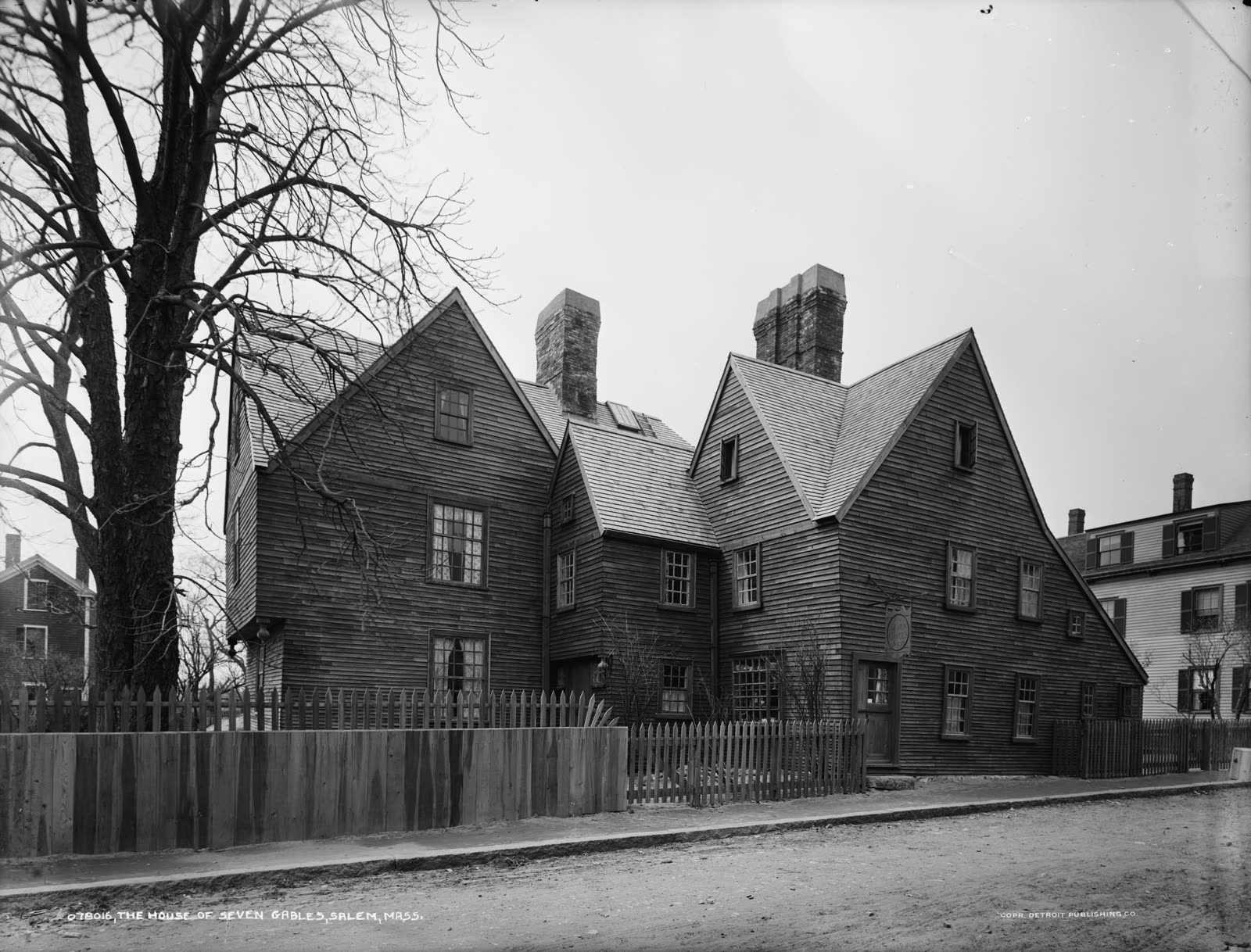
Nathaniel Hawthorne begins The House of the Seven Gables by asking the reader to look at a building as if it had a face. The old Pyncheon house stands with "seven acutely peaked gables," a central chimney, an elm before the door, and enough accumulated family history to feel less like a residence than a long legal argument in timber.[1] That opening is not merely Gothic scenery. It gives the novel its method. Hawthorne turns property into a symbolic system, then watches what happens when people mistake possession for innocence.
The story is simple enough in outline: the Pyncheon family has inherited a house tied to ancestral greed, a disputed land claim, and the execution of Matthew Maule for witchcraft. Generations later, Hepzibah Pyncheon lives in genteel poverty inside the family house, her brother Clifford returns after a long imprisonment, Judge Jaffrey Pyncheon arrives as the smiling public face of old appetite, and Phoebe brings a younger, practical warmth into rooms that have been trained by grievance.[1][2] Its continued circulation as a Penguin Classic is a small afterlife signal: the book has outlived local antiquarian interest because its family-house story keeps speaking to guilt, class, inheritance, and the stories property tells about itself.[3] The novel's force lies less in whether a curse literally operates than in how the house teaches everyone to behave as if the past still owns them.
The real Salem house deepens that doubleness. Britannica identifies The House of the Seven Gables as an 1851 romance and notes the Salem house that served as the model for Hawthorne's fictional dwelling.[2] The National Park Service's account of Hawthorne's Salem years is useful context too: before the novel, Hawthorne had already turned the Custom House into literary material in The Scarlet Letter, converting local buildings and bureaucratic wounds into fiction.[4] In Seven Gables, he goes further. The building is not a backdrop. It is a machine for converting inherited wrong into daily posture.
The gables make inheritance visible
The gables are the first symbol because they make age look structural. Hawthorne does not introduce the Pyncheon house as a neutral address. He gives it angles, shadows, depth, and a sense of accumulated weather. The "weather-beaten edifice" appears almost physiognomic, bearing outward storms and inward human history at once.[1] Before any character speaks, the house has already trained the reader to treat architecture as evidence.
That matters because the Pyncheons' inheritance is not simply money or land. It is a habit of standing under a roof and calling the roof proof. Colonel Pyncheon built the house over a prior wrong: the dispossession of Maule's land under the pressure of witchcraft accusation.[1] The gables therefore turn ownership into display. They announce status, antiquity, and family continuity, while also making visible the shape of a claim that cannot stop pointing backward.
Hawthorne's question is not "Was the house cursed?" in the cheap supernatural sense. His sharper question is whether a family can inherit the benefits of injustice without inheriting the ethical problem that made those benefits possible. The narrator asks whether each inheritor, conscious of wrong and failing to repair it, commits the ancestor's guilt again.[1] That is the novel's real haunting. A house can be old without being guilty. This house is guilty because the living keep treating its history as settled property rather than as unfinished responsibility.
The portrait turns ancestry into surveillance
The Pyncheon portrait is the house's second governing symbol. It hangs not as decoration but as a watching instrument. Colonel Pyncheon persists in image form, and his descendants keep reading faces through him. When Hepzibah sees Judge Pyncheon, she recognizes not merely a relative but a recurrence: the old Pyncheon has come again in new clothes, new manners, and a more publicly respectable smile.[1]
The portrait motif gives Hawthorne a way to dramatize family resemblance as moral pressure. Judge Pyncheon does not need to swing a sword or wear seventeenth-century costume. He can be modern, civic, polished, and benevolent in public; the old shape still shows through. That is why his smile matters so much. It is social varnish over acquisitive continuity. The face says reform, prosperity, and public service. The portrait says repetition.
This is one reason the book's Gothic machinery remains subtler than its premise. Hawthorne does not need ghosts to walk across the page every few chapters. He can make a face do the work. The old portrait teaches the living to see likeness as fate, and the reader gradually learns to distrust polite surfaces. In a novel full of rooms and windows, the human face becomes another framed image: apparently open to view, actually layered with inherited concealment.
Maule's well holds the counter-history
Maule's well is the novel's water-symbol, but it is not cleansing in any easy way. It belongs to the dispossessed line, to the ground beneath the Pyncheon claim, and to a tradition that survives outside the official family story.[1] Water should imply freshness, but Hawthorne makes it ambiguous. It is transparent and secretive at once, a medium in which Clifford can imagine seeing through things, yet also a reminder that clarity may come from below the house's authorized history rather than from its portraits and papers.
The well's power comes from its position. It is close enough to the house to belong to its daily world, yet symbolically older than the Pyncheon claim. It is not grand like the gables or official like the portrait. It persists at ground level, associated with local rumor, buried knowledge, and Maule inheritance. If the house is the architecture of possession, the well is the surviving sign that possession never fully absorbed what came before it.
That counter-history matters most because Hawthorne is interested in how wrong survives in ordinary objects. The novel does not need a courtroom scene to keep the old accusation alive. It has water, garden ground, thresholds, stories, and the uneasy proximity of families who have lived beside one another for generations. The well keeps saying that land is not mute. It remembers through use, rumor, and placement.
The little shop humiliates pride into contact
Hepzibah's cent-shop is one of the novel's best symbols because it is almost comic. A decayed gentlewoman opens a tiny shop window in the ancestral house and tries to sell small goods with aristocratic awkwardness.[1] The scene punctures Pyncheon pride without simply mocking her. Hepzibah is proud, frightened, loyal, impractical, and wounded by the need to turn family space into commerce. The shop window makes all of that visible at once.
The symbolic reversal is exact. The house that once expressed command must now face the street through exchange. Hepzibah cannot live entirely inside inherited dignity because dignity does not buy food. Her shop is therefore both degradation and rescue. It lowers the Pyncheon house into ordinary economic contact, but that lowering is morally healthier than Judge Pyncheon's grander appetite. Hepzibah sells gingerbread and thread; the Judge wants power, property, and control over Clifford's hidden knowledge.[1]
Phoebe changes the shop's meaning because she treats contact as natural rather than humiliating. She brings order, sunlight, labor, and social ease into the same spaces that Hepzibah experiences as shame. The shop window becomes a test: can the house open itself to ordinary circulation without reproducing domination? Phoebe's answer is practical. She does not redeem the Pyncheon past by speech. She works, listens, tends, and lets daily life move through rooms that have been held too long in symbolic stiffness.
The daguerreotype changes what a likeness can prove
Holgrave's daguerreotypes belong to the novel's modern edge. Photography arrives as a new kind of image beside the old portrait. The portrait carries ancestry, status, and repetition; the daguerreotype promises a more immediate exposure. Holgrave's craft matters because it changes the question of likeness. What if a face could be caught not as family myth wants it seen, but as a chemical registration of what stands before the lens?
Hawthorne is not naive about this technology. The daguerreotype does not magically abolish interpretation. It can still be staged, read wrongly, or folded into desire. But its presence unsettles the old image-system of the house. A painted ancestor can authorize a family legend for generations. A photographic likeness can interrupt that legend by making the present harder to idealize. Holgrave, as a Maule descendant and an image-maker, stands at the crossing of counter-history and modern perception.[1]
This is why the novel's romance between Holgrave and Phoebe is not merely a soft plot resolution. It joins competing symbolic orders: Maule and Pyncheon, critique and domestic renewal, suspicion and sunlight, the old house and the possibility of leaving it behind. If the portrait keeps the past fixed, the daguerreotype suggests that seeing might still change. Not automatically, and not without risk. But the novel needs that possibility.
The garden tries to teach another form of ownership
The Pyncheon garden offers Hawthorne's gentlest counter-symbol. It is not free of the past; nothing in this novel is. Yet the garden lets care replace claim, at least temporarily. Phoebe tends plants, Clifford responds to air and light, chickens wander as comic remnants of old family grandeur, and the house's suffocating interior loosens.[1] The garden is still enclosed property, but it behaves differently from the gables. It asks for maintenance rather than reverence.
That distinction is central to the book's moral pattern. Property that exists only to certify status becomes a curse-machine. Property that requires care, sharing, repair, and exposure to weather can become livable. Hawthorne does not make the garden a utopia. He is too alert to historical damage for that. But he lets it show what the house lacks: motion, seasonality, small labor, and a relation to the living that is not primarily about legal descent.
The ending can feel too neat if read only as plot settlement. Read through the motifs, it is more interesting. The novel does not simply lift a curse and reward the good. It dismantles a symbolic arrangement. The old house, the portrait, the concealed claim, the Judge's smile, and the inherited posture of ownership all lose their power to define the future. What remains possible is less grand and more demanding: relationships not organized by an ancestral wrong.
That is why The House of the Seven Gables still feels sharper than a conventional haunted-house romance. Its central terror is not that the dead return. It is that the living keep making themselves useful to the dead. Hawthorne's symbols show how that happens through things people touch every day: a roofline, a face in a frame, a well, a shop window, a photograph, a garden path. The curse is property behaving as memory without conscience. The cure, if the book has one, is to stop treating inheritance as proof of innocence.
Sources
- Nathaniel Hawthorne, The House of the Seven Gables. Project Gutenberg HTML text, used for textual reference and short quoted phrases.
- Encyclopaedia Britannica, "The House of the Seven Gables" - publication context, genre framing, and relation to the Salem house.
- Penguin Random House, The House of the Seven Gables Penguin Classics page - current edition and publication context.
- National Park Service, "Nathaniel Hawthorne" - Salem Maritime National Historical Park context for Hawthorne's Salem life and Custom House experience.
- Wikimedia Commons, "File:House of the Seven Gables (1915).jpg" - source page for the Detroit Publishing Company / Library of Congress archival cover photograph.