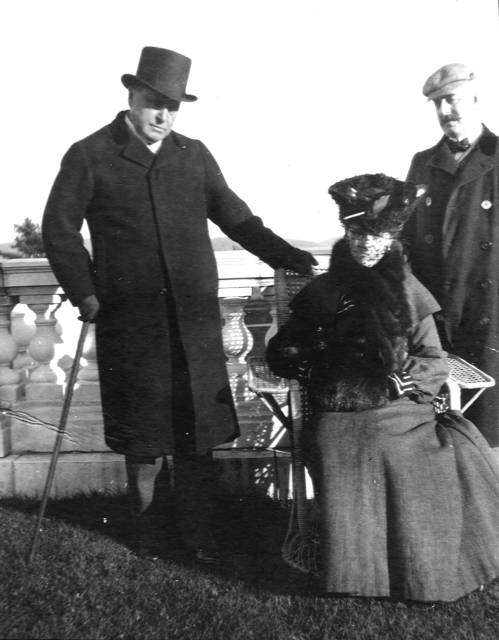
Two people wait for an extraordinary event. John Marcher, in Henry James's The Beast in the Jungle, believes that something “rare and strange” has been reserved for him. Mary Boyne, in Edith Wharton's “Afterward,” moves into an old English house with a ghost that cannot be recognized until after it appears. Marcher expects a catastrophe. Mary and her husband expect a pleasure. Both expectations are forms of confidence: when the great thing comes, they imagine, they will know what kind of story they are in.[1][2]
They reach the same late knowledge by different moral routes. Marcher makes delay into a way of life: his imagined future event absorbs the attention that May Bartram offers him in the present. Mary does not choose ignorance in the same fashion. Ned conceals the disputed business history behind their fortune, while their cultivated retreat helps keep its human consequences out of view. James turns self-absorption into a psychological revelation beside a grave. Wharton turns secrecy and economic distance into a supernatural revelation delivered by a newspaper photograph. In each story, knowledge comes from another person's face—and comes too late to repair the life it suddenly explains.
The resemblance is especially suggestive because Wharton and James were close friends as well as exacting literary peers. Their sustained literary exchange began in 1900, when James answered Wharton's “The Line of Least Resistance” with a letter that joined admiration to detailed criticism.[5] “The Beast in the Jungle” appeared in 1903; “Afterward” followed in 1910.[1][2] Yet the point of reading them together is not to turn influence into a guessing game. It is to watch two writers make suspense betray the person who enjoys it.
Two promises that quietly change the present
James gives Marcher a private prophecy. As a young man, he tells May Bartram that some overwhelming fate lies in wait for him. Years later she recalls the confession he has forgotten. Her memory establishes their bond, and their renewed friendship becomes a vigil: together they will watch for the beast.[2]
Wharton opens with a prophecy too, but hers sounds like drawing-room teasing. Asked whether the Dorset house called Lyng has a ghost, Alida Stair says, “you'll never know it”—at least “not till long afterward.”[1] Ned and Mary Boyne are enchanted. Newly rich Americans, they want an old house complete with inconvenience, Tudor atmosphere, and supernatural pedigree. A ghost that arrives incognito seems like the rarest amenity of all.
Both promises distort attention, though not equally. Marcher treats the present as an antechamber to his fate; waiting becomes the method by which he organizes a life. The Boynes treat the past as an atmosphere they can purchase and the future ghost as a retrospective thrill. Their game does not cause Ned's disputed conduct or his concealment of it. It does, however, prepare them to look for an antique apparition while a modern claim approaches the door. Marcher lets expectation define the terms of his intimacy with May. The Boynes' romance with antiquity helps them imagine that their new leisure has no unsettled account behind it.
The stories therefore do not spring traps at the end so much as teach the reader to notice a trap closing from the first page. The word afterward and the image of a crouching beast both promise delayed meaning. For Marcher that promise licenses neglect; for Mary it mislabels the evidence. What matters most will indeed be understood later, but by then understanding cannot become rescue.
James makes May carry the future
Marcher's conviction sounds self-effacing because he does not expect fame or achievement. He expects merely to suffer something exceptional. But exceptionality remains the center of the fantasy. It allows him to see ordinary attachment as secondary and to recruit May as the one person qualified to witness his difference.[2]
James makes the arrangement painful by showing how much life it contains. May remembers what Marcher forgets. She meets him, listens, jokes, ages, falls ill, and repeatedly offers a form of attention more substantial than the event they are monitoring. When she tells him to repay her by “going on as you are,” the line is tender, evasive, and terrible: going on preserves their closeness while preserving the blindness that makes closeness insufficient.[2]
Marcher even notices May's aging as if time had surprised only him. Her changing face becomes another late message. He can fear losing her and still evaluate that loss as a possible answer to his riddle. James keeps us close enough to Marcher's consciousness to feel its sincerity and far enough away to see its appetite. May is loved as companion, interpreter, and safeguard, but not yet apprehended as a life whose meaning need not culminate in him.
That boundary matters because the story's reception has not settled into one universal lesson. A once-common reading treats Marcher's failure simply as missed romantic love; later criticism has complicated that moral with questions of sexuality, identity, power, and the story's control of May's perspective.[3] The text certainly makes his failure to love central. It does not require us to reduce love to marriage, or May to a prize he failed to claim. The sharper charge is in Marcher's own final recognition: he had thought of her in the light of “her use.”[2]
Wharton makes money return as a person
“Afterward” begins where Marcher dreams of ending: after the windfall, after work, in a life arranged for cultivated attention. Ned Boyne's success with the Blue Star Mine has released the couple from fourteen years in the American Midwest. At Lyng, Mary can paint and garden while Ned writes The Economic Basis of Culture. Wharton lets the title sit in the library like a private joke with teeth.[1]
The Blue Star fortune has an economic basis of its own. Robert Elwell, a ruined former associate, accused Ned of benefiting at his expense in a transaction whose legal and moral status Parvis refuses to settle neatly. The dispute seems safely distant—first financial, then legal, then transatlantic—until a slight man comes down Lyng's lime avenue. Ned sees him and is alarmed. On a later visit Mary speaks to the same stranger in the garden but says Ned cannot be disturbed. He returns, the kitchen maid admits him, and he enters the library; Ned is never seen again.[1]
Only a newspaper portrait makes the visitor legible. The pictured man is Elwell, who had already died when the servant admitted him. The revelation does more than identify a ghost. It converts everything the Boynes had held as abstraction—shares, lawsuit, withdrawal, settlement, retirement—back into a human face. Their picturesque isolation was financed by a relation they had not finished having.
Wharton's ghost is thus literal without being merely decorative. He does not materialize out of the ancient house's vague history. He crosses from modern American finance into an English interior curated to exclude modern inconvenience. The couple wanted a haunting as proof that Lyng possessed a past. What arrives is proof that their own past possesses them.
Criticism of Wharton's shorter fiction often places “Afterward” within her recurring treatment of women as moral interpreters rather than sentimental domestic angels.[4] Mary fits that pattern uneasily, which is precisely why she is compelling. She neither causes Ned's business conduct nor knows enough to judge it in time. Her work is retrospective: she compares letters, dates, expressions, and the photograph until the charming legend of the house becomes an accusation. Knowledge gives her no power over the outcome. It gives her responsibility for seeing the sequence whole.
The face that finally explains the plot
The two endings rhyme at the level of craft. James sends Marcher to May's grave, where the ravaged face of another mourner passes him on the path. Seeing grief displayed without reserve, Marcher understands that another man has possessed—and lost—a depth of attachment absent from his own life. A stranger's face becomes the evidence by which he reads May's name and his history anew.[2]
Wharton gives Mary a face reproduced in newsprint. She has already seen Elwell twice, but sight alone was not knowledge. The portrait joins the man in the garden to the investor in Ned's papers and the dead man in the timeline. Where Marcher envies the stranger's visible wound, Mary recognizes the wound her household had kept offstage.[1]
Neither device is a simple flash of intuition. Each is an act of belated reading. Marcher needs another mourner to teach him what May's presence meant. Mary needs a captioned image to identify the man her household admitted. The face breaks the private genre each character has built: Marcher is not the hero awaiting an exotic doom, and Mary is not the connoisseur awaiting an antique ghost. Both are witnesses who failed to understand what they were witnessing.
One beast is figurative; one ghost is not
The differences keep the comparison honest. James's beast is a governing metaphor that finally names a life organized around apprehension. Wharton's ghost walks, speaks, and removes Ned from the visible world. Marcher's failure develops through a long intimacy; Mary's recognition condenses around concealed business history and a disappearance. May has partial knowledge that she cannot make Marcher receive. Mary has missing knowledge that Ned does not share.
Their endings also distribute guilt differently. Marcher comes to see waiting itself as his fate: “the wait was itself his portion.”[2] His catastrophe has been enacted through his own habits of attention. Mary, by contrast, is implicated without being equivalent to Ned. She enjoyed the fortune, shared the fantasy of retreat, and met Elwell without recognizing him, but Wharton does not give her access to the transaction on which a final moral verdict would depend. Her horror includes the discovery that intimacy did not mean full disclosure.
What the stories share is not a verdict but a temporal ethic. Paying attention later is not the same as paying attention now. A person treated as witness, dependent, opponent, or atmospheric stranger may eventually become the key to the plot; by then, becoming legible cannot bring that person back.
The second reading begins before the revelation
Both stories invite rereading because their endings send pressure backward. May's pauses and careful answers cease to be only mysteries about Marcher's future; they become measures of what she can say inside a relationship he has defined as surveillance. Ned's worry, unfinished letter, and dash down the stairs cease to be Gothic signals floating free of history; they become the behavior of a man who recognizes a claim approaching his door.
That backward motion is the deepest pleasure of the comparison. James and Wharton do not merely hide information. They show how a reader, like a character, can be seduced by the promised category of an event. We look for the beast and miss the years. We look for the ghost and miss the balance sheet. Then one face changes the genre, and everything ordinary becomes evidence.
Late knowledge is real knowledge in these stories. It hurts, clarifies, and strips away vanity. It simply is not rescue. Marcher can finally feel the shape of May's life only at her tomb. Mary can finally name Elwell only after he has taken Ned away. Meaning arrives, but Marcher's self-chosen vigil and the Boynes' hidden economic history become legible only after the relations they deformed can no longer be repaired.
Sources
- Edith Wharton, “Afterward,” in Tales of Men and Ghosts (1910), Project Gutenberg ebook 4514 — primary text for the Lyng legend, Blue Star Mine history, disappearance, and final recognition.
- Henry James, The Beast in the Jungle (1903), Project Gutenberg ebook 1093 — primary text for Marcher's prophecy, his vigil with May Bartram, and the cemetery revelation.
- Gert Buelens, “Recent criticism (since 1985),” in Henry James in Context (Cambridge University Press, 2010) — overview of the shift beyond the story's conventional universal-romantic reading.
- Gloria C. Erlich, “The Female Conscience in Wharton's Shorter Fiction,” in The Cambridge Companion to Edith Wharton (Cambridge University Press, 1995) — critical context for Mary Boyne's role as moral interpreter.
- Library of America, “Moved by a story, Henry James writes to Edith Wharton for the first time” (2010) — account of James's 1900 response to “The Line of Least Resistance” and the beginning of their literary correspondence.
- Wikimedia Commons, “Henry James, Edith Wharton and Howard Sturgis on the veranda at The Mount” — source page and identification for the archival photograph used as the article image; photographer and original source unrecorded.