Latimer knows where the bell is. He knows he will pull it, knows why the servants will fail to answer, knows the lamp will go out. George Eliot opens The Lifted Veil with a man rehearsing his own death in such domestic detail that even the household arrangements seem settled. Then she sends him back to childhood. The story has scarcely begun, and its narrator has already shown us the room in which he expects it to end.[1]
That arrangement gives this small, disturbing book its peculiar suspense. Knowledge arrives ahead of experience, but experience still has to be endured. Eliot makes the distance between the two into the space of her story.
This essay discusses the whole novella, including its ending. Chapter references follow the 1878 Cabinet Edition linked in source 1.
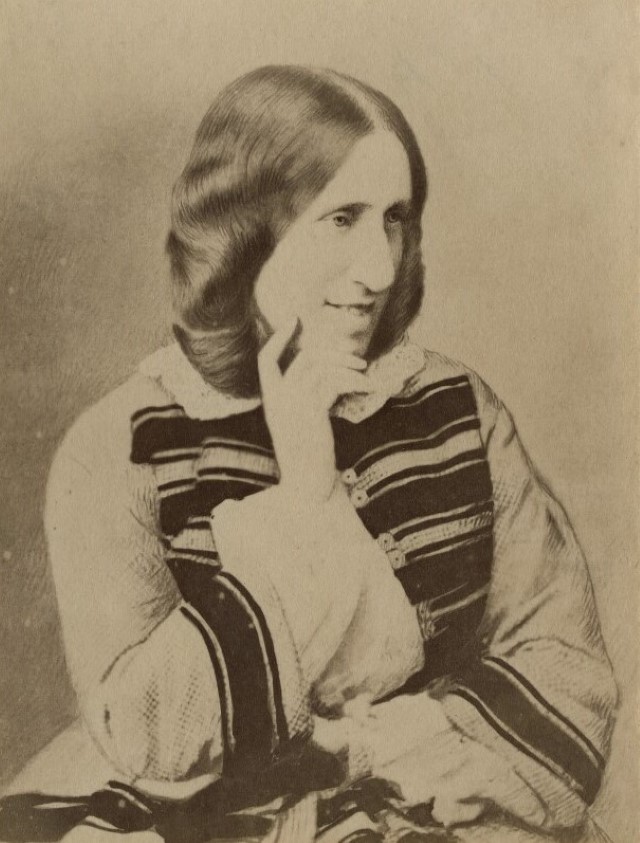
The novella appeared anonymously in Blackwood’s Edinburgh Magazine in July 1859, after the success of Adam Bede. Its publisher was troubled by its macabre material, especially the experiment near the end. Melissa Raines’s account of the publication records that Eliot insisted on keeping that scene.[3] The unease is understandable: a writer capable of making ordinary social life richly intelligible had imagined a man for whom excessive access to other people becomes intolerable.
A scene happens twice
Chapter I gives the reader a small demonstration of Latimer’s predicament. Recovering from an illness in Geneva, he sees his father enter with two women. One is the unfamiliar Bertha Grant. His father begins, “Well, Latimer, you thought me long,” and the group disappears. A little later, after Latimer has tried to steady himself with eau-de-Cologne, the visitors arrive and his father speaks those words again.[1]
The repeated sentence makes the second entrance uncanny. We have already read it; the words seem to have been waiting for the people to catch up. The episode also lets us feel the welcome slowness of the interval. Latimer takes out the bottle, removes its cork, and applies the scent. Each manageable action gives him something to do with his hands while the future remains beyond his control.
Joy Johnson’s study of the novella emphasizes these repetitions of language between visions and their later realization. She connects their disturbing effect with the story’s wider interest in images and reproduction.[4] On the page, the device is remarkably economical. A familiar sentence becomes frightening because it arrives again in precisely the place where novelty should have been possible.
The Prague episode works across a longer interval. Latimer first sees the city while still in Geneva. When he eventually reaches its bridge, he searches for a particular patch of rainbow light cast through a star-shaped lamp. Finding it closes Chapter I.[1] A small visual detail now carries an enormous burden: its accuracy lends credibility to a far more painful vision of his future marriage.
The woman whose present stays hidden
Latimer’s powers have crucial gaps. He can receive other people’s thoughts, yet Bertha’s mind initially remains closed to him. He has to wait for a smile, interpret a remark, and wonder what she wants. This ordinary uncertainty becomes the most absorbing part of his life.[1]
Eliot complicates that refuge by giving him a vision of Bertha as his wife, openly contemptuous of him. He knows a terrible future scene while remaining ignorant of the young woman beside him. The two kinds of knowledge refuse to join up. Her touch has an immediacy that a remembered vision cannot match.
This is why the disclosed future does so little to shorten the courtship. Latimer still feels jealous of his brother Alfred, still watches Bertha for encouragement, still wants what he expects will hurt him. As he explains in Chapter I, “The fear of poison is feeble against the sense of thirst.”[1] The sentence gives desire a bodily urgency that a forecast cannot satisfy or extinguish.
There is also a warning here about accepting Latimer’s account too readily. He describes Bertha through a passion that becomes hatred, and his claim to see her mind gives that hostility the authority of revelation. We receive her interior life through his report. The novella supplies no second narrator to separate his extraordinary access from his ordinary resentment.
His foreknowledge therefore puts pressure on the reader as well as on him. We can recognize the coming misery while continuing to read the gestures that make him hope. Eliot allows anticipation and present feeling to occupy the same pages without resolving their disagreement.
Years squeezed into sentences
Chapter II alters the pace. Alfred dies in a riding accident; Latimer eventually marries Bertha. After his father’s death, he says that her thoughts become accessible to him, and the mystery that sustained his attachment disappears. The account then passes through years of estrangement in a few paragraphs.[1]
Latimer notices what his own narration is doing. He complains that people summarize another person’s suffering and then pass judgment “in neat syntax.”[1] A sentence can make a life sound comprehensible simply by making it short.
The complaint folds back on the book we are reading. He has just compressed years himself. He asks for sympathy while giving us a narrative form that cannot reproduce the duration of his pain. Earlier, we had to experience a brief entrance twice; now we cross a long marriage almost at a stride. The uneven pacing makes us feel the difference between knowing what happened and inhabiting the time it took.
It also complicates his self-portrait. Latimer can be perceptive about the cruelty of other people’s summaries while reducing Bertha to his own devastating judgments. His sensitivity remains moving, but it offers no guarantee of fairness.
Back to the waiting room
By this stage, Latimer’s insight into other minds has faded and Bertha’s thoughts are closed to him again.[1] The late experiment seems ready to deliver a conventional revelation. Latimer’s physician friend Meunier transfuses blood into Bertha’s recently deceased maid, Mrs. Archer. Briefly revived, she accuses her mistress of planning to poison her husband. The scene supplies a speaking witness to a hidden intention, though we still encounter it within Latimer’s account.[1]
Yet this sensational disclosure cannot finish the story. Latimer and Bertha separate; he wanders; illness eventually confines him to the Devonshire house where he depends on servants. The narrative returns to the date announced at its opening.[1]
Its final paragraph begins, “It is the 20th of September 1850.” Latimer recognizes the figures he has just written because he has repeatedly seen that very page in his visions of dying. Then the text trails away.[1] Johnson reads this return as part of the novella’s looping structure, in which the last words send us toward the first again.[4]
There is a precise limit to what Eliot actually stages. No independent voice arrives to certify the death. The final paragraph leaves Latimer recognizing his own writing; the detailed death scene remains the forecast we read at the beginning. This does not establish that he escapes his fate. It keeps us inside the anticipation of it.
That last delay gives the opening bell a lingering force. We know why Latimer expects no answer. We have spent the novella learning how little comfort knowing can provide. Now the page stops, and the unanswered summons is still ahead of him.
Sources
- George Eliot, The Lifted Veil, 1878 Cabinet Edition, Chapters I–II, transcribed on Wikisource from scanned pages; primary text for the opening prophecy, repeated scenes, marriage, transfusion, and final paragraph.
- COVE and the George Eliot Archive, “George Eliot Portrait Gallery,” entry “George Eliot, Albumen Print (1858, 1881)”—the 1881 albumen print after Mayall’s 1858 photograph; image provenance.
- Melissa Raines, “Knowing too much: The Burden of Omniscience in The Lifted Veil,” The George Eliot Review 43 (2012)—public repository abstract documenting publication and Blackwood’s objection to the transfusion scene.
- Joy Johnson, “Print, Image, and the Cycle of Materiality in George Eliot’s The Lifted Veil,” Nineteenth-Century Gender Studies 3.2 (Summer 2007), especially sections 5–9 and 21–23—repeated language, visual experience, and the circular ending.