
Alice Munro begins her substitute Nobel lecture by undoing a story. As a child, after hearing Hans Christian Andersen's The Little Mermaid, she walked around her family's brick house and invented the happy ending she believed the heroine had earned. The revision had no audience and changed no printed page. In her mind, though, imagining it was already a kind of publication.[1][2]
That memory is charming, but it is not a decorative origin story. The 2013 conversation keeps returning to the same motion in adult form: begin with an arrangement, discover that it is inadequate, and follow the story into knowledge the original plan could not contain. Munro says she needs a fairly clear plot at the outset, then watches it change as she writes. Later comes the morning when promising pages look foolish and the actual work starts.[2]
Recorded in Canada on November 12 and 13, 2013, the conversation with Swedish broadcaster Stefan Åsberg replaced the formal Nobel lecture and was shown at the Swedish Academy on December 7. The official Nobel Prize YouTube upload preserves the complete English-language interview rather than a prize-night highlight reel.[1][2] What makes it worth an annotated viewing is the gap between Munro's modest delivery and the severity of her method. She makes writing sound ordinary—walking to school, making lunch, opening a bookstore—while describing a practice built on radical distrust of the first satisfactory version.
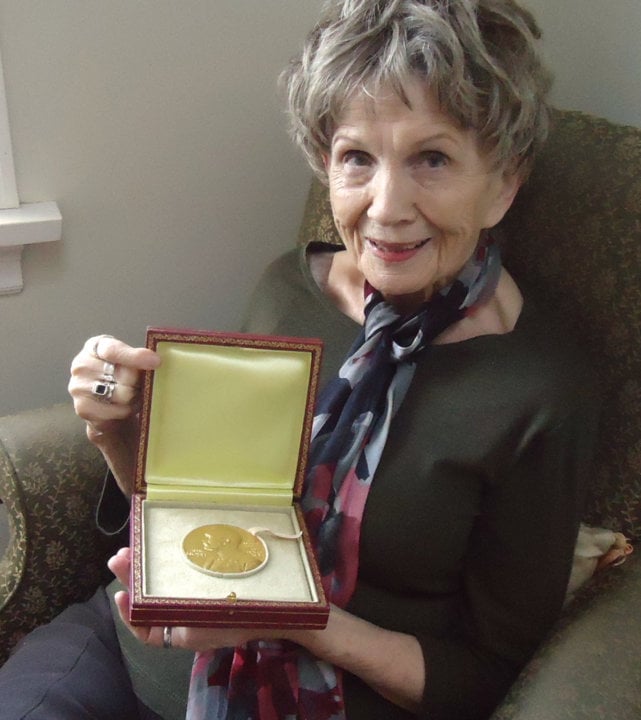
Image context: the cover is Sheila Munro's real photograph of Alice Munro holding the Nobel medal, not a generated portrait or a symbolic still life. Its armchair, window light, and open presentation case place literary prestige back inside the domestic world from which the interview says the work was made.[6]
Watch the Conversation
The video comes from the Nobel Prize's institutional channel. Watch for the way three apparently separate subjects—the rewritten mermaid, the interest of small-town life, and the embarrassment of rereading a draft—gradually disclose one craft principle: a story becomes alive when the writer stops protecting the idea that first produced it.[1][2]
The Mermaid Is a Draft, Not a Destiny
Munro's child-writer changes Andersen because she cannot tolerate the ending. Her mature practice does almost the reverse. She starts with a plot because she needs somewhere to enter, but she does not demand that the finished story preserve the comfort of that entrance. The initial design is permission to begin, not a contract the characters must obey.[2]
This distinction explains why Munro's turns feel less like twists than revisions of reality. A conventional twist withholds a fact and then reveals it. A Munro story often changes the weight of facts already present: an old choice becomes legible in a new moral weather; a remembered encounter may be part fact, part self-protection; an apparently minor person acquires an interior claim the opening did not grant. The story has not cheated. It has learned more than its first arrangement knew.
Her 1994 Paris Review interview makes the method tangible. Munro describes rereading “Carried Away” after publication, finding a small but important paragraph unsatisfactory, and rewriting it by hand in the anthology's margin before the story appeared in book form. She also admits that late revision can become obtrusive once a writer has lost the story's rhythm.[3] Revision is therefore not a ritual of polishing every sentence until it shines. It is judgment under uncertainty: knowing a passage is not doing enough, while recognizing that anxious improvement can make it do too much.
“Any Life” Does Not Mean Generic Life
When Åsberg asks what is interesting about small-town Canadian life, Munro answers that “any life can be interesting.”[2] The sentence is easy to flatten into encouragement. The interview gives it sharper edges. Her Ontario was not an empty backdrop waiting for universal themes. It supplied class embarrassment, gendered divisions of work, long roads, houses with social histories, women who read, and neighbors alert to anyone who appeared to think too much of herself.[2][4]
The Carried Away excerpt included in the Nobel program shows what this attention looks like on the page. Before a wartime letter can become romance, Munro fixes Louisa in the Commercial Hotel dining room among steak and potatoes, oilcloth mats, coal fumes, gravy, a widowed dentist, and a library address.[2] Those details do more than authenticate a period setting. They establish a whole economy of appetite, respectability, work, and loneliness. The stranger's letter enters a world that already has pressure in it.
This is the useful correction to the phrase “write what you know.” Munro does not treat familiarity as authority. She treats it as material dense enough to resist summary. Her return to Huron County in the 1970s intensified the physical precision of her fiction, while her publication history shows repeated restructuring at the level of stories and whole books.[4] Ordinary places become inexhaustible only when the writer refuses to use “ordinary” as another word for simple.
The Bad Draft Is the Moment of Contact
The interview's least glamorous passage may be its best craft lesson. Munro describes the rhythm of making a story: early excitement, a period when the work seems sound, then the morning when it looks like nonsense. Her response is neither mystical nor punitive. If the story is bad, she says, that is the writer's fault, “not the story's fault.”[2]
That phrasing moves failure away from identity. A weak draft does not prove that the writer lacks a gift, and it does not prove that the material is dead. It indicates that characters have not been given their chance, the prose may be disguising uncertainty, or the writer has not yet found what the story is about. Munro mentions learning to remove flowery language, but subtraction is only one tool. The deeper task is to stop forcing the work to remain the object that generated the initial excitement.[2]
The archival record supports this less romantic picture. The Nobel biographical account describes the Alice Munro Fonds as draft after draft, changed beginning after changed beginning, and revised endings followed by further revised endings.[4] The video is valuable because her plain speech makes that persistence audible without turning it into productivity theater. She wrote around household labor and children, but she does not offer interruption as a charming secret to efficiency. She offers recurrence: return to the pages, discover the new wrongness, work again.
The Reader's Reward Is Change, Not Reassurance
The opening mermaid anecdote makes happiness sound like the child's measure of a successful story. By the end of the interview, Munro has abandoned that measure. She says she wants the writing to move readers so that they are “a different person when you finish.”[2] A rewarding story need not reward its characters, settle its argument, or confirm what the reader brought to it.
This aim clarifies the apparent plainness of her prose. Ease at sentence level allows instability to arrive without a warning label. A letter can become an attachment, an absence, a historical trace, or evidence of what someone needed to imagine. A local room can widen across decades. The plot can appear to resolve, then continue long enough to change the meaning of its resolution. Munro's reader is altered not by a lesson placed above the story but by having occupied several incompatible understandings in sequence.
The video itself performs a quieter version of that effect. Åsberg's questions invite a familiar laureate narrative: gifted child, regional inspiration, perseverance, recognition. Munro repeatedly makes the sequence less clean. Confidence gives way to doubt; plots wander; domestic constraints coexist with consuming work; old books remain vulnerable to the urge to change them. The interview does not present mastery as certainty. It presents mastery as a durable capacity to become uncertain at the right stage.
The Boundary This Interview Cannot Cross
No viewing of Munro now should treat the Nobel setting as a certificate of moral authority. In 2024, Andrea Robin Skinner's public account and Rachel Aviv's later reconstruction established a devastating reception context: Munro's second husband, Gerald Fremlin, sexually abused Skinner as a child; he pleaded guilty to indecent assault in 2005; and Munro, after learning of the abuse, remained with him.[5] That record changes what responsible readers can grant the genial, self-effacing speaker on screen.
It does not make every story a coded confession, and it does not make formal analysis an acquittal. Those are opposite versions of the same mistake: asking literature to collapse a difficult record into one total explanation. The interview remains strong evidence about how Munro understood plot, place, revision, and readerly change. It is not sufficient evidence about the truths she accepted or refused in life. Reading after 2024 requires holding both facts without using either to erase the other.[3][4][5]
That boundary finally sharpens the annotated viewing. The reason to watch is not to recover an innocent literary idol. It is to observe a major writer describe the machinery of her art, then test that self-description against drafts, stories, publication history, and the public record. Munro's central craft lesson survives the test in a chastened form: a first plot is never the whole story, ordinary surfaces can conceal decisive pressures, and revision begins when the arrangement that pleased us no longer deserves protection.
Sources
- Nobel Prize, “Alice Munro, In Her Own Words: 2013 Nobel Prize in Literature,” official YouTube video.
- Nobel Prize, “Alice Munro — Nobel Lecture,” official interview transcript, recording provenance, and the Carried Away excerpt used in the December 7, 2013 program.
- Jeanne McCulloch and Mona Simpson, “Alice Munro, The Art of Fiction No. 137,” The Paris Review, Issue 131 (Summer 1994).
- Robert Thacker, “Alice Munro — Biographical,” NobelPrize.org (2013), on Huron County, publication history, restructuring, and the Alice Munro Fonds.
- Rachel Aviv, “Alice Munro's Passive Voice,” The New Yorker (December 23, 2024), reporting on Andrea Robin Skinner, Gerald Fremlin's guilty plea, family silence, and the changed reception of Munro's work.
- Nobel Prize, “Alice Munro — Photo Gallery,” source page and credit for Sheila Munro's photograph of Alice Munro with her Nobel medal.