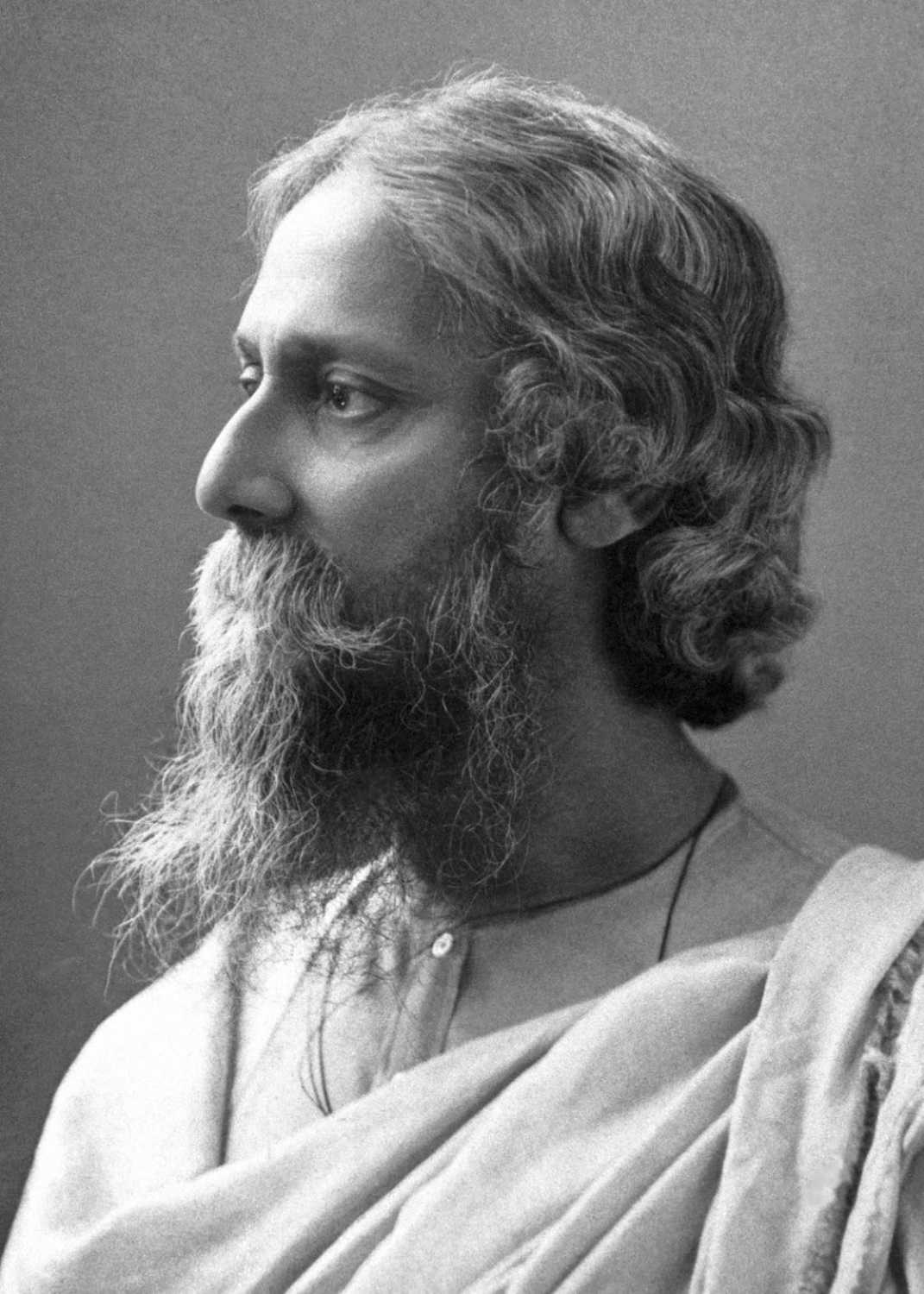
Rabindranath Tagore's thirty-fifth poem in Gitanjali is easy to quote badly. It has the polished outline of a civic prayer. It gives readers phrases that can be lifted onto speeches, classroom walls, and national commemorations. But the passage is stranger and more demanding than a noble caption. Its power comes from the way it delays its main verb. The poem does not begin by announcing a free country. It begins by testing what kind of mental, social, and moral weather would make freedom possible at all.[1]
That delay matters. Tagore's English Gitanjali, available through Project Gutenberg with W. B. Yeats's introduction, became the book through which many Anglophone readers first encountered him; the Nobel Prize made that global recognition official when Tagore received the 1913 literature award.[1][2] Yet poem 35 does not feel like a poet stepping onto a monument. It feels like a sentence trying to build the conditions under which a country could deserve its own awakening.
The most famous phrase, "mind is without fear," is only the first condition.[1] The poem then keeps adding clauses, each one exposing a different way unfreedom hides inside daily life. Fear is not merely police violence or colonial force, though the poem's historical horizon makes those pressures hard to miss. Fear is also intellectual crouching, social division, verbal caution, mechanical obedience, and the habit of letting inherited walls decide what thought may reach.
A Prayer Made Out Of Conditions
The poem's grammar is its argument. It does not say, Let my country be proud, strong, pure, victorious, or restored. It says, first, imagine a place where knowledge is free, where speech comes from truth, where striving does not stop at a private success, where reason has not dried up into ritualized habit, and where action keeps widening rather than narrowing.[1]
This makes the poem feel less like patriotic uplift than like a diagnostic checklist for civic life. A country can have flags, schools, courts, newspapers, songs, and borders while still failing the poem's tests. If knowledge is hoarded, the country is not awake. If speech is clever but false, it is not awake. If reason exists only as ornament while "dead habit" directs behavior, it is not awake.[1] Freedom, in this poem, is not a status conferred from outside. It is a practiced condition of the mind and public world.
The passage is also careful about scale. It moves from the inward life of the mind to the collective life of a country without making one swallow the other. Fear begins in the person, but it is sustained by institutions and customs. Knowledge may be individual, but the poem insists that it must be publicly available. Speech may come from a mouth, but its truthfulness depends on whether a society rewards frankness or punishes it. Tagore's sentence keeps crossing the boundary between self and nation because the poem's freedom requires both to change together.
The Walls Are Domestic Before They Are Political
One of the poem's sharpest moves is to place division inside the household word. The "narrow domestic walls" are not only national borders or formal caste lines.[1] The phrase brings enclosure down to rooms, kinship habits, inherited pride, and private codes of belonging. It suggests that the country may be broken before politics names the break. A people can live close together and still divide the world into tiny compartments of class, sect, language, region, gender, and family honor.
That is why the line does not read as a vague plea for unity. It identifies a social architecture. Narrowness is built, maintained, and normalized. Domesticity can be warm, but it can also become the first school of exclusion. Tagore's phrasing is potent because it refuses to let public freedom excuse private confinement. A country that wants to wake must examine the small walls it teaches people to love.
The biographical context does not replace the poem, but it helps clarify why this pressure feels so alive. The Nobel biographical essay presents Tagore as a Bengali poet, educator, and cultural figure whose work crossed lyric, song, fiction, drama, and public thought.[3] That breadth matters here. Poem 35 is not simply literary ornament attached to political aspiration. It is the work of a writer who understood education, language, art, and social imagination as connected disciplines.
Reason Has To Stay Liquid
The poem's most beautiful intellectual image is also its most severe. Reason is not treated as a possession one can store safely. It is a stream that must keep moving. Its enemy is not emotion; its enemy is the dry ground of dead habit.[1] That distinction prevents the poem from becoming a thin rationalist sermon. Tagore is not asking for a society without song, tenderness, devotion, or inherited memory. He is asking that inheritance not become a desert where thought no longer flows.
This is where the passage becomes especially modern. Many societies praise reason while rewarding rote performance. They build exams, offices, slogans, and procedures that look rational from a distance but punish living judgment up close. Tagore's image catches that danger. Reason can be honored in name and still die in practice if custom directs every channel.
The phrase "ever-widening thought and action" keeps the poem from resting in private enlightenment.[1] Thought must widen, but so must action. A mind that sees more and does nothing is incomplete. An activism that moves without wider thought risks becoming another habit. The poem wants the two to enlarge one another: attention into conduct, conduct into further attention.
The Last Verb Refuses Completion
The ending is often remembered for its upward music, but its grammar is not triumphant. The poem's final request is "let my country awake."[1] That verb matters because it leaves the desired country in a state of not-yet. The poem does not claim that freedom has arrived. It asks to be led into the "heaven of freedom," which means the poem is still speaking from outside it.[1]
That not-yet quality is why the passage survives being quoted so often. It does not flatter the reader with easy belonging. Every generation that recites it has to ask whether the conditions have been met. Is knowledge free enough? Is speech truthful enough? Are the walls still narrow? Has reason stayed alive? Have thought and action widened together, or merely changed costume?
The Nobel facts page frames Tagore's international recognition around the freshness and artistry of his poetic thought in his own English rendering.[2] Poem 35 shows why that mattered. The English is simple, but not simple-minded. It creates elevation through syntax, not decoration. The sentence opens space after space, then withholds fulfillment until the final plea. The reader is carried forward by promise and made responsible by incompletion.
So the poem's afterlife as a civic quotation is not a misuse, exactly. It is a risk. The passage can become a banner and lose its questions. Read closely, though, it remains an instrument of unease. Tagore does not ask for freedom as a slogan to admire. He asks for a country awake enough to sustain fearless thought, public knowledge, truthful speech, mobile reason, and widening action. The poem is famous because it sounds like a prayer. It endures because it behaves like an audit.
Sources
- Rabindranath Tagore, Gitanjali, Project Gutenberg ebook 7164 - public-domain English text and W. B. Yeats introduction used for the passage reading.
- Nobel Prize, "The Nobel Prize in Literature 1913" - award facts and official context for Tagore's international recognition.
- Nobel Prize, "Rabindranath Tagore - Biographical" - life, literary range, and public context.
- Wikimedia Commons, "File:Rabindranath Tagore in 1909.jpg" - source page for the archival photographic portrait used as the article image.