Pushkin's The Bronze Horseman is often introduced through a clean opposition: Peter the Great builds St. Petersburg; the little clerk Yevgeny is broken by the city's flood; the imperial statue comes alive as nightmare.[1][2] That summary is useful, but it makes the poem sound more schematic than it feels. The real pressure comes from a chain of symbols that will not stay in their assigned places. A city that begins as design becomes weather. A flood that seems like nature becomes historical memory. A statue that should stand still becomes motion, judgment, and pursuit.
That is why a motif map suits the poem better than a plot recap. Written in 1833 and published after Pushkin's death in 1837, The Bronze Horseman is one of the densest meditations in Russian literature on what happens when state ambition and ordinary life occupy the same ground.[1][2][3] Britannica compresses the problem as the "little man" whose happiness is destroyed by a great leader's ambition.[1] The poem's artistry lies in making that abstract problem visible through recurring objects and forces: shore, granite, Neva, city, home, monument, hoofbeat.
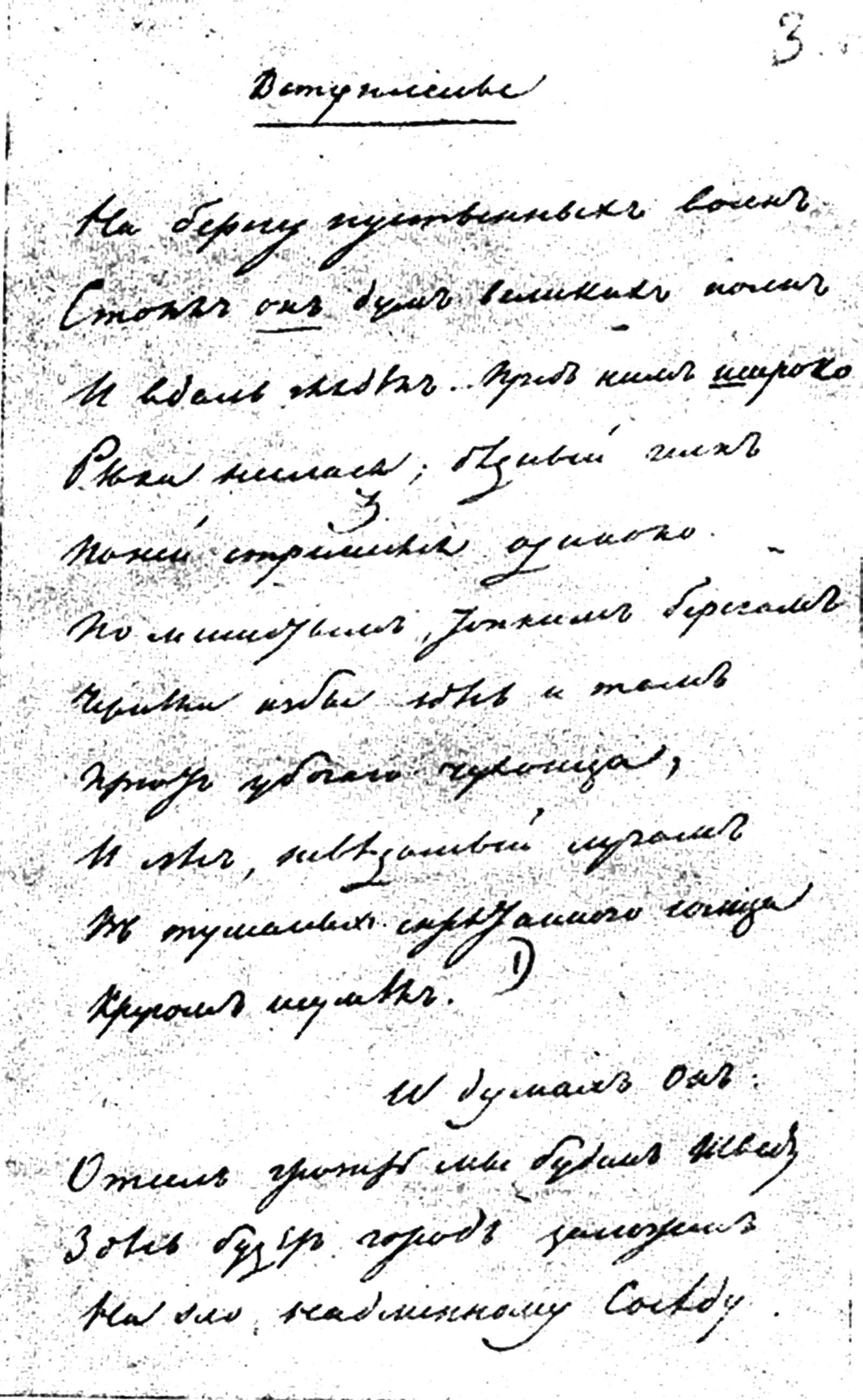
Image context: the cover uses a real photographic scan of Pushkin's manuscript opening, not an illustration or generated visual. The choice is deliberately documentary. It keeps the article close to the poem's material origin: a handwritten page where Peter first stands by the Neva, already imagining a city into existence.[5]
The City: Order Built On Wet Ground
The poem opens with a founding gesture. Peter stands by an empty, wave-beaten shore, looks outward, and imagines a city that will face Europe, command the Baltic, and outshine old Moscow.[3][4] In the translation and analysis gathered by Ocaso Press, the opening's Russian stresses keep returning to spatial pressure: shore, river, skiff, mossy banks, low huts, forest, fog.[3] Before St. Petersburg is a capital, it is a difficult physical site.
That matters because the city motif never loses its swamp memory. Pushkin can praise Petersburg with real intensity: its strict lines, granite embankments, iron railings, bright northern nights, military parades, and Admiralty spire.[3] The poem loves the city as form. It sees discipline, rhythm, and splendor in the built environment. But the praise is unstable because every hard surface is also an answer to water. Granite is not just decoration; it is restraint. Bridges are not just civic convenience; they are a bargain with channels, islands, and flood risk.
So the city becomes the poem's first double sign. On one side it is Peter's triumph: a planned capital raised against local softness and old geography. On the other it is a wager that the materials of order can permanently govern the materials of instability. The poem never lets the reader forget that St. Petersburg's beauty depends on pressure against the Neva. Its elegance is hydraulic before it is architectural.[1][3]
That is the first key to Yevgeny's story. He does not live in an abstract empire. He lives in an urban system whose grandeur has consequences at the scale of housing, routes, wages, bridges, and neighborhoods. His dream is modest: marriage, a household, a future with Parasha.[2][4] Against Peter's city of destiny, Yevgeny's desired city is tiny and domestic. Pushkin makes both cities occupy the same map.
The Flood: Nature Returns As History
The flood of 1824 is not a random disaster pasted into the poem for melodrama. It is the moment when the suppressed material under the city's design returns to the surface.[2][3] Water crosses boundaries that stone and rank had tried to stabilize. Streets, houses, and social arrangements become vulnerable together. The Neva stops behaving as an imperial river and becomes force.
The Encyclopedia.com overview is useful here because it stresses the poem's later publication history, censorship, and the long critical attention to its conflict between private life and state power.[4] The flood is where that conflict becomes physical. It does not argue against Peter in political prose. It climbs stairs, breaks dwellings, carries off homes, and leaves Yevgeny unable to translate his private loss into any institution's language.[2][4]
Pushkin's flood is frightening because it attacks scale. The city was built to appear large: palaces, towers, embankments, military spectacle. Yevgeny's life is small, and the poem initially lets that smallness seem almost fragile enough to miss. Then the flood shows that smallness is exactly where historical ambition is felt most cruelly. A capital can survive an inundation and remain a symbol. A poor man's future cannot be rebuilt so easily.
This is why the flood motif is not anti-city in a simple sense. Pushkin is too alert to Petersburg's beauty for that. The flood does something sharper: it reveals that the city's heroic form has an unpaid material debt. The Neva had been dressed in granite, but it had not been abolished. The founding scene's nature problem returns as Yevgeny's life problem.
The Statue: Stillness Learns To Chase
The Bronze Horseman itself gathers the poem's symbolic pressures into one terrifying object. A statue normally fixes power. It turns a ruler into public metal, a gesture into civic permanence, a horse into mastered energy. In Pushkin's poem, that fixity fails. Yevgeny confronts the monument, threatens Peter in a burst of mad clarity, and then hears pursuit.[1][2]
That transformation is the poem's most famous uncanny turn, but it only works because the statue has been prepared as more than scenery. Peter's founding vision at the start and Falconet's monument at the end are linked by the same question: what kind of will can place a city where water, weather, and ordinary lives resist it? The statue is not only Peter remembered. It is Peter's project compressed into a body: rider, horse, lifted hoof, forward command.
When it seems to chase Yevgeny, the poem does not simply switch genres into Gothic hallucination. It makes imperial abstraction move at human speed. A historical decision that once looked distant now sounds behind one frightened man. The hoofbeats convert policy into panic. They make state scale audible in a street.
That is why the title belongs to the statue rather than to Yevgeny or the flood. The monument is the place where the poem's motifs cross. It is made of metal but charged with motion; public but experienced privately; commemorative but threatening; heroic from one angle and monstrous from another. It also refuses neat moral sorting. Pushkin does not make Peter merely wicked. He makes Peter immense. The danger of immensity is the point.
The Map The Motifs Draw
Put together, the city, flood, and statue create a three-part symbolic machine. The city says: design can impose order on nature. The flood answers: nature and history can return through the foundations. The statue says: the will behind design may outlive the ruler and pursue the people who suffer from it.
That machine is why The Bronze Horseman remains more disturbing than a simple anti-imperial parable or a simple praise poem for Petersburg. Pushkin keeps both registers alive. The city is beautiful. The flood is real. Peter is visionary. Yevgeny is crushed. The statue is glorious in public memory and terrifying in private experience.[1][3][4]
The poem's manuscript image helps make that doubleness concrete.[5] On the page, the opening still looks delicate: ink strokes, revisions, a hand making lines. Yet those lines call up one of the most durable symbolic cities in literature. The manuscript is small; the city is vast. That is also the poem's moral scale. Private marks can build public monuments. Public monuments can press back on private lives.
Read this way, The Bronze Horseman is not only a story about a poor clerk and a flood. It is a study in what symbols do after they enter civic life. A capital can become a dream of national destiny. A river can become the memory of everything the dream tried to master. A statue can become the sound of authority refusing to stay still. Pushkin's greatness is that he lets all three remain true at once, so that Petersburg appears not as backdrop, but as a weather system of power.
Sources
- Encyclopaedia Britannica, "The Bronze Horseman" - work overview, publication note, and the "little man" conflict.
- Encyclopaedia Britannica, "Aleksandr Pushkin: Return from exile" - narrative account of the poem's flood, Yevgeny, and Peter's statue.
- Ocaso Press, "Translating The Bronze Horseman by Pushkin" - Russian opening lines, structural overview, translation discussion, and full English rendering.
- Encyclopedia.com, "The Bronze Horseman" - educational overview covering publication history, censorship, and interpretive context.
- Wikimedia Commons, "File:MednyiVsadnik-vstuplenie.jpg" - photographic scan of the opening manuscript page of Pushkin's The Bronze Horseman.