Franz Kafka’s The Trial is often summarized as a plot machine: Josef K. is arrested without explanation, enters a legal labyrinth, and is slowly broken by processes he cannot fully see. That summary is accurate, but it still underestimates where the novel’s force comes from. Kafka’s deepest pressure is stylistic. The prose does not scream. It remains formally calm while causality is withdrawn, and that mismatch is exactly what makes the book feel airless a century later.[1][2][3]
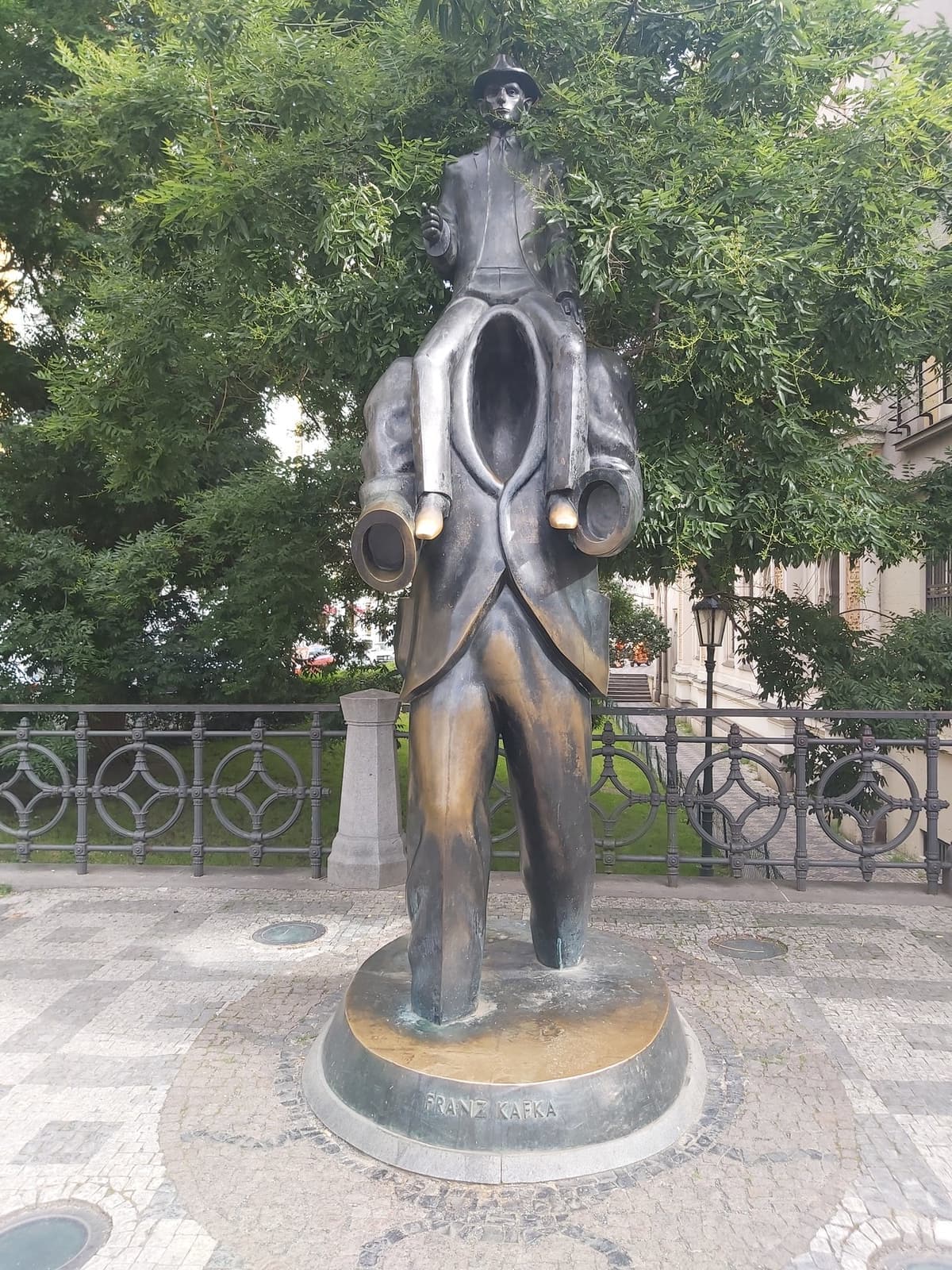
The lead image, a contemporary photograph of the Kafka monument in Prague, underlines the article’s central point: in The Trial, architecture and voice work together. Corridors, stairwells, offices, and attics are not neutral settings; they become extensions of sentence logic.
1) The opening line installs a logic of ordinary catastrophe
“Someone must have been telling lies about Josef K., he knew he had done nothing wrong but, one morning, he was arrested.”[1]
This first sentence is one of modern fiction’s most efficient stylistic traps. It offers three things at once: accusation, denial, and event. But it withholds the only thing readers expect from legal language—grounds. The sentence is grammatically stable and narratively unstable. That asymmetry becomes the novel’s governing contract.
Notice the tonal choice: Kafka does not launch with gothic thunder. He uses a plain declarative register, almost administrative in surface rhythm. The effect is terrifying because the line sounds like a report while behaving like an enigma.
2) Bureaucratic dialogue as acoustic design
A lot of the novel’s dread comes from talk that refuses to resolve into information. Officials, warders, assistants, advocates, and minor clerks all speak in procedural fragments: instructions without authority mapping, warnings without legal basis, reassurance without relief.
This dialogue pattern matters stylistically. Each exchange seems locally coherent—someone is always explaining something—but globally incoherent. Readers keep receiving language that has syntax yet lacks orientation. That is the acoustic structure of Kafkaesque pressure.[2][3]
In practical terms, Kafka turns bureaucracy into a genre of voice. The law in The Trial is never presented as a single doctrine. It appears as distributed utterance: half-rules, rumors, etiquette cues, and institutional mood. Speech itself becomes infrastructure.
3) Narrative distance keeps shrinking and sliding
Kafka’s third-person narration around Josef K. is deceptively tight. We often feel close enough to his irritation, pride, and tactical self-justifications that we read events through his urgency. Yet the text repeatedly creates tiny slips in distance—small moments where K.’s confidence is exposed as miscalibration.
That sliding distance is crucial. If narration were fully objective, the book would read like a social case study. If it were fully interior, it might become private paranoia. Kafka chooses an unstable middle distance that lets institutional absurdity and personal self-deception appear together in the same scene.
This is why many chapters feel like a controlled suffocation rather than a mystery to be solved. The narrative camera does not grant us enough altitude to master the system, but it gives us enough proximity to feel each tactical mistake in real time.
4) Space behaves like syntax
Readers usually discuss The Trial as a legal or philosophical novel, but its style is also deeply spatial. Rooms are overfull, offices are hard to find, hearings occur in domestic spaces, and pathways seem to promise orientation before folding into further confusion.[1][3]
Kafka writes these environments with an almost clerkly precision: doors, passages, stair turns, waiting areas, neighboring tenants. The details are concrete, but their arrangement denies stable mapping. The result mirrors the sentence-level logic of the book: clear local units, obscured global order.
Put simply, Kafka does with architecture what he does with dialogue. He gives readers procedural texture without procedural sovereignty.
5) Why the style still reads as contemporary
The afterlife of The Trial is often reduced to one adjective—Kafkaesque. But that label only helps if we keep the stylistic engine in view. The novel still feels modern because it models a condition familiar to contemporary institutional life: complete exposure to process with incomplete access to explanation.
Kafka achieves that not by maximal ornament but by disciplined restraint.
- Declarative calm under epistemic stress (events happen, reasons recede).
- Speech saturation without informational closure (many voices, little jurisdictional clarity).
- Procedural motion without destination confidence (movement through systems that never stabilize).
That triad is the article’s main claim. The Trial endures because its voice teaches readers how power can sound ordinary while remaining fundamentally unreadable.[1][2][3][4]
Sources
- Project Gutenberg, Franz Kafka, The Trial (full text)
- Encyclopaedia Britannica, “Franz Kafka”
- Encyclopaedia Britannica, “The Trial”
- Wikipedia, “The Trial” (publication and compositional context)
- Image source (Wikimedia Commons, “Franz Kafka monument, Prague, June 2024”)