Most writers age through plot. George Eliot ages through voice.
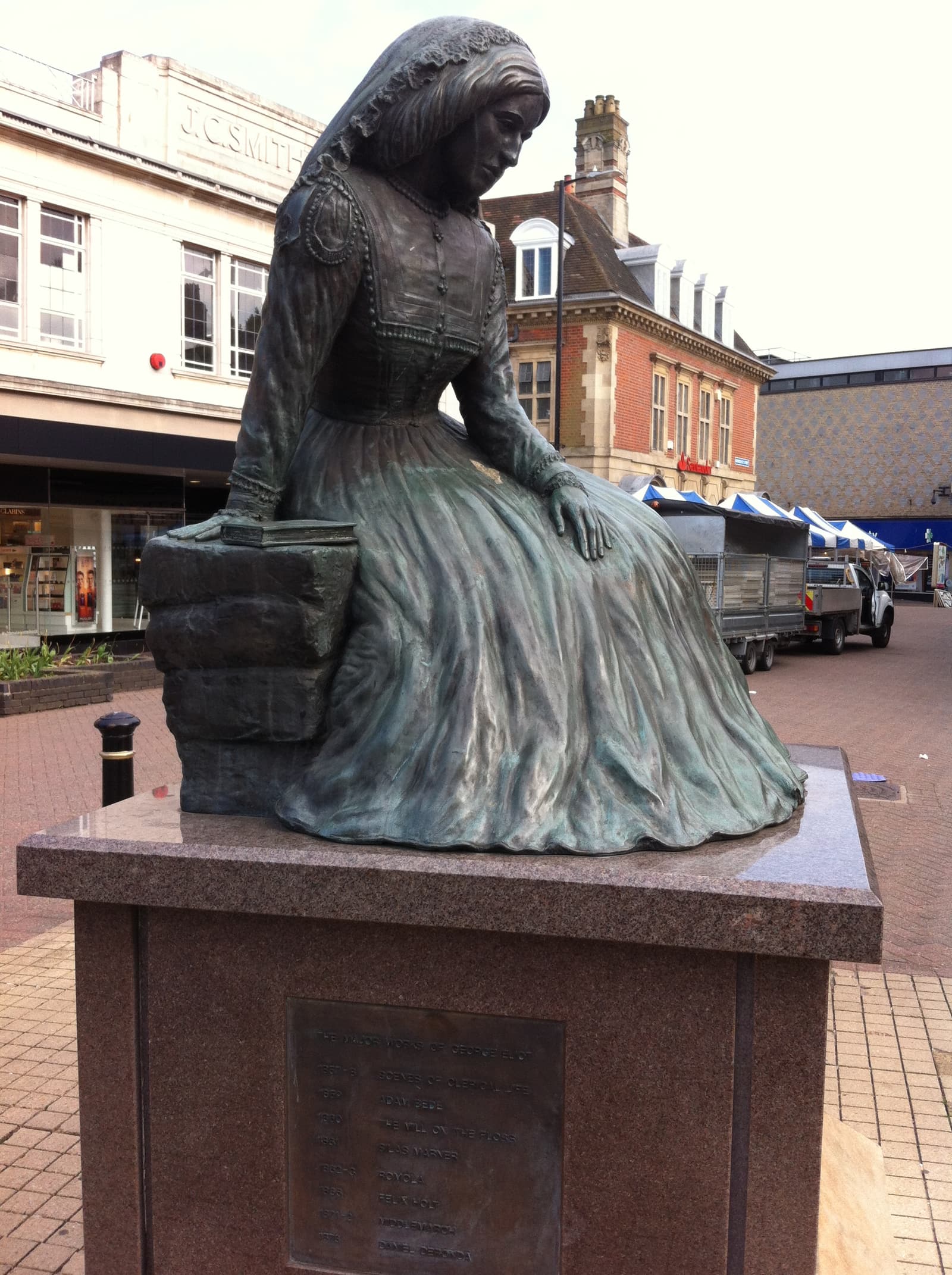
The lead image matters as context, not decoration: Eliot’s Coventry statue marks how a once-controversial novelist became a civic memory object, which mirrors this essay’s focus on career-long method rather than biography gossip.[7]
You can feel this most clearly in Middlemarch (1871–72), where the narratorial intelligence does something still hard to imitate: it judges without flattening, and sympathizes without becoming sentimental. The novel’s social field is provincial, but its perceptual range is huge. Eliot can move from Dorothea’s inward hunger to municipal politics, from marital disappointment to medical reform, without sounding like she has switched books.
This is why a George Eliot author profile is best done through the work rather than through biographical myth. The biography matters, of course—Mary Ann Evans, pseudonym, scandal, editorial life, philosophical reading—but her lasting force comes from the method she built across novels and then concentrated in Middlemarch: moral attention at sentence level.
The career shape behind the “Middlemarch effect”
Britannica’s timeline reminder is useful: major fiction arrives in a tight stretch—Adam Bede (1859), The Mill on the Floss (1860), Silas Marner (1861), then later Middlemarch (serialized 1871–72) and Daniel Deronda (1876).[3][4] That arc matters because Eliot’s signature is cumulative rather than sudden.
In the early novels, she is already testing a problem she never abandons: what happens when a morally serious person lives inside social forms that are too small for their ethical ambition? By Middlemarch, that question is no longer confined to one protagonist. It becomes a full-system novel, where clerical vanity, property law, debt, reputation, and reformist aspiration all shape what a person can become.
So if you ask why Eliot still feels modern, one answer is structural: she writes character as a function of institutions without reducing character to institutions.
Voice as method: the narrator who refuses cheap certainty
The most quoted line in Eliot criticism may be the famous passage:
“If we had a keen vision and feeling of all ordinary human life, it would be like hearing the grass grow and the squirrel’s heart beat, and we should die of that roar which lies on the other side of silence.”[2]
Readers often treat this as lyrical ornament. It is actually craft doctrine.
Eliot’s narrator repeatedly insists that ordinary life is cognitively overwhelming, and that judgment therefore has to be provisional, revisable, and relational. She does not deny error—Dorothea misjudges Casaubon, Lydgate misjudges Rosamond, almost everyone misjudges someone. But she keeps widening the explanatory frame before delivering verdict. That order is her great technical choice: context first, condemnation last.
In current terms, we might call this anti-performative intelligence. The prose does not perform omniscience as domination; it performs attention as discipline.
Why Dorothea is the profile’s center—even when Eliot writes an ensemble
The Prelude’s Saint Theresa motif gives the key in advance: many people with spiritual or ethical grandeur will find no historical stage proportionate to their aspiration.[2] Eliot then tests that proposition through Dorothea’s marriage mistake, her humiliations, and her eventual re-scaling of what “a large life” can mean.
Crucially, Eliot refuses two easier stories:
- She does not let Dorothea become a pure martyr icon.
- She does not give her a triumphalist emancipation arc.
Instead, she gives her a life in gradients—desire, error, recalibration, action inside limits. That is much closer to modern psychological realism than to Victorian moral fable.
The ending line about “the growing good of the world” and “unhistoric acts” is often cited as consolation.[2] It reads more sharply if we place it in Eliot’s career logic: she is revising the scale on which significance is measured. Public monument is one register; ethical diffusion through everyday conduct is another. Eliot asks readers to take the second seriously without pretending it is glamorous.
Work-centered profile: three durable Eliot competencies
1) She fuses philosophical seriousness with novelistic tact
The Stanford Encyclopedia entry is helpful here: Eliot’s sustained concerns include ethics, aesthetics, and their relation, shaped by engagement with Spinozist and Romantic traditions.[5] But in fiction she rarely lectures in abstract terms for long. Instead, she operationalizes ideas through social pressure scenes: inheritance anxiety, professional aspiration, marriage bargaining, provincial gossip.
In other words, thought appears as lived friction, not just as declared doctrine.
2) She treats institutions as emotional weather
In weaker social novels, institutions appear as backdrop paragraphs. In Eliot, institutions are atmospheric: they change what people can imagine, fear, and dare. Reform politics in Middlemarch is not “context”; it is one of the forces that modulate intimacy and self-interpretation.
That is why her novels remain useful to contemporary readers who care about systems: she shows how macro arrangements become micro emotions.
3) She writes sympathy as an achieved practice, not a default virtue
Eliot never assumes empathy is automatic. Her characters are frequently vain, myopic, self-justifying. Sympathy appears when someone labors to re-see another person against their own convenience. The narrator models that labor formally by revisiting scenes from shifted vantage points.
This is one reason Eliot feels less dated than many canonical contemporaries: she is not staging moral identities; she is staging moral work.
Reception and afterlife: why the canon keeps returning to Eliot
Middlemarch has had unusually durable critical authority, repeatedly treated as a peak English novel in both academic and public-facing rankings.[4][6] That persistence is not just prestige inertia. Eliot helps solve a recurring reader problem: how to think ethically without collapsing into either cynicism or sermon.
Her answer is a difficult middle register—ironic but not sneering, principled but not puritanical, intimate without anti-political blindness. In a media environment that rewards immediate judgment, Eliot’s delayed, layered judgment feels newly instructive.
A practical way to read her now is not to start with “greatness” claims, but with craft observation:
- Watch how often a chapter pivots by reframing motive rather than by adding event.
- Track where the narrator withholds condemnation until institutional context is visible.
- Notice how endings redistribute significance from spectacle to ordinary consequence.
Do that, and the supposedly “Victorian” texture reads less like distance and more like method.
Why this author profile still matters
George Eliot’s long-term contribution is not merely that she wrote one masterpiece. It is that she built a prose ethics that still challenges contemporary reading habits.
She asks us to treat intelligence as attention, not speed. She asks us to treat moral life as iterative, not declarative. She asks us to treat ordinary lives as historically consequential even when no monument records them.
That is why Middlemarch keeps surviving each new cycle of literary fashion: it is not just a book about a town. It is a model for how to see other people without lying about power, vanity, or failure.
Sources
- Project Gutenberg ebook page, Middlemarch
- Project Gutenberg full text, Middlemarch
- Encyclopaedia Britannica, “George Eliot”
- Encyclopaedia Britannica, “Middlemarch”
- Stanford Encyclopedia of Philosophy, “George Eliot”
- BBC Culture, “The 100 greatest British novels”
- Wikimedia Commons image file page (lead image provenance)