
Jhumpa Lahiri's move into Italian can look, from a distance, like a biographical curiosity: a Pulitzer-winning English-language fiction writer falls in love with another language, moves to Rome, and begins writing across a new threshold. The more interesting version is technical. In the Conversations with Tyler video, recorded live at George Mason University and paired with a full transcript, Lahiri describes language not as a neutral instrument she already owns, but as a room whose unfamiliar proportions change the person writing inside it.[1][2]
That matters because Lahiri's early public reputation was built on a different kind of precision. Interpreter of Maladies won the 2000 Pulitzer Prize for Fiction; The Namesake, Unaccustomed Earth, and The Lowland gave many readers a Lahiri of elegant English sentences, family pressure, migration, marriage, and the half-visible emotional cost of belonging between places.[3] Barnard's profile now describes a wider career: writer, translator, critic, teacher, author in English and Italian, translator of Domenico Starnone, editor of Italian short fiction, and self-translator of Dove mi trovo as Whereabouts.[3]
The video is useful because it catches that widening in spoken form. Lahiri is not making a simple argument for bilingual freedom. She is more exact and less triumphant than that. Writing in Italian gives her permission to be less smooth, less protected by mastery, and less likely to confuse fluency with truth. When she says that in Italian she does not "pretend anymore," the phrase is not a slogan of liberation; it is a craft statement about what happens when a writer steps away from the language in which she has already learned how to sound finished.[2]
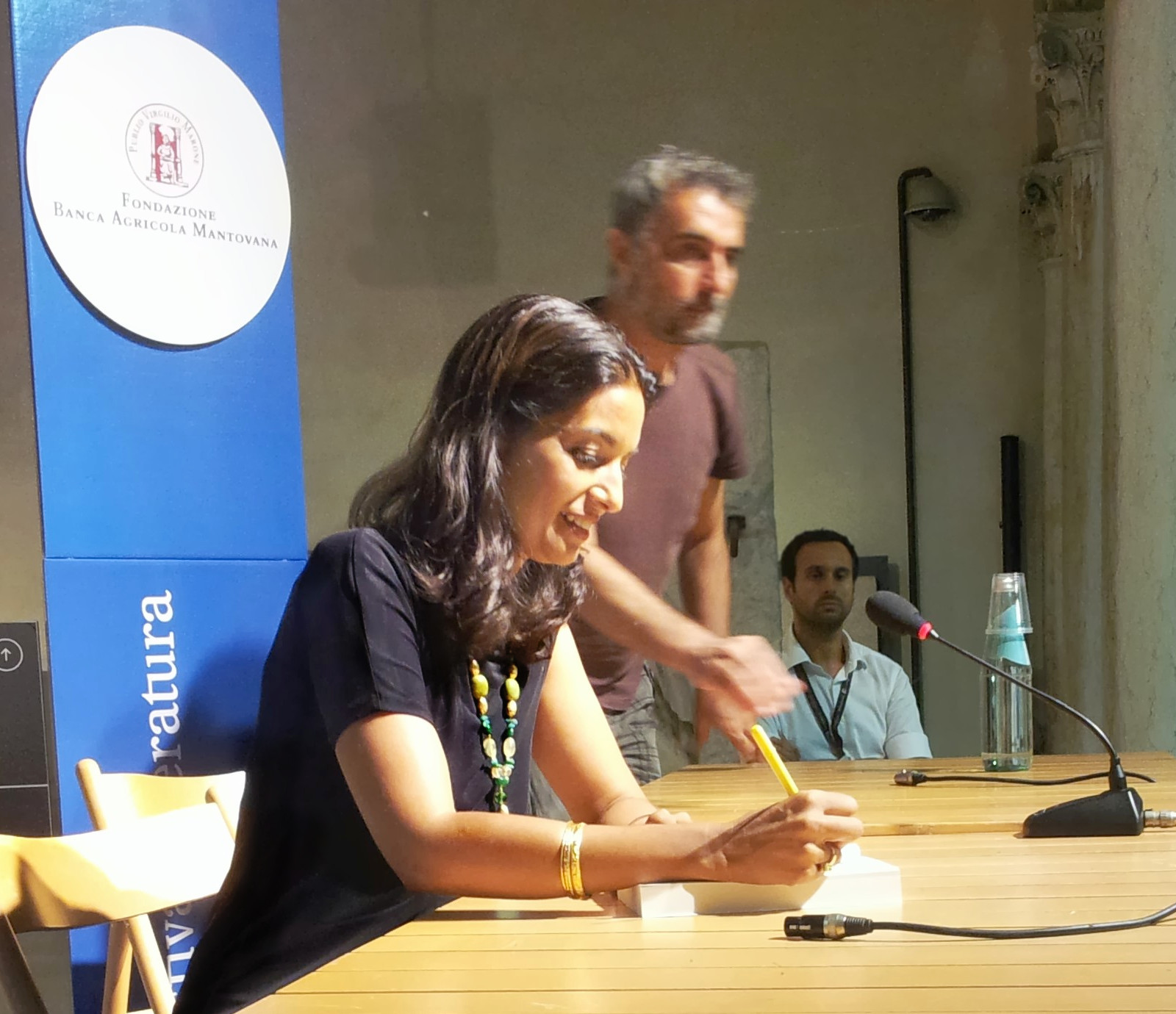
*Image context: the cover photograph shows Lahiri in Mantova in 2013, the year after she had moved to Rome and before the English publication of *In Other Words. It is a situated literary-event photograph, not a decorative quote card or symbolic book stack. The Italian setting matters because this viewing is about language as a chosen place, not merely language as subject matter.[4][7]
The Conversation
The embedded video is the Conversations with Tyler YouTube upload of Lahiri speaking with Tyler Cowen. The episode page supplies the full transcript, which is helpful because Lahiri's answers move between anecdote, reading history, Italian architecture, translation, and the discipline of not over-claiming what a language can do.[1][2]
The first thing to watch for is how often Lahiri treats writing as a problem of spatial arrangement. Early in the conversation she links Rhode Island, imagined New England settings, architecture, and the act of naming place directly. That is not travel memoir atmosphere. It explains something about her fiction's pressure. Rooms, houses, campuses, cities, train lines, kitchens, and thresholds in Lahiri often do more than hold characters; they define what can be said, withheld, misread, or translated between people.[2][3]
Italian changes the room. Penguin Random House's page for In Other Words frames the book as a meditation on learning to express herself in Italian and seeking a new voice.[4] Princeton University Press's page for Translating Myself and Others pushes the development further, describing essays on translation and self-translation, including Lahiri's thinking about Ovid, Aristotle, Gramsci, Calvino, Starnone, and the special difficulty of carrying one's own Italian work back into English.[5] The video sits between those two public accounts. It lets us hear the personal discomfort before it hardens into literary program.
That discomfort is the core. Lahiri describes the Italian project as a form of "voluntary blindness."[2] The metaphor is severe because it refuses the easy romance of mastery. She is not saying another language simply makes her freer. She is saying it makes her less sure, and that less-sureness becomes productive. In English, a writer with Lahiri's command can move so elegantly that style risks becoming a shelter. In Italian, the shelter is not fully built. The sentence has to disclose its labor.
This is why the turn to Italian should not be treated as an abandonment of the earlier fiction. It clarifies a hidden continuity. Interpreter of Maladies and The Namesake were already full of translation problems: names that carry family histories imperfectly, children who hear parental language as intimacy and burden, interpreters who misunderstand what illness is being confessed, and immigrants who inhabit one social script while remembering another.[3][4] Italian makes that condition explicit at the level of Lahiri's own authorship. The writer is no longer only representing divided language. She is choosing to write under division.
The most illuminating portions of the interview are not the resume markers, though the resume is substantial. Barnard records Lahiri's teaching interests in literary translation, exophonic writers, classical reception, Italian literature, and the diary as literary craft.[3] NYPL's archive description, covering papers from 1967 to 2023, likewise treats her career as a long record of creative process, correspondence, drafts, and translation work rather than as one fixed identity.[6] Those institutional frames matter because they show how the Italian turn has become part of the archive, not an eccentric aside next to the "real" novels.
But the video is better than a profile because it keeps the question open. Around the middle of the conversation, Lahiri talks about Italian writers and about partial vision as a point of view.[2] That is the hinge. If partial vision is a defect, then writing in a learned language is a stunt. If partial vision is a point of view, then the defect becomes method. The writer notices edges, substitutions, hesitations, and awkwardness that fluency often polishes away. Translation becomes less like transporting meaning across a bridge and more like discovering that the bridge changes the walker.
That difference helps explain why self-translation matters. Translating another writer asks for humility before someone else's structure. Self-translation adds a stranger problem: the source text is yours, but it no longer belongs to the same self once language changes. Princeton's description of Translating Myself and Others emphasizes metamorphosis, and the word is apt because the translated work does not merely wear a new surface.[5] It sheds habits, gains different stresses, and reveals what the first language had hidden by seeming natural.
For readers, this offers a practical way into Lahiri's later work. Do not ask whether the Italian books are "as good" as the English stories by the same measure. Ask what measure they are trying to alter. In Other Words is not simply a confession of linguistic desire; it is a laboratory for chosen constraint.[4] Whereabouts is not simply an English novel that happened to pass through Italian; it arrives with a different relation to anonymity, city movement, solitude, and first-person observation because it was first made under another language's pressure.[3][5]
The video also complicates the usual immigrant-language story. Lahiri's Bengali inheritance, American education, English-language fame, and Italian adoption do not line up into one clean ladder from origin to achievement. They make a more unstable geometry. Translation is not only the movement from home language to public language, or from foreign literature into English. It is an ongoing disturbance in the idea that any writer owns a single, native, final room. That disturbance has been present in Lahiri's fiction from the beginning; Italian merely gives it a new architecture.
The reason to watch, then, is not to collect authorial explanation for a reading list. It is to hear a major prose stylist think against the comfort of being a major prose stylist. Lahiri's English reputation was built on restraint, exact surfaces, and emotional compression. Her Italian practice risks rougher footing in order to make those virtues answerable to another kind of truth. In the conversation, the risk sounds calm rather than dramatic. That calmness is part of its force.
By the end, translation looks less like a literary service and more like an ethics of renewed attention. A sentence translated by Lahiri has not escaped loss; it has been asked to survive loss with its senses sharpened. A writer moving between languages has not solved displacement; she has made displacement into a working condition. The chosen room is smaller, stranger, and less forgiving than the room of mastery. That is exactly why it lets Lahiri notice what mastery can miss.[2][5][6]
Sources
- Conversations with Tyler, "Jhumpa Lahiri on Writing, Translation, and Crossing Between Cultures," YouTube video.
- Conversations with Tyler, "Jhumpa Lahiri on Writing, Translation, and Crossing Between Cultures" episode page and full transcript.
- Barnard English, "Jhumpa Lahiri," faculty profile with biography, works, teaching areas, and honors.
- Penguin Random House, In Other Words by Jhumpa Lahiri, official book page.
- Princeton University Press, Translating Myself and Others by Jhumpa Lahiri, official book page.
- New York Public Library Archives, "Jhumpa Lahiri papers," collection description, 1967-2023.
- Wikimedia Commons, "File:Jhumpa Lahiri Mantova.jpg," source page for the article photograph.