Sonnet 73 is famous for its three images of decline: autumn branches, late twilight, and a fire burning down into ash. That summary is true, but it makes the poem sound colder than it is. Shakespeare does not simply decorate aging with pretty metaphors. He stages a lesson in attention. The speaker asks the beloved to look at him three times, each time under a different pressure of ending, until love is no longer an abstract feeling but a practiced way of seeing what will not last.[1]
The poem's first phrase, "That time of year," matters because it begins with perception rather than complaint.[1] The speaker does not say, I am old, I am afraid, or pity me. He says, look. The beloved is placed in front of a changing object and asked to recognize its condition. The sonnet's philosophy begins there: love becomes stronger not by denying loss, but by learning how to behold it without turning away.
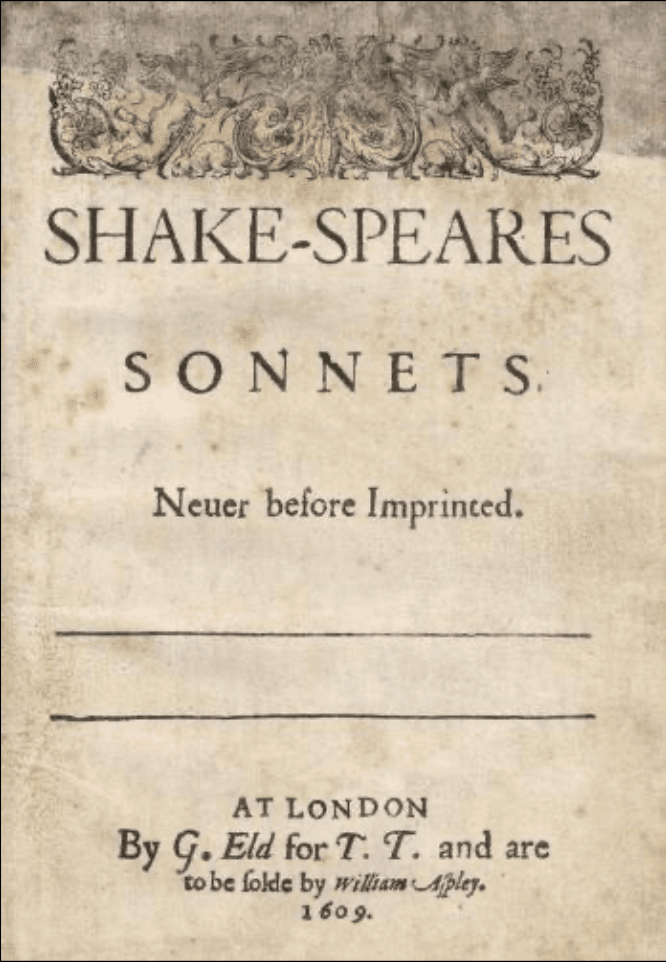
Image context: the cover image is the title page of the 1609 quarto, the first collected printing of Shakespeare's sonnets. Internet Shakespeare Editions preserves the quarto's old-spelling text, and the Folger overview notes that modern editions generally follow that 1609 text as their source.[2][3][4] The title page is not decorative here. It reminds us that this intimate poem reaches us through a small printed artifact built to outlast the body that wrote it.
Three endings before the ending
The architecture of Sonnet 73 is unusually severe. The first quatrain gives the year approaching winter. The second gives the day approaching night. The third gives the fire approaching extinction. Then the couplet turns from image to consequence: what the beloved perceives should make love stronger because the thing loved must be left "ere long."[1]
That structure matters because each image shortens the scale of time. A year narrows to a day; a day narrows to a flame; a flame narrows to the last fuel that consumes itself. The poem does not simply repeat the same lesson three times. It tightens the lesson. The beloved is made to experience mortality first as season, then as evening, then as heat nearly gone.
This is why the poem feels both calm and devastating. There is no dramatic crisis, no deathbed scene, no narrative of betrayal or repentance. Instead, the sonnet converts endings into forms. Autumn is a form. Twilight is a form. Ember is a form. Shakespeare makes mortality bearable to think about by placing it inside patterns the mind can hold.
But form is not consolation by itself. The first twelve lines are not a comforting nature calendar. They are a discipline in scale. The beloved must move from the visible world toward the inward fact that the speaker's life is finite. The images keep changing because no single metaphor can contain that fact.
Autumn is a broken music room
The first quatrain begins with branches, cold, and few or no leaves. Its most startling phrase is "Bare ruined choirs."[1] The image is double. On one level, the bare boughs resemble roofless church spaces. On another, the vanished birds leave behind the memory of singing. The place where music happened is still visible after the music has gone.
That is a more complicated image of aging than simple barrenness. The tree is not merely empty. It is resonant. Its emptiness contains evidence of former life: leaves, birds, song, shelter, movement. The beloved is not asked to see the speaker as nothing, but as a structure in which past vitality can still be read.
This is one reason Sonnet 73 avoids self-pity. The speaker's decline is real, yet the poem gives that decline architectural dignity. The ruined choir is damaged, but it is not trivial. It is still a place of memory. In the old-spelling quarto text, the phrase appears with the texture of early print, its spelling and type reminding us that what we now treat as a smooth lyric once lived as a material page with its own irregularities.[2]
The first quatrain therefore changes what it means to behold age. The beloved must not look for youth where youth is gone. Nor should the beloved reduce absence to mere loss. The right act of seeing is historical. To love the speaker now is to see the late form and the earlier music together.
Twilight teaches delay
The second quatrain shifts from year to day. The speaker is now visible as late light, the moment after sunset when the west still holds some color but night is already advancing. Shakespeare calls night "Death's second self," a phrase that makes sleep, darkness, and extinction overlap without making them identical.[1]
This image changes the emotional temperature. Autumn can be contemplated at a distance; twilight feels closer. A season may take weeks to finish, but evening is already in motion while we watch it. The beloved is not only looking at decline after the fact. The beloved is watching a process that cannot be paused.
Yet the poem does not rush. Its syntax lets the fading happen gradually. Sunset gives way to westward dimming, then to black night, then to rest. The experience is not sudden catastrophe but sequence. That sequence is ethically important. The beloved is being taught not only that the speaker will die, but that time will take him by degrees.
The Folger's general introduction to the sonnets stresses how these poems often philosophize inside a tight English sonnet form, speaking in tones close to inner monologue or intimate dialogue.[3] Sonnet 73 is a perfect example. It thinks by making the beloved look. Its philosophy is not a lecture about death; it is a guided change in perception.
Twilight also introduces tenderness. If night is death's double, then the remaining light becomes precious precisely because it is temporary. The poem does not say that love should become stronger because death is heroic or because age is noble. It says love should strengthen because perception has become honest. The light is going. Therefore the light matters.
The fire makes love ethical
The third quatrain is the most intimate because the image turns inward. The speaker is no longer like a landscape or a sky. He is like "the glowing of such fire," a heat that rests on the ashes of what fed it.[1] This is the sonnet's hardest thought: life is consumed by the very youth that nourished it.
The fire image refuses the fantasy that age is simply the opposite of youth. Youth is not somewhere else, untouched and recoverable. It has become ash inside the present flame. The speaker's remaining life is made from what has already been spent. That is why the metaphor hurts. It makes survival and consumption inseparable.
Here the poem's philosophy becomes more than melancholy. If the beloved sees only decline, love may turn into pity. If the beloved sees only former youth, love may turn into nostalgia. The fire demands a more exact response. It asks the beloved to love the present person as a late concentration of the life that produced him.
That is an ethical demand because it resists replacing the aging person with an earlier image. The sonnet does not ask to be loved as if winter were spring, evening were noon, or ember were bonfire. It asks to be loved with full knowledge of lateness. Love becomes serious when it stops needing the beloved object to appear untouched by time.
The 1609 quarto context sharpens this effect. Printed sonnets promise survival, but Sonnet 73 does not pretend print can defeat bodily ending. The page can carry the words forward; it cannot keep the speaker young. The poem's greatness lies in that humility. It uses durable form to tell the truth about non-durable life.[2][3]
The couplet does not solve grief
The final couplet is often read as the sonnet's consolation: seeing loss makes love stronger. That is true, but the consolation is not easy. The couplet does not cancel the previous twelve lines. It gathers them into an instruction. The beloved perceives the coming departure, and that perception intensifies love.[1]
The word "perceiv'st" is doing quiet work. The speaker does not say that the beloved believes, remembers, or hopes. The beloved perceives. Love is grounded in accurate seeing. It becomes stronger not because it escapes mortality, but because it has accepted mortality as part of the beloved's visible condition.
That is why the poem's ending can feel more demanding than soothing. To love what must be left is not simply to enjoy the beloved more while time remains. It is to accept that love includes rehearsal for loss. The poem asks the beloved to practice leaving before the leaving arrives.
This makes Sonnet 73 different from a carpe diem poem. It does not say seize pleasure because time is short. It says recognize time's shortening so that affection can become less casual. The beloved is not pushed toward appetite, conquest, or urgency. The beloved is pushed toward care.
The whole sonnet therefore turns mortality into a test of attention. Autumn asks whether the beloved can see absence without erasing memory. Twilight asks whether the beloved can watch fading without pretending it has stopped. Fire asks whether the beloved can honor a life that is still warm because it has already burned.
The answer is not spoken by the beloved. Shakespeare leaves that silence in place. We hear only the speaker's argument, arranged with such controlled beauty that it nearly conceals how vulnerable it is. The poem cannot force love to become stronger. It can only show love what it is looking at.
That is the enduring force of Sonnet 73. Its images are not ornaments placed around an old fear. They are exercises in fidelity. The speaker says: look at the leaves gone, the light fading, the fire consuming itself. If you can see all that and still love, then love has become more than attachment. It has become attention under the pressure of time.
Sources
- Folger Shakespeare Library, "Sonnet 73," edited text of Shakespeare's sonnet with line numbering and reading interface.
- Internet Shakespeare Editions, Shake-speares Sonnets (Quarto 1, 1609), peer-reviewed old-spelling transcription including Sonnet 73.
- Folger Shakespeare Library, "Shakespeare's Sonnets," overview page with introduction, early printed-text context, and edition resources.
- Wikimedia Commons, "File:Shakespeare's sonnets title page.png," source page for the 1609 quarto title-page scan used as the cover image.