Fathers and Sons is often introduced as the novel that gave Russian nihilism its public face. That is true, but it can make the book sound flatter than it is. Turgenev did not simply attach a label to a young radical and wait for the label to scandalize readers. He made Bazarov too vivid for the label to control. The result, published in 1862 as Ottsy i deti, became controversial precisely because neither side could comfortably claim it.[1][2][4]
The situation is almost perfectly designed for reception trouble. Arkady Kirsanov returns home from university with Bazarov, a doctor, materialist, and self-declared nihilist. The young men enter an estate world of fathers, uncles, servants, inheritance, old liberal hopes, and aristocratic style. Bazarov then proceeds to offend nearly everyone by refusing inherited authority, aesthetic reverence, social polish, and sentimental language.[1][2] If he were only a caricature, the controversy would be easy to explain. But he is not only a caricature. He is intelligent, disciplined, funny, useful, rude, tender where he least expects it, and finally mortal.
That is why a context-and-reception dossier is the right way to read the book. Fathers and Sons is not merely about generational conflict inside the plot. It became an event in the generational conflict outside the plot. Britannica's account preserves the double backlash: radical younger readers attacked the novel as slander, while conservatives condemned it for being too lenient toward nihilism.[2] That split tells us almost everything. Turgenev had written a character powerful enough to frighten enemies and disappoint allies.
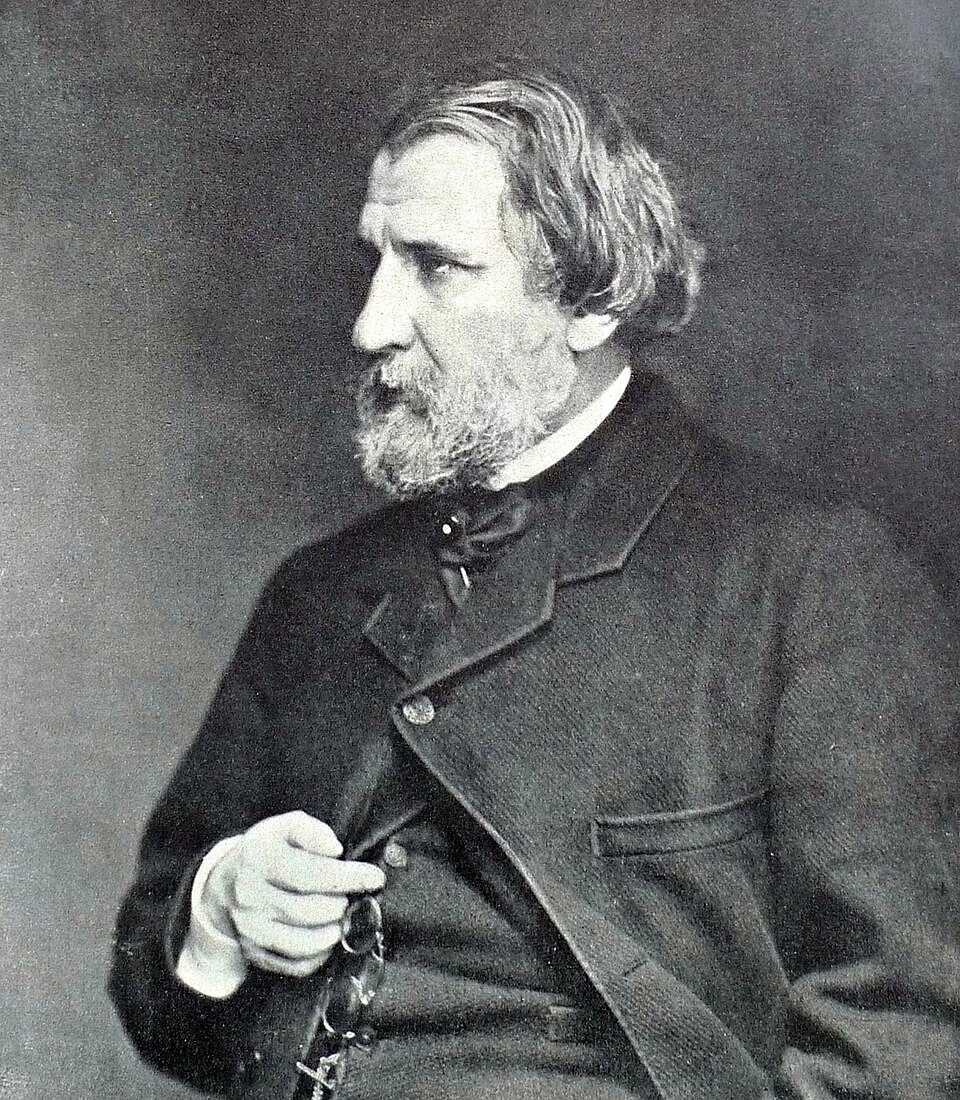
Image context: the 1871 portrait comes from Wikimedia Commons, which identifies it as a photograph of Turgenev taken in Baden-Baden and first printed in 1913.[5] The image is not decorative. It places this post near the later European Turgenev, the liberal artist whose most famous Russian political novel kept refusing the comfort of party ownership.[6]
The word arrives as a social shock
The novel makes "nihilist" memorable because it first appears as a conversational disturbance, not as a settled encyclopedia entry. Arkady tries to explain Bazarov to his elders, and the explanation immediately changes the room. A nihilist, he says, is someone who "does not bow down before any authority."[1] The phrase has the speed of youth and the shape of doctrine. It sounds clean, portable, and dangerous.
Yet Turgenev's craft begins where the definition stops. Bazarov's negation is not an airy metaphysical despair. In the Russian context described by Britannica, nineteenth-century nihilism was tied to utilitarianism, scientific rationalism, rejection of aestheticism, and revolt against authority exercised by state, church, and family.[3] That background matters because Bazarov is not bored with meaning in the later casual sense of "nihilistic." He is hostile to inherited claims that cannot pass his test of use, evidence, and material force.
This is why his famous dismissal of art and nature has such bite. Nature, for Bazarov, is "not a temple, but a workshop."[1] The line sounds brutal because it attacks a whole culture of reverent feeling. But it is also exact. He wants the world demystified so it can be handled. Turgenev lets that impulse feel both invigorating and narrowing. Bazarov cuts through false piety; he also cuts away kinds of attention that the novel itself quietly values.
Bazarov becomes more than his program
The simplest anti-nihilist novel would expose Bazarov's doctrine as hypocrisy, then punish him. Turgenev does something more durable. He lets Bazarov be genuinely impressive before exposing the insufficiency of his system. The young doctor's competence matters. He knows bodies, disease, frogs, experiments, and the habits of practical observation.[1] His contempt for elegant talk has moral weight because some of the elegance around him really is evasive.
At the same time, the novel keeps giving him experiences that his vocabulary cannot absorb. Love is the obvious one. Bazarov's attraction to Anna Odintsova does not make him suddenly sentimental; it embarrasses him, divides him, and turns his own body into counterevidence.[1][2] Britannica's summary is useful here because it refuses to make him only a political type: he is a nihilist, but he is also susceptible to love, and that vulnerability helps doom him to unhappiness.[2]
That is the book's central pressure. Bazarov can reject principles, phrases, and authorities; he cannot reject the fact that he is embodied, desiring, proud, wounded, and finally exposed to chance. His death from infection is therefore not a neat moral punishment for wrong ideas. It is more severe than that. A man who trusted material reality meets material reality at its most indifferent. The ending does not prove that the fathers were right. It proves that no slogan, old or new, can fully organize a life.
The fathers are not simple winners
The title can tempt readers into symmetrical thinking: fathers versus sons, old versus new, tradition versus rupture. Turgenev is subtler. Nikolai Kirsanov is kind and limited. Pavel is proud, elegant, wounded by irrelevance, and partly ridiculous. Arkady is less radical than he thinks. Bazarov is stronger than his hosts and less free than he imagines.[1][2]
This distribution is the source of the novel's afterlife. The older generation is not granted a clean vindication. The estate world has inertia, affection, music, memory, and manners, but also class blindness and exhausted authority. The younger generation has energy, intellectual violence, and real impatience with dead forms, but also simplification and theatrical contempt. Fathers and Sons keeps both sides from becoming morally complete.
Encyclopedia.com's reception overview notes that the novel's generation gap neatly symbolized contemporary political debates between older reactionaries and younger radicals, and that controversy attached to the book even before publication.[4] The important word is "symbolized," not "settled." Turgenev found a symbolic form for the debate, then made that form unstable by building characters whose actual behavior exceeded their positions.
Why the backlash was the achievement
The famous double rejection of Fathers and Sons is often treated as a biographical headache for Turgenev. It was that, but it was also evidence of literary success. If radicals had been fully pleased, Bazarov might have been propaganda. If conservatives had been fully pleased, he might have been a cautionary monster. Instead, both groups found something intolerable because the novel gave each side partial recognition and partial injury.[2][3][4]
That is why the book matters beyond the history of one Russian term. Britannica's broader entry on nihilism explains that Turgenev popularized the term through Bazarov, and that later associations with disorder, revolt, and political terror complicated its meaning.[3] But the novel's Bazarov remains sharper than many later uses of the word. He is not a generic emblem of meaninglessness. He belongs to a world in which science, reform, class, family, and style are fighting over who gets to define seriousness.
Read now, the book feels fresh because it understands a recurring literary and political problem: once a new generation names the old world as false, it still has to live in bodies, households, economies, affections, and mortality. Bazarov's negation is powerful because it exposes fraud. It fails when it mistakes exposure for a complete ethic.
The final force of Fathers and Sons lies there. Turgenev did not ask readers to choose between a cozy past and a triumphant future. He wrote a young man whose mind is too strong for inherited reverence and too narrow for the full human field he enters. That is why Bazarov made nihilism famous. He made it argumentative, charismatic, wounded, and alive enough to keep escaping the slogan that first named him.
Sources
- Ivan Turgenev, Fathers and Children / Fathers and Sons, translated by Constance Garnett, Project Gutenberg ebook page.
- Encyclopaedia Britannica, "Fathers and Sons" - publication context, Bazarov, nihilism, and the double-sided reception controversy.
- Encyclopaedia Britannica, "Nihilism" - Russian nihilism, Turgenev's popularization of the term, and the later political associations of the label.
- Encyclopedia.com, "Fathers and Sons" - publication background, controversy, and critical-history overview.
- Wikimedia Commons, "File:Turgenev 1871.jpg" - source page for the archival photographic portrait used as the article image.
- Encyclopaedia Britannica, "Ivan Turgenev" - biographical context, liberal position, European life, and major works.