Many first descriptions of The House of Mirth stop at surface: lilies, orchids, country houses, bridge tables, afternoon calls, and the polished cruelty of Old New York. Those things matter, but Wharton’s sharper instrument is arithmetic. The novel keeps asking what Lily Bart can spend, what she owes, how long she can postpone decision, and when beauty stops functioning as credit.[1][3][4]
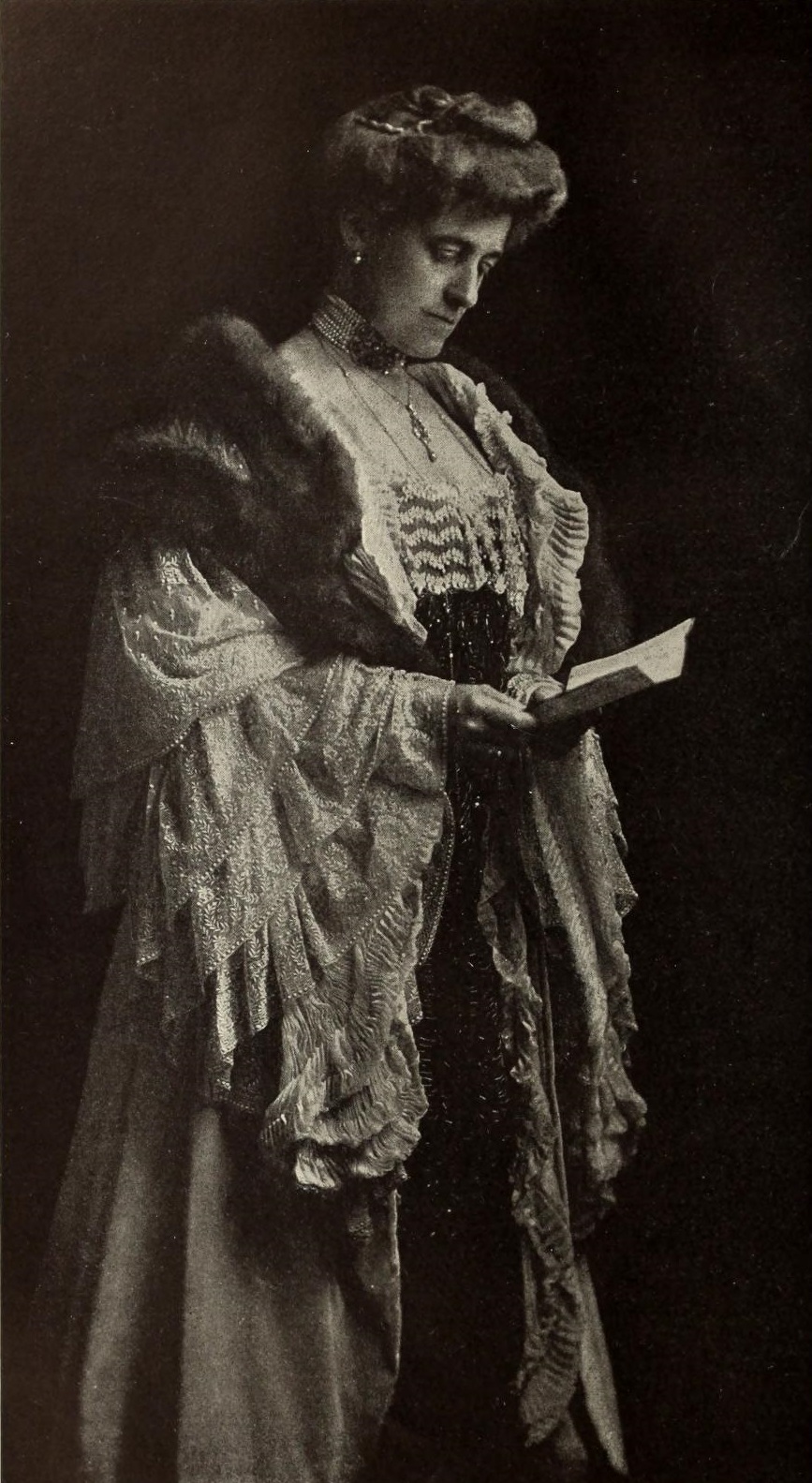
Image context: this by-1905 photograph of Edith Wharton matters because the novel’s book publication belongs to the same social world she knew from the inside and rewrote with unusual fiscal clarity. In her fiction, taste is never only taste; it is also schedule, obligation, and exposure.[2][4][5]
1) The opening is a timetable before it becomes a flirtation
Wharton begins at Grand Central with an apparent accident: Lily has missed her train to Bellomont and must fill two hours in the city.[1] On first glance the scene feels airy and social, a chance encounter with Lawrence Selden. Read closely, it is already a crisis of timing. Lily is always most vulnerable in transitions, in the space between one hosted environment and the next, when she has to manage herself rather than be carried by a room.
That is why Selden’s flat matters so much. The tea itself is almost incidental. What Lily notices is a private order she does not own: books, a writing table, the heap of letters and notes, the masculine ease of a life not fully mortgaged to display.[1] Selden’s rooms give off what the novel will later call a world outside the social cage. The contrast is not simply romantic. It is infrastructural. He has interior margin; she has circulation.
Wharton therefore does something ruthless in the first chapter. She lets Lily appear luminous, witty, and fully legible to others, while quietly establishing that her life depends on exact sequencing. A missed train is never just a missed train in this book. It is a brief exposure of the machinery underneath charm.[1][3]
2) “Horribly poor and very expensive” is the novel’s central equation
The line Lily gives Selden, “I am horribly poor and very expensive,” is famous because it sounds epigrammatic.[1] Its real force is diagnostic. In six words Wharton fuses personality, class training, and market logic. Lily’s problem is not reducible to vanity. She has been formed to operate beautifully in expensive settings and has not been given an alternative system for earning security within the standards of her set.[1][4]
This is where weaker readings shrink the book into moral caution about luxury. Wharton is doing something harder. She shows that elegance is labor and that the labor has carrying costs. Clothes, leisure, travel, tact, strategic availability, the correct degree of flirtation, the refusal to look desperate while depending on rescue: each of these is part of Lily’s expenditure profile.[1][3] By the time Percy Gryce enters as a possible husband, the question is not whether Lily can perform charm. She can. The question is whether she can convert temporary attraction into durable solvency before some tiny failure of timing closes the window.
That is why delay in the novel always feels expensive. Lily’s social world punishes hesitation more harshly than vice. The person who cannot decide in time, marry in time, answer gossip in time, or cash in beauty while it still earns interest begins to fall through the floor.[1][4]
3) The “great gilt cage” offers insight, not escape
Selden attracts Lily partly because he appears to stand just outside what Wharton calls the “great gilt cage.”[1] He has points of contact with a freer life, and he can name the thing Lily cannot yet inhabit: a “republic of the spirit.”[1] Those phrases are some of the most revealing in the book because they stage freedom as a recognizable ideal while refusing to make it operational.
Lily understands the appeal immediately. That quick response is important. She is not too shallow to perceive another scale of value. She is trapped by a social formation in which perception alone changes nothing. Wharton denies her the sentimental escape route by making Selden a witness to freedom more than an engineer of it.[1][2]
This is one reason the novel still bites. It refuses the fantasy that insight automatically becomes action. Lily can see the cage. She can even imagine, in flashes, what it would mean to live less expensively in spirit. But she has been trained for a world in which furniture, invitations, railway movement, and marriageability all belong to one continuous ledger. The novel’s cruelty lies in letting consciousness outrun circumstance.[1][2][4]
4) The tableaux vivants scene turns Lily into her own most profitable object
The Brys’ tableaux vivants are among the most dazzling pages in the novel, and they are also among the coldest.[1] Society gathers to watch fashionable women become framed pictures. Wharton could hardly have devised a neater emblem for the terms on which Lily is valued. At her highest moment of social radiance, she is motionless, arranged, looked at, and briefly lifted above the shabby mechanics of pursuit.[1][3]
What makes the scene unforgettable is that Lily genuinely triumphs there. She becomes, for a moment, the perfect object of collective attention. Yet the triumph is fatal in structure because it rewards precisely the form of value that cannot protect her. The more completely she can be admired as an image, the less room the novel gives her to exist as an agent with durable bargaining power.[1]
Wharton’s social comedy sharpens into something close to forensic analysis here. Beauty in The House of Mirth is not false; it is simply liquid only under certain conditions. The same society that gasps at Lily in the frame is fully capable of converting her beauty, hours later, into rumor, leverage, and debt.[1][3][4]
5) The ending contracts spectacle into bookkeeping
By the last movement, the novel has stripped away almost every ornamental buffer. What remains is desk-level fact: rent, wages, legacy, cheque, letters, the pressure of unpaid obligation, the temptation to postpone one compromise by making another.[1] Wharton narrows the scale with brutal intelligence. The book that began among trains, country houses, and expensive interiors ends with account-keeping and a bottle of chloral.
One detail matters especially. After Lily dies, Selden discovers that she had in fact used her small legacy to free herself from Trenor’s claim, though doing so left her exposed to bare poverty.[1] That discovery changes the moral weather of the ending. The novel does not rescue Lily with secret vindication, but it does insist on the shape of her final act. She had not drifted into indifference. She had tried, at the first real opportunity, to clear the debt that had become intolerable to her.[1][4]
That is why the ending wounds so deeply. Wharton does not say that Lily was too pure for the world, nor that she was simply vain enough to deserve ruin. She shows a woman trained as ornament trying, too late and with too little room, to convert style into moral action. The margin between those two things has been the subject of the book from the first missed train.
6) What the novel still knows
The House of Mirth survives because Wharton understood that class power is often felt as tempo before it is felt as doctrine. Lily Bart is ruined by money, but not by money alone. She is ruined by timing, by the shrinking half-life of social attractiveness, by the way a polished world turns delay into compound interest against the person who can least afford it.[1][2]
That is why the novel rewards close reading. It is not merely a satire of rich people behaving badly. It is a study of how a society prices women, how long it lets them remain legible, and how quickly the same room that admired them can convert them into residue. Once you see that ledger under the flowers, Wharton’s elegance becomes much harder and much sadder.
Sources
- Edith Wharton, The House of Mirth, Project Gutenberg HTML text.
- Library of America, "Edith Wharton" author page.
- Encyclopedia.com, "The House of Mirth."
- Encyclopedia.com, "Wharton, Edith (1862-1937)."
- Wikimedia Commons, "File:Picture of Edith Wharton.jpg" — dated by 1905 from The World's Work.