People often describe Emma as a charming matchmaking comedy and stop there. That gets the tone but misses the design. Austen’s deeper achievement is structural: she builds a novel that teaches readers how confident misreading feels from the inside, then shows how that confidence collapses under social pressure. The famous opening description, “handsome, clever, and rich,” is not just praise; it is the novel’s first warning sign.[1][2]
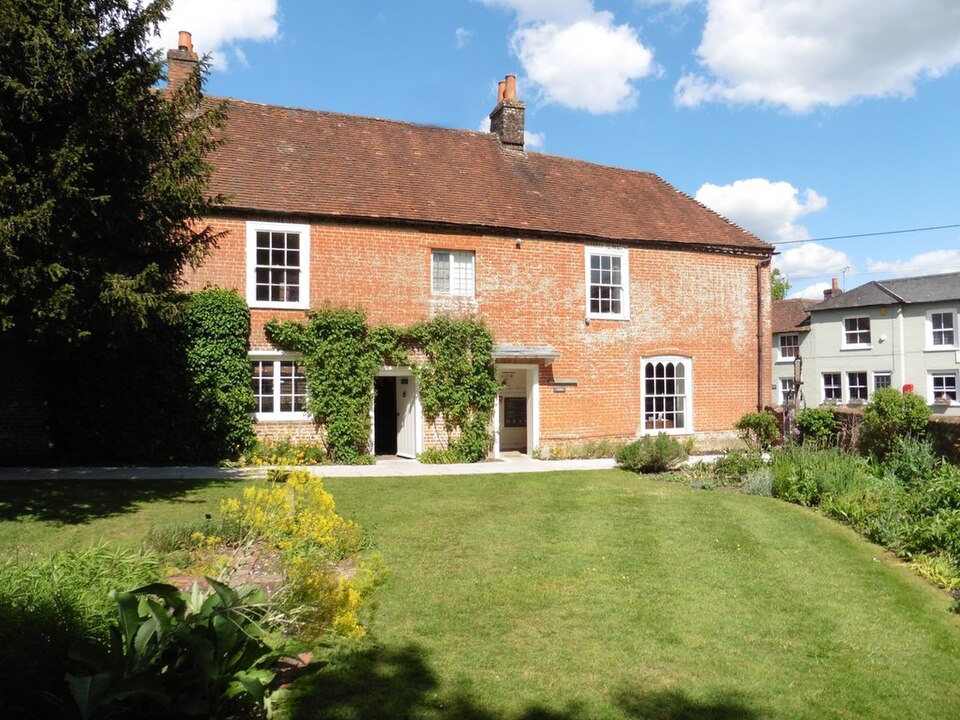
The image here is Jane Austen’s House in Chawton, where the mature novels were written or revised. It matters because Emma feels like the work of a writer operating with unusual formal control: a small map, a restricted cast, repeated encounters, and a heroine whose confidence is so high that plot can be generated almost entirely from interpretive error.[3][5]
1) The opening sentence is a contract, not a compliment
The first sentence does something more technical than many remembered summaries admit. Emma Woodhouse arrives with every visible advantage already stacked in her favor: rank, comfort, intelligence, beauty, and local authority.[1][2] Austen therefore removes the usual engine of scarcity that drives many marriage plots. Emma is not scrambling for money or status. She already has social surplus.
That choice changes the whole architecture of the novel. Because Emma does not need to marry, she has room to meddle. Because she has room to meddle, the plot can shift from external necessity to internal overconfidence. Austen can ask a sharper question than "Who will marry whom?" She can ask what happens when a socially protected person begins to treat other people’s feelings as material for interpretation and arrangement.
This is why the novel feels so modern. Its central problem is not deprivation but miscalibration. Emma’s advantages become the very conditions that let her read too quickly, infer too much, and act as though charm were evidence.[1][4]
2) Highbury is a closed circuit for information
Austen’s formal brilliance depends on scale. Highbury is large enough to sustain variety, but small enough that every movement leaves a trace.[1][2] Visits, dinners, walks, carriage rides, and churchgoing all function as information exchanges. News does not remain private for long, yet it also arrives in fragments, with enough delay and enough gossip to invite distortion.
That makes the village more than a setting. It is the novel’s circulation system. Harriet Smith can become a project because Emma can observe her repeatedly; Mr. Elton can be misread because tiny acts of politeness acquire speculative value inside a tight social field; Frank Churchill can generate suspense because his absences, letters, and gestures are legible to everyone but fully knowable to no one.[1][2][4]
Once you see Highbury this way, Emma stops looking like a sequence of comic episodes and starts looking like a pressure chamber. Austen has reduced the radius so that interpretation itself becomes plot. People are constantly reading posture, tone, sequence, seating, and timing. The smallest error travels outward.
3) Austen keeps us inside Emma’s mind, but never entirely at ease there
The most important structural tool in the novel is perspective. Austen keeps readers close to Emma’s interpretive process while preserving enough distance for irony to accumulate. Modern criticism often points to Emma as one of the great demonstrations of how narrative can inhabit a character’s assumptions without openly endorsing them.[4]
That is why the book can feel so smooth on a first read and so sharp on a second. Emma’s inferences are often plausible at the moment they occur. Austen does not make her stupid. She makes her fluent, fast, and socially practiced. The reader is therefore tempted to travel with her. Only later does the pattern become visible: Emma repeatedly mistakes manageability for understanding.
This is clearest in the early Harriet-Elton sequence. Emma believes she is detecting a romance because she has already decided the social script in which that romance should fit. She reads little signs as confirmation instead of treating them as ambiguous data.[1] The form collaborates with her just enough to let us feel the seduction of that confidence. Then the proposal scene with Mr. Elton snaps the arrangement in half. The surprise works because Austen has distributed knowledge asymmetrically, not because she has hidden facts unfairly.
4) Harriet is not only a friend; she is the novel’s mirror surface
Harriet matters structurally because she gives Emma a human medium through which to project theory. If Emma merely misread her own prospects, the novel would become inward and narrow. Harriet enlarges the system. She lets Austen show what interpretive vanity looks like when it begins to reorganize another person’s life.
This is why the novel’s comedy always carries a hard edge. Emma’s mistakes are not private errors in a diary. They alter expectations in the world. Harriet is encouraged to imagine upward mobility in one direction, then another. The emotional damage comes from sequence: suggestions harden into hopes, hopes into humiliations, humiliations into revised self-knowledge.[1]
Knightley’s function becomes clearer against this pattern. He is not simply the eventual husband placed at the edge of the story until the ending. He is the figure who keeps noticing where Emma’s reading habits become socially dangerous. His judgments are sometimes stern, but the novel needs that sternness. Without a counter-reader inside the system, Emma’s interpretation would have no real resistance until too late.
5) Box Hill is the point where style becomes ethics
The Box Hill excursion is the novel’s decisive pivot because Austen converts wit into evidence.[1][2] Up to that point, Emma’s errors can still be enjoyed mainly as comic misfires. She has been vain, intrusive, and too certain of her own diagnostic powers, yet the novel keeps enough lightness around her to preserve mobility.
At Box Hill, that mobility tightens. Emma’s joke at Miss Bates’s expense reveals that her quickness of mind can become a weapon when social boredom and superiority align. Knightley’s rebuke, “Badly done, Emma!”, lands with such force because it is not merely a moral lecture.[1] It is a structural verdict. The book has been teaching us that misreading has costs; Box Hill is where those costs can no longer be mistaken for harmless cleverness.
After that moment, the second half of the novel rearranges its energies. Self-correction becomes more important than social maneuver. Emma does not turn into a different person overnight, but the book changes what counts as success. Earlier, successful reading meant controlling outcomes. Later, successful reading means seeing other people with less vanity in the frame.
6) The ending closes the plot by revising the reader’s habits
The final recognition that Emma loves Knightley works because Austen has spent the whole novel training attention away from the obvious romance line.[1][2] The marriage ending matters, but it is not the only payoff. The deeper payoff is retrospective. Readers are asked to look back over the entire structure and notice how often intimacy was present while interpretive vanity pointed elsewhere.
This is also why Emma has proven so portable in reception history. Contemporary readers admired Austen’s command of ordinary social incident, later critics prized the novel’s handling of perspective, and modern adaptations keep rediscovering how durable its design is.[2][3][4] Clueless is the most famous example because it shows how little of the surface one needs to preserve if the underlying machine remains intact: privileged interpreter, dense social network, confident misreading, humiliating correction, earned self-knowledge.[2]
That durability comes from form. Emma is not just a story about matchmaking gone wrong. It is a novel about what interpretation does when it is protected by comfort, speed, and status. Austen keeps the canvas small so that every error can be heard when it lands. The result is a comedy whose true subject is calibration.
Sources
- Jane Austen, Emma, Project Gutenberg ebook 158.
- Encyclopaedia Britannica, "Emma".
- Jane Austen's House, "Emma".
- Jan Fergus, "Emma" chapter in The Cambridge Introduction to Jane Austen.
- Wikimedia Commons, "File: Jane Austen's house and museum, Chawton - geograph.org.uk - 6161267.jpg".