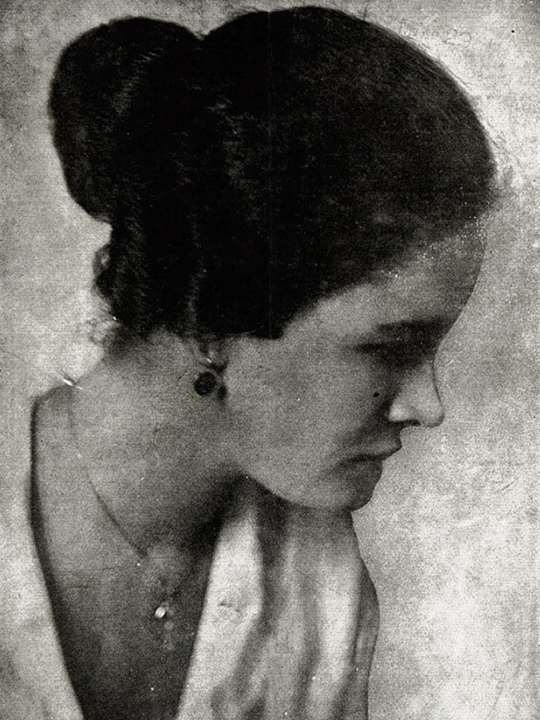
Georgia Douglas Johnson's “The Heart of a Woman” lasts only eight lines. It contains a whole day, but almost no event: at dawn a heart goes out; at night it comes back. The violence lies in the name given to its destination. What first sounds like home becomes “some alien cage,” and what ought to protect the heart becomes a set of “sheltering bars.”[1]
That last phrase is the poem's trap. Sheltering asks the reader to imagine safety, care, perhaps domestic belonging. Bars cancels the comfort without canceling the claim that the cage is for the captive's own good. Johnson does not have to explain who built it. She makes the language of protection disclose the prison.
Published as the opening poem of The Heart of a Woman and Other Poems in 1918, the lyric stands at the threshold of Johnson's first collection.[2] Its position invites a manifesto-sized reading, but its craft is smaller and sharper than a declaration. Two matched quatrains, linked by repeated syntax and paired rhymes, turn a daily rhythm into an argument about desire, return, and the social stories that make confinement look natural.
Two Stanzas Make a Day Look Inevitable
The first stanza begins with dawn; the second begins with night. Each opens with the same grammatical subject, “The heart of a woman,” followed by a verb of movement. The parallel is so neat that departure and return initially seem as ordinary as sunrise and sunset.[1] That apparent naturalness matters. A rule imposed every day can start to feel like weather.
Johnson breaks the symmetry through the verbs. At dawn, the heart “goes forth.” It is active, choosing a direction beyond the page. The next line keeps it aloft as “a lone bird, soft winging,” and the adverb “restlessly” prevents softness from becoming passivity.[1] This is not a decorative songbird perched for inspection. It is alone, in motion, and unsatisfied with stillness.
At night, the heart does not fly home. It “falls back.”[1] The change is tiny enough to pass on a first reading, yet it alters the physics of the poem. Going forth belongs to intention; falling back sounds like gravity, exhaustion, or defeat. The day has not simply completed a circle. Something has reduced flight to descent.
The paired rhymes reinforce that difference. “Dawn” carries the bird toward “on”; “roam” finds an answering “home.” In the second stanza, “night” closes around “plight,” and the dreamed-of “stars” meet the material fact of “bars.”[1] Rhyme usually promises completion. Here it keeps making the freer word answer to the narrower one.
The Heart Is the Part Allowed to Travel
Johnson never says that the woman herself goes forth. Her heart does. That substitution gives desire a body light enough to escape while leaving the person who desires almost entirely outside the frame. The poem's central freedom is therefore real but precarious: inward life can range beyond the cage even when the social self cannot.
The opening movement expands quickly. The bird travels “afar o'er life's turrets and vales,” crossing high structures and low ground in a single line.[1] Turrets suggest built height—castles, boundaries, positions from which the world is surveyed—while vales bring the flight back toward the earth. The heart claims both scales. It is not searching for one improved room within its enclosure; it is testing a landscape.
Then Johnson complicates the word home before any cage appears. The heart roams “in the wake of those echoes the heart calls home.”[1] An echo is not an address. It is a sound detached from its source, present because something has already happened elsewhere. To follow an echo is to be guided by recognition without possessing the thing recognized.
The grammar also leaves a productive uncertainty. Are these echoes what the heart names as home, or are they sounds by which the heart calls home to itself? Either way, home enters the poem first as an acoustic trace, not a building. The heart knows belonging as something heard across distance. Only the night stanza supplies an enclosure, and that enclosure is “alien.” The place to which the heart returns is therefore not identical with the home it seeks.
“Some Alien Cage” Is Both Vague and Exact
The word some can look disposable. It is not. Johnson does not write the cage, which might imply one named household or a single biographical grievance. She writes “some alien cage,” making the destination indefinite and repeatable.[1] The heart may fall into any one of the structures that promise to contain a woman's life properly.
That does not make the poem a code in which every image has one historical equivalent. Johnson offers no husband, employer, law, or room. Her own career crossed poetry, drama, newspaper writing, music, federal employment, and the literary gatherings later associated with her S Street home in Washington, D.C.[3][4] Those facts illuminate the number of thresholds a Black woman writer navigated; they do not authorize us to turn this bird into a simple diagram of her marriage or career.
The poem instead works by pressure. Alien says the cage cannot become home merely because the heart is made to enter it. Plight makes confinement a condition, not a preference. Most painfully, the heart “tries to forget it has dreamed of the stars.”[1] The demand is not only to remain inside. It is to erase the knowledge that outside once felt navigable.
For a bird, stars are more than elevated ornaments. They belong to orientation. Johnson does not explicitly invoke migration, so the image should not be turned into a scientific claim the poem never makes. But within its own small system, the contrast is clear: the stars give the heart a field beyond the cage; the bars divide that field into something visible and unreachable.
The Cruelest Word Is “Sheltering”
If Johnson had ended with prison bars, the poem would have named an obvious injustice. “Sheltering bars” are harder to resist because the adjective supplies the cage with a benevolent explanation.[1] The bars may limit, the phrase implies, but they also keep danger out. Confinement can then present itself as love, propriety, stability, or rescue.
The line refuses that bargain through sound. The heart “breaks, breaks, breaks” against the bars.[1] Repetition interrupts the lyric's otherwise smooth forward motion. The same verb strikes three times, yet no strike opens the cage. It can mean the heart is being broken, but it also retains a trace of action: the heart keeps breaking on the obstruction, testing it again and again.
The preceding word while makes two processes simultaneous. The heart tries to forget its dream while it breaks against the structure meant to shelter it.[1] Forgetting is not achieved; obedience is not peace. The outwardly quiet return contains continuing collision.
Even the stanza's tidy shape participates in the unease. Four rhymed lines hold a heart that cannot accept being held. The poem does not shatter its form to imitate liberation. It lets formal composure carry an experience that composure cannot solve. That is one reason the lyric can sound gentle when read aloud and still leave a bruise.
The First Reader Praised Endurance
William Stanley Braithwaite's introduction to the 1918 volume quotes the entire second stanza. He hears in it access to hidden feminine feeling and praises women's “patience,” “endurance,” and “persistent faith.”[2] His response supplies valuable evidence of the book's publication moment, but it also demonstrates the problem Johnson's adjective creates.
Braithwaite looks at a heart repeatedly breaking against bars and converts the spectacle into admirable endurance. His language is sympathetic, even progressive by its own account; he says women's emancipation remains incomplete. Yet sympathy can leave the cage standing when it celebrates how nobly the captive survives it. The poem is more destabilizing than the introduction that ushers it into print.
This difference does not require making Johnson's eight lines say everything her later career would say. She went on to publish Bronze in 1922, host writers at 1461 S Street, and write plays confronting racial violence—a body of work much broader than the genteel category of “woman's heart.”[3][4] But the title poem already knows how a flattering category can constrain. It names a collective heart, then shows what happens when the world treats that heart as tender enough to protect and not authoritative enough to free.
The Bars Rhyme with the Stars
“The Heart of a Woman” does not end by opening the cage. It offers no consoling dawn after the final line, although the two-stanza day implies that dawn may come again. Its achievement is more exact: it makes the justification for confinement impossible to hear innocently.
The heart has already crossed turrets and vales. It has followed the echoes it calls home. It has dreamed by the stars. Once the reader knows that range, the cage cannot define the heart's proper size. And once bars have been made to rhyme with stars, shelter can no longer pretend it merely keeps the dreamer safe. The rhyme measures the distance between the life imagined for her and the life she can imagine for herself.
Sources
- Georgia Douglas Johnson, “The Heart of a Woman,” Academy of American Poets—public-domain text used for quotation and close reading.
- Georgia Douglas Johnson, The Heart of a Woman and Other Poems. The Cornhill Company, 1918—digitized first edition, including William Stanley Braithwaite's introduction and the poem's original placement.
- Academy of American Poets, “About Georgia Douglas Johnson”—biographical overview of Johnson's writing, work in Washington, and forty-year literary salon.
- New Georgia Encyclopedia, “Georgia Douglas Johnson”—career, Harlem Renaissance context, later writing, and critical afterlife.
- Wikimedia Commons, “Georgia Douglas Johnson on The Crisis cover, March 1920”—source page and publication metadata for C. M. Battey's archival portrait used as the article image.