Hetty Sorrel is easy to condemn quickly, and George Eliot knows it. She is vain, secretive, shallow in sympathy, dazzled by rank, and dangerously skilled at refusing facts she does not want to face. But Adam Bede becomes a more unsettling novel when Hetty is not treated as a moral label. Eliot makes her tragedy grow out of a small, recognizable habit before it becomes catastrophic: Hetty lives as if being desired can protect her from consequence.[1]
That habit is not harmless, but it is also not the same thing as villainy. First published in 1859 and set in rural Hayslope in 1799, Adam Bede places Hetty inside a social world where beauty is a public fact, class is a daily pressure, pregnancy can become legal ruin, and reputation travels faster than self-knowledge.[1][2][4] The George Eliot Archive's character record captures the plain outline: Hetty is the seventeen-year-old village beauty whose dream of becoming Arthur Donnithorne's lady ends in tragedy.[3] Eliot's art is in making that outline feel both morally sharp and painfully insufficient.
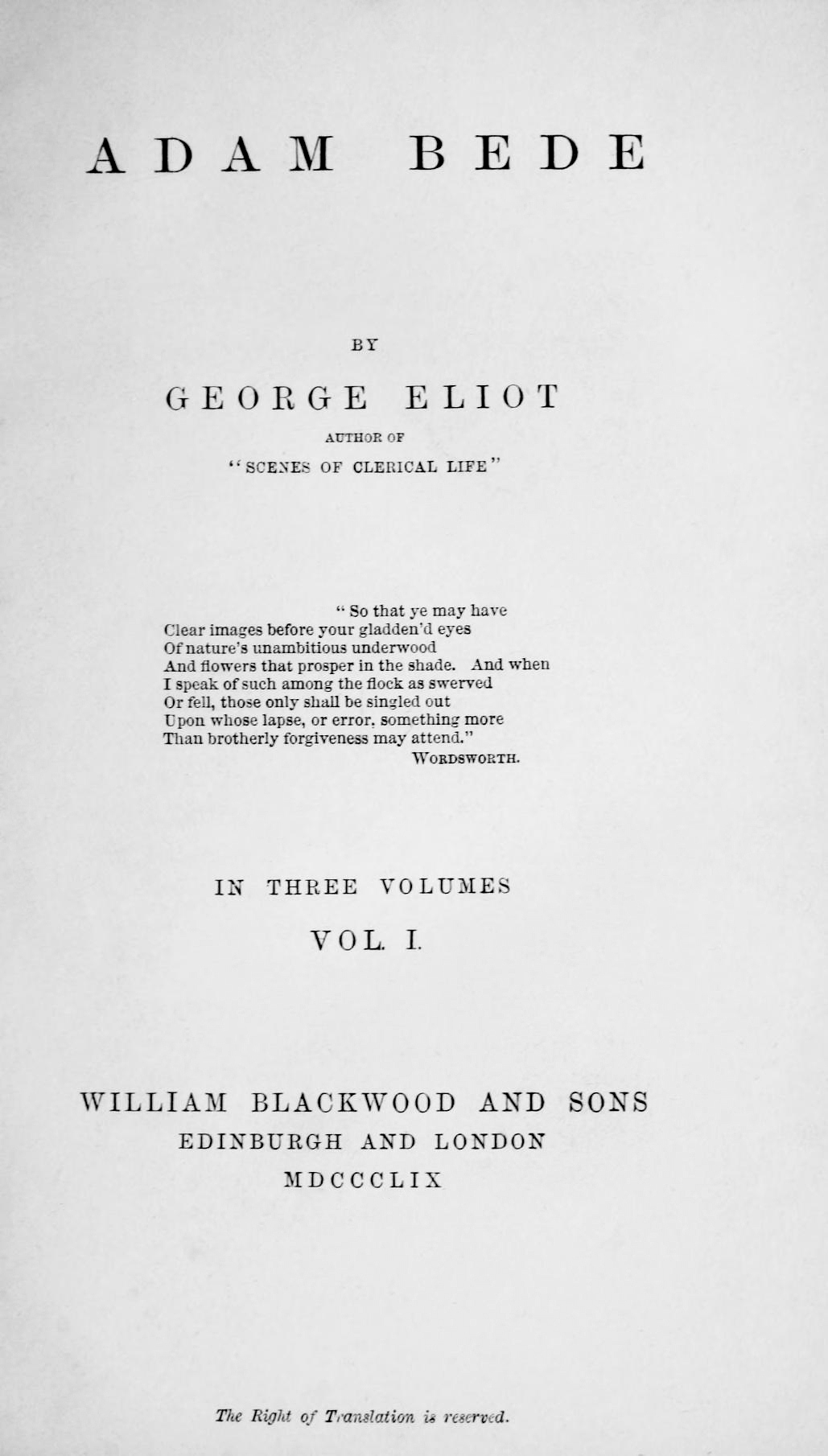
Image context: the cover is not a decorative bookish placeholder. It is the first-edition title page of the very novel that made Hetty public. A title page suits this essay because Hetty's character is built around legibility: how she is displayed, misread, hidden, narrated, judged, and finally forced into a public story she can no longer control.[6]
Beauty as a closed room
Eliot introduces Hetty through the problem of looking. In the dairy, she is not simply pretty; she is almost too successfully pretty. The narrator famously calls her a "distracting kittenlike maiden," a phrase that is affectionate, comic, and faintly dangerous at once.[1] It turns Hetty into motion and surface: softness, charm, self-absorption, and animal immediacy. The description is not neutral praise. It tells us that beauty has become the social medium through which other people approach her and through which she imagines herself.
That matters because Hetty's inner life is narrower than her effect on others. She does not command rooms as Becky Sharp does, argue as the Wife of Bath does, or revise herself as Dorothea Brooke does. She receives attention and mistakes it for destiny. In the chapter bluntly titled "Hetty's World," Arthur's admiring glances set her heart playing its "little foolish tunes."[1] The language is small on purpose. Hetty's fantasy life has rhythm and sweetness, but it does not yet have structure. She can imagine finery, elevation, and being singled out. She cannot imagine the social mechanics that would have to make those images real.
Eliot is severe here, but not crude. Hetty's vanity is not merely personal failure. It is trained by the world around her. She works in a farm household where class lines are visible in clothing, speech, inheritance, leisure, and male mobility.[1][4] Arthur's rank gives his attention a magical charge because it seems to offer escape from ordinary labor without requiring Hetty to develop a plan. She wants the result of transformation, not the path. That is why her dream is so fragile: it depends on being looked at by the right person and on never having to translate the look into terms, promises, or obligations.
Denial becomes a method
Hetty's tragedy deepens when denial stops being a mood and becomes a method of survival. After Arthur begins to retreat, she does not read his evasions as evidence; she reads them as obstacles to be wished away.[1] When Adam's steadiness becomes available, she does not suddenly discover moral clarity. She turns toward him as a form of cover and possibility, not because she has learned to love him in a new register. The result is painful because Adam's mistake and Hetty's mistake are asymmetrical. He over-idealizes her; she under-imagines everyone else.
This is where a character study has to resist two simplifications. Hetty is not simply a helpless emblem of the Victorian "fallen woman," though Victorian Web's summary rightly places her inside that cultural script of seduction, class fantasy, and sexual punishment.[5] She is also not simply the author of her own ruin. Arthur has social power, sexual freedom, and the luxury of remorse delayed. Hetty has beauty, secrecy, and very little practical knowledge. The relationship is unequal before it becomes illicit, and that inequality shapes every later choice.[1][4][5]
Yet Eliot does not absolve Hetty by making her purely acted upon. The novel's harshness lies in showing how a limited imagination can still do real harm. Hetty cannot picture Adam's inward life clearly enough. She cannot picture the Poysers' vulnerability clearly enough. Most terribly, she cannot picture the infant as a continuing claim until the claim has become unbearable.[1][4] Her failure is not that she wants a larger life. It is that she wants a larger life without relation. She dreams of being lifted out, not of being answerable within.
The face that means more than the self
One of Eliot's strongest character moves is to separate Hetty's face from Hetty's moral capacity. At the birthday dance, the narrator says Hetty's "face had a language" beyond the feeling actually inside her.[1] That insight is devastating. Other characters read depth into her appearance because the appearance seems to promise it. Arthur imagines a pathos that flatters his passion. Adam imagines a sweetness that fits his hope. Even readers can be tempted by the same error, because Eliot's descriptive power makes Hetty vivid before it makes her knowable.
The problem is not that beauty deceives everyone and ugliness would tell the truth. Eliot's realism is subtler than that. The problem is that beauty creates credit. It gives Hetty emotional loans she cannot repay. People around her supply inward richness, moral tenderness, or romantic significance because her surface seems to invite those investments. When crisis comes, the loans are called in. Everyone discovers that the imagined Hetty and the actual Hetty are not the same person.
Miriam Jones's Cambridge Core article on Adam Bede is useful here because it frames the novel's catastrophe through the movement from public street to domestic parlor and legal exposure.[4] Hetty's story is never only private. The village, the household, the seduction plot, the journey, the trial, and the prison all convert inward avoidance into social fact. Once the pregnancy can no longer be folded back into fantasy, Hetty's world changes scale. The same society that enjoyed looking at her now has a punitive story ready for her.
Why pity arrives late
The prison scenes matter because they do not magically make Hetty wise in the modern therapeutic sense. They make her reachable. Dinah Morris does not give Hetty a clever argument; she gives her presence, tenderness, religious language, and a way to speak the truth after every practical evasion has failed.[1] That is the point at which pity becomes possible without becoming sentimental. Hetty's suffering does not erase the dead child. It does reveal how poor the earlier moral vocabulary has been.
Before the prison, Hetty is often discussed as if she were a problem of appetite: vanity, prettiness, flirtation, ambition above station. After the prison, she has to be read as a problem of isolation. She has been looked at constantly and known very little. She has wanted fiercely and understood almost nothing about consequence. She has been condemned by law and also exposed as a person whose emotional education was catastrophically inadequate.[1][3][4]
That late shift is why Hetty remains one of Eliot's most uncomfortable characters. She is not admirable in the usual sense. She is not secretly brilliant, not ethically lucid, not redeemed into strength. But she forces the novel to ask what happens when a young woman is made socially visible before she is morally or practically equipped to survive visibility. Beauty opens doors in imagination, but not in law. Desire feels private, but pregnancy, poverty, trial, and punishment make it public. Shame feels like an emotion, but in Hetty's world it becomes infrastructure.
Hetty Sorrel turns vanity into a survival trap because she treats attention as shelter. Eliot's judgment is that attention is no shelter at all. It can warm, distort, expose, and abandon. The tragedy of Adam Bede is that Hetty learns this only after the fantasy of being chosen has collapsed into the harsher fact of being named.
Sources
- George Eliot, Adam Bede. Project Gutenberg HTML text.
- George Eliot Archive, "Adam Bede (1859, Original Publication)" - bibliographic record for the first edition.
- George Eliot Archive, "Sorrel, Hester, called Hetty" - character record.
- Miriam Jones, "'The Usual Sad Catastrophe': From the Street to the Parlor in Adam Bede," Victorian Literature and Culture, Cambridge Core.
- Rosalind White, "The Role of the 'Fallen Woman' in Three Victorian Novels," Victorian Web.
- Wikimedia Commons, "File:Adam Bede.jpg" - source page for the 1859 first-edition title-page image.