Most readers meet Hamlet’s most famous line as if it were a quotation carved in marble: self-contained, detachable, almost aphoristic. But in the play it is not detached at all. “To be, or not to be” sits inside a trap-rich corridor where Hamlet is already being watched, Ophelia is being used, and Claudius is testing what kind of threat the prince has become.[1][2]
That staging context changes the speech’s force. It reads less like a private metaphysical monologue and more like a decision engine running in public risk.
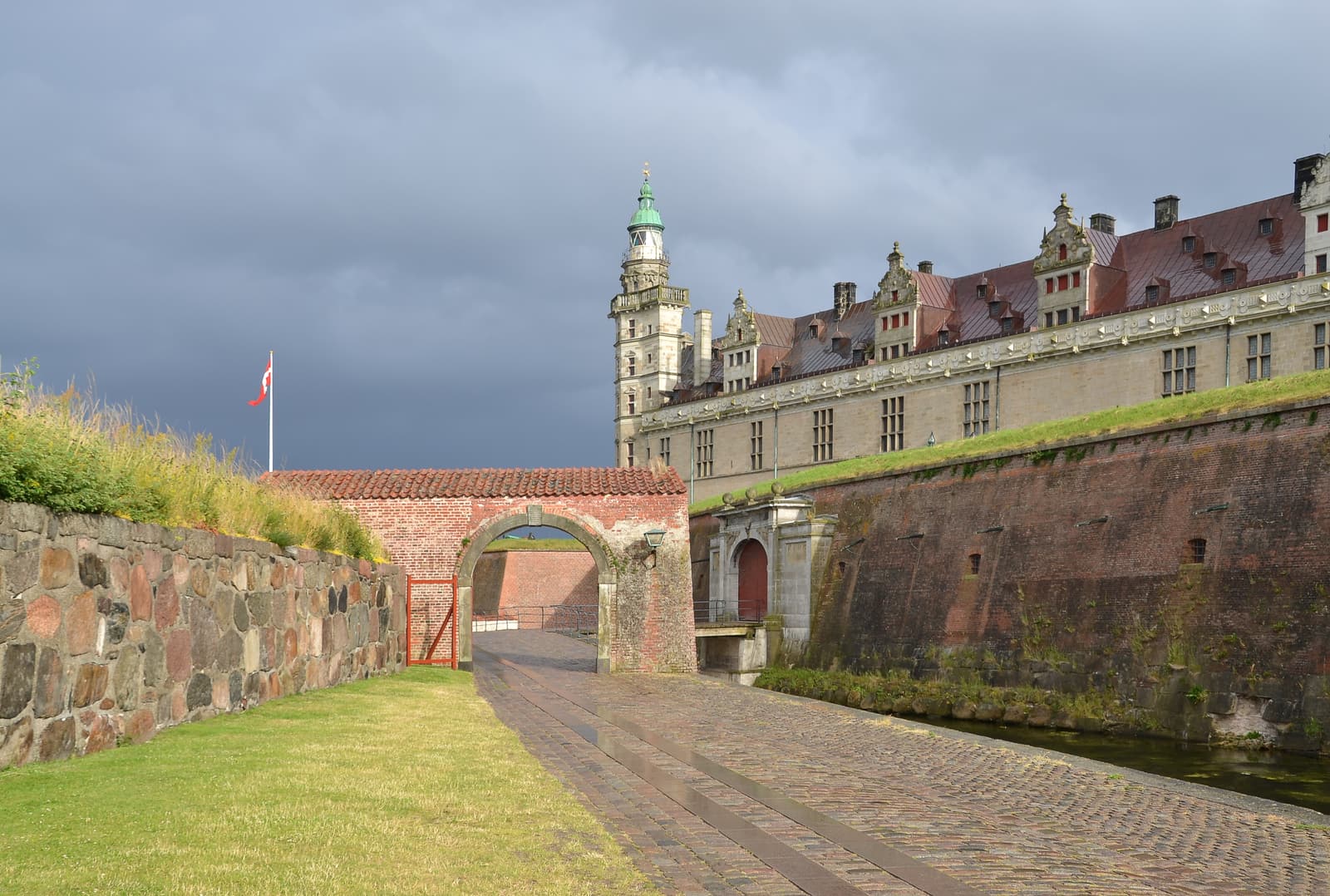
Image context: the Kronborg Castle cover image anchors the essay in Hamlet’s Elsinore setting, where visible architecture and possible surveillance heighten the speech’s pressure.
Start with where the speech lives, not only what it says
In Folger’s Act 3, Scene 1 sequence, Claudius and Polonius explicitly arrange surveillance before Hamlet enters. Polonius places Ophelia as bait; he and the king withdraw to observe.[1] So when the soliloquy begins, Hamlet is not simply “alone with himself” in a modern therapeutic sense. He is in a court world where privacy is unstable and language is always potentially overheard.
That setting explains why the speech never settles into pure confession. It oscillates between abstraction (“To be, or not to be”) and legal-moral generalization (“the oppressor’s wrong, the proud man’s contumely”), as if Hamlet is testing what can be thought without yet becoming evidence.[1]
The real problem is not death vs life; it is action vs unknowability
The common paraphrase says Hamlet asks whether to live or die. True, but incomplete. The stronger hinge arrives when he moves from suffering in known time to the uncertainty of what follows death: “the dread of something after death, / The undiscovered country.”[1]
That turn matters because it shifts the logic from courage to epistemology. Hamlet does not stop because pain is small. He stops because the next state cannot be verified. The speech is therefore not a morality poster about bravery; it is a model of decision latency when outcomes are asymmetrically unknown.
Read this way, the famous line “Thus conscience does make cowards of us all” is not merely self-insult.[1] It is a diagnosis of what reflective cognition does under extreme uncertainty: it multiplies branches faster than resolve can collapse them.
Why this passage still feels modern: it sounds like risk language
The soliloquy’s syntax repeatedly stages alternatives—bear/endure/act/not act—without granting closure. In operational terms, Hamlet keeps running scenario analysis with no trusted probability model. That is why the speech still maps onto modern dilemmas that have no clean data horizon: whistleblowing inside political institutions, catastrophic personal choices, medical decisions with irreversible cost.
Shakespeare’s craft move is to make that uncertainty audible in cadence. Resolution appears, then is interrupted by subordinate clauses and conditionals. The language itself performs hesitation.
The nunnery turn is part of the same mechanism
After the soliloquy, Hamlet’s exchange with Ophelia turns abruptly hostile. Readers often split the scene into two separate Hamlets: philosophical prince, then cruel misogynist. But the structure supports a less fragmented reading. The soliloquy has already established a mind locked between action demand and trust collapse. Once Ophelia enters under surveillance conditions, suspicion and performative aggression become tactical options inside the same pressure system.[1][2]
This does not excuse the harm. It clarifies dramatic continuity: verbal violence in the nunnery scene is connected to political paranoia, not isolated from it.
Textual history sharpens the passage, not blurs it
The speech’s authority today often feels singular, but Hamlet comes to us through multiple early textual states (Q1 1603, Q2 1604/5, Folio 1623), each with meaningful differences across the play.[4][5][6] That textual plurality reinforces a useful interpretive discipline: instead of treating one line as untouchable doctrine, read the scene as a performable unit shaped by editorial and theatrical decisions.
In other words, “To be” survives not because it is frozen, but because it remains stage-flexible while preserving its core cognitive pressure.
Reception: from quoted wisdom to performance stress test
Institutional introductions (Folger, Britannica) still position Hamlet as Shakespeare’s most debated tragedy, partly because motive and sanity are never fully stabilized.[2][3] Contemporary major productions continue to prove that this passage is not museum language but performance machinery: directors repeatedly reset tone, pace, and proximity in Act 3, Scene 1 to decide whether Hamlet sounds introspective, strategic, or already fractured.[7][8]
That afterlife pattern is the key reception fact. The speech persists because it can absorb changing historical anxieties while keeping the same skeleton question: when knowledge is partial and consequence is total, what counts as action?
Why the line keeps returning
Readers quote “To be, or not to be” because it is famous. The play keeps it alive for a harder reason: it converts philosophical doubt into dramatic timing. Hamlet cannot remain in pure thought; the scene forces him back into relationship, surveillance, and damage.
That is why the passage still stings. It does not offer a wise answer. It models the cost of having to choose before certainty arrives.
Sources
- Folger Digital Texts, Hamlet, Act 3 Scene 1
- Folger Shakespeare Library, Hamlet overview and scene-reading context
- Encyclopaedia Britannica, “Hamlet” (dating, publication, and critical context)
- Internet Shakespeare Editions, Hamlet (Quarto 1, 1603)
- Internet Shakespeare Editions, Hamlet (Quarto 2, 1604)
- Internet Shakespeare Editions, Hamlet (Folio 1, 1623)
- Royal Shakespeare Company, Hamlet production page
- National Theatre, Hamlet production archive page
- Image source (Wikimedia Commons, Kronborg Castle, Helsingør)