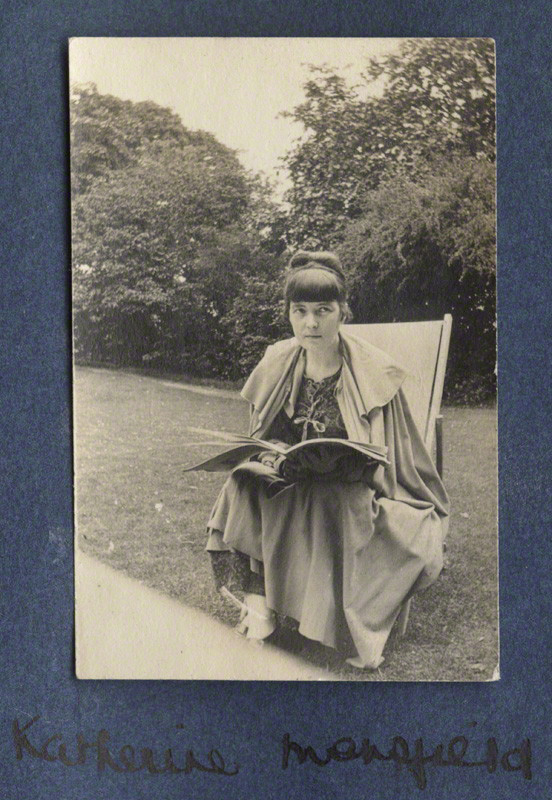
A barrel-organ starts playing in the street, and two women jump to their feet. Josephine tells Constantia to run: there is money to send the musician away. Then both remember that their father is dead. The noise can continue. In the final section of Katherine Mansfield’s “The Daughters of the Late Colonel,” freedom first arrives as a household task that no longer needs doing.[1]
The discovery is almost comic in its smallness. No one must win an argument, secure permission, or make a courageous exit. The sisters can simply remain where they are and listen. Yet by the end of this brief scene, neither can tell the other what she wants. Mansfield gives them a world that has changed and a conversation that still obeys the old rules.
The story appeared in the London Mercury in 1921 and was collected in The Garden Party and Other Stories the following year.[2] Its opening finds the sisters busy with the practical and ceremonial aftermath of their father’s death. Even the possibility of giving away his hat requires them to imagine his response. By section XII, the closing scene, the colonel’s power has become an automatic movement: music begins, daughters spring up, nuisance must be removed. His absence takes a moment to catch up with their bodies.[1]
That delay matters. Mansfield does not merely tell us that the sisters have been dominated. She lets obedience happen in front of us, efficiently and without a living person to command it. When they stop, the interruption opens a little space in the day. For once, the music belongs to them.
The prose changes with it. The barrel-organ seems to supply words about the stick that will never thump again; sunlight settles on the carpet and deepens toward gold. Josephine announces the sun’s appearance “as though it really mattered.” That qualification catches the old practical mind encountering something it has not been trained to value. Weather has ceased to be background. Pleasure is briefly important enough to mention.[1]
Mansfield then allows each sister a separate inward passage before bringing them together. Josephine watches sunlight reach their mother’s faded photograph. She wonders whether a different childhood might have led to marriage, and remembers the almost total absence of opportunities to meet men. Constantia recalls a more private freedom: going close to the sea and singing something she had invented. Beside these memories, errands and the arrangement of their father’s trays seem unreal.[1]
The distinction prevents the women from collapsing into a single picture of deprivation. Josephine tries to reconstruct the social life that might have happened. Constantia remembers occasions when she already felt most herself. One looks toward a missed possibility; the other toward experiences that might be recovered. Mansfield gives us access to both movements of thought, but the sisters do not yet have access to each other’s.
Their inward questions accelerate toward the present: “Now? Now?” It is a tiny change in tense with an enormous emotional reach. The past can be rehearsed indefinitely. Now requires a next action. Constantia walks over to Josephine, wanting to speak about the future, and begins: “Don’t you think perhaps—”. Josephine interrupts with “I was wondering if now—”.[1]
Both openings reach outward. Each sister has something to offer; each also leaves her thought dependent on another clause. Constantia asks for agreement before identifying the proposal. Josephine begins inside the shelter of wondering. The dashes preserve the moment before either must commit herself. We hear the courage of starting and the precautions that make starting safer.
Then comes an exquisitely uncomfortable exchange about whose turn it is. Josephine invites Constantia to continue. Constantia insists that Josephine speak first. The invitation becomes insistence; insistence becomes irritation; eventually they are calling each other’s familiar names. The subject has vanished beneath the management of the conversation.[1]
It would be too easy to blame this on excessive good manners. Josephine’s sharper responses also repeat the unequal rhythm heard elsewhere in the story, while Constantia’s retreat keeps that rhythm going. Tenderness, impatience, and habitual deference are entangled. My reading is that neither woman needs to intend suppression for the exchange to suppress them both. Each waits for the other to make speaking possible, and each becomes another reason to wait.
Constantia finally says she has forgotten her thought. Josephine looks at a cloud where the sun had been and answers, “I’ve forgotten too.” The weather has changed during a conversation that has achieved almost nothing. The word too joins them again, but in a shared loss. For the reader, who has just witnessed their separate longings, the forgetting is painful because something was there to be said.[1]
Thomas Hardy apparently wanted more of the sisters. In her study of Mansfield’s developing literary confidence, Louise Jane Edensor quotes the writer’s response to his request, sent to Dorothy Brett in 1921: “As if there was any more to say!”[3] The impatience illuminates the ending’s peculiar completeness. A reader may want to know what happens next, but the story has already made its particular failure visible. Another episode would not necessarily bring us closer to the thought that disappeared.
The story does not show enough of the future to establish that the sisters will remain unchanged forever. It does show why their father’s death cannot by itself supply a new way of living. The last conversation is a small, exact test: can a private wish survive the journey into shared speech? For this afternoon, it cannot. The musician has been allowed to play; the daughters still cannot quite allow themselves a turn.
Sources
- Katherine Mansfield, “The Daughters of the Late Colonel,” in The Garden Party and Other Stories (1922), Project Gutenberg — primary text, especially sections I and XII.
- Brigham Young University, Modernist Short Story Project, “Daughters of the Late Colonel” — original publication in the London Mercury, volume 4, issue 19 (1921), pages 15–30, and collection history.
- Louise Jane Edensor, Katherine Mansfield and Conceptualisations of the Self, PhD thesis, University of Northampton (2018), page 215 — Mansfield’s response to Hardy, quoting her letter to Dorothy Brett in Collected Letters, volume 4, page 316.
- Wikimedia Commons, “Mansfield 1917.jpg” — Ottoline Morrell’s photograph of Katherine Mansfield, dated 1916–1917; National Portrait Gallery, London, NPG Ax140568.