Many readers approach The Epic of Gilgamesh as a museum obligation: very old, very important, probably stiff. That expectation gets the poem almost exactly wrong. Gilgamesh is ancient, but it is not remote in the way prestige can make old books remote. It is fast, physical, wounded, and surprisingly practical. Its deepest question is not "What did people believe long ago?" but "What can a human being do with power, love, grief, and the knowledge that the body ends?"[1][2][4]
The best way in is to stop treating the poem as a monster adventure with a famous flood episode attached. Begin instead with the wall of Uruk. The Standard Babylonian opening, often rendered as the story of the one "who saw the Deep," sends the reader toward a built city before it settles into remembered action.[1][2] That matters. The poem starts from civic form, not from wilderness spectacle. Gilgamesh will fight Humbaba, reject Ishtar, lose Enkidu, seek Utnapishtim, and fail to keep the plant of renewed life. But the frame keeps pulling him, and us, back toward what can actually remain: a city, a story, a tablet, a name set into human work.[1][2][5]
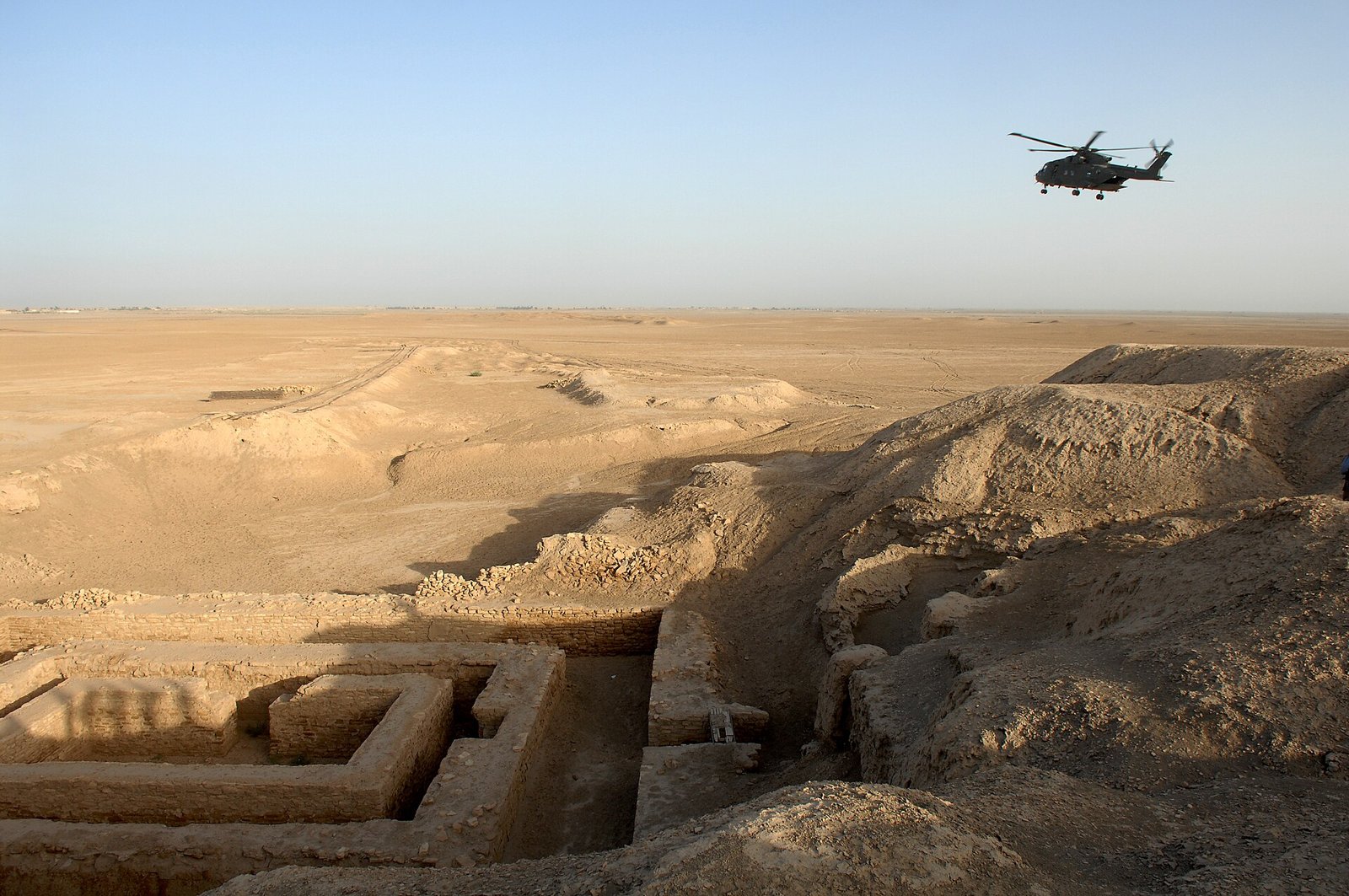
Image context: the cover photograph shows Uruk/Warka as a real landscape rather than an isolated museum object. That is the right reading cue for this guide: the poem asks us to look first at the city and its wall, then to understand monsters, friendship, grief, and the failed immortality quest as movements that return Gilgamesh to civic form and mortal work.[2][6]
1) Read for the wall first
The wall is the poem's first reading instruction. Uruk is not just background scenery; it is the scale against which Gilgamesh's life is judged.[1][2] He begins as an excessive king, part divine and part human, with strength that has become social damage. The city needs him, but it also suffers under him. That contradiction is essential. Gilgamesh is not interesting because he is powerful. He is interesting because power without measure must be educated.
So when the poem directs attention to Uruk's masonry, it is doing more than boasting about ancient architecture. It is telling the reader to measure heroic life against durable civic form.[1][2] A monster can be killed. A journey can be survived. A plant can be stolen. A wall, if maintained, can hold collective memory longer than any single body. The ending will return to that same logic, which means the opening is not ornamental. It is the answer in advance, though Gilgamesh cannot understand it yet.
For a first reading, keep one question beside you: where does the poem move from private appetite toward shared form? The answer is not immediate. Early Gilgamesh treats the city as a stage for his own force. The later Gilgamesh will return to the city after discovering that no heroic exception releases him from mortality.[1][2] The arc is not from bad king to saint. It is from unbounded force to bounded knowledge.
2) Let Enkidu be more than the "wild man"
Enkidu is often introduced as Gilgamesh's double, rival, or companion. All of that is true, but too thin. Enkidu is the poem's first major experiment in human formation. He begins outside the city, among animals, then is drawn into human life through desire, food, clothing, speech, and social recognition.[1][4] The Yale University Press excerpt from John Carey's account usefully emphasizes that Enkidu's movement into human community is not a single conversion but a sequence of bodily and social changes.[4]
That sequence changes Gilgamesh too. Their first serious relation is not sentimental agreement but resistance. Enkidu comes to stop Gilgamesh; the poem turns that confrontation into friendship.[1][4] This is one of the reasons the story still feels alive. Friendship here is not leisure, affinity, or polite support. It is a force that interrupts tyranny, redirects energy, and makes heroic ambition shareable.
Read the Cedar Forest episode through that lens. On the surface, it is a quest narrative: two heroes, a distant forest, a terrifying guardian, a victory.[1][2] Underneath, it is a test of what companionship does to courage. Gilgamesh and Enkidu strengthen each other, but they also amplify each other. Together they can act beyond ordinary human scale; together they can also overreach. The poem does not ask us to choose between admiration and unease. It lets friendship become both humanizing and dangerous.
That double quality prepares the grief. Enkidu's death is not merely a plot reversal that sends Gilgamesh on the next adventure. It is the moment when companionship teaches the fact that power had concealed. Gilgamesh sees death not as an abstraction or battlefield risk, but as the loss of the one person who made his own force intelligible.[1][5] Read slowly there. The poem's energy changes from outward conquest to inward panic.
3) Treat the flood episode as a detour with a purpose
Tablet XI is famous because it contains a flood story with parallels that startled nineteenth-century readers once the cuneiform tablets were deciphered.[3][4][5] That fame can distort a first reading. The flood episode is important, but in Gilgamesh it is not a detachable comparative-religion exhibit. It is part of Gilgamesh's failed attempt to turn grief into an exemption.
He goes to Utnapishtim because Utnapishtim survived what ordinary humans did not survive and received a kind of life beyond the normal limit.[1][5] The flood story therefore enters the poem as testimony, but also as a correction. Utnapishtim's exceptional survival does not become a transferable method. Gilgamesh wants the secret that will make mortality negotiable. What he receives is a story of catastrophe, divine decision, survival, and separation from ordinary human conditions.[1][5]
This is why the flood tablet makes such a good cover image for a reader's guide. It is visually the most archive-like object in the poem's modern afterlife, but narratively it marks the limit of Gilgamesh's hope. The story survives on clay; Gilgamesh's body will not survive by learning it. That tension is the poem's hard lesson: literature can preserve an encounter with mortality without abolishing mortality itself.[1][3][6]
4) Do not rush the failed immortality quest
The last movement can feel almost cruel on a first reading. Gilgamesh reaches the distant survivor, hears the flood account, receives tests and instructions, and still cannot secure what he wants.[1][5] Even the plant of renewed youth, once found, is lost. The episode is easy to summarize as "he fails." But the poem's art lies in how many kinds of failure it distinguishes.
First, he cannot stay awake. That failure is bodily and immediate. Then he cannot keep possession of the plant. That failure is practical and worldly. Finally, he cannot convert exceptional knowledge into escape from human limits. That failure is metaphysical, and it is the one the poem has been preparing all along.[1][2]
Do not read this as a simple moral about accepting death cheerfully. Gilgamesh does not become serene. The poem is too honest for that. What changes is the scale of possible action. He returns to Uruk with no immortality prize, but the city remains available to be seen, named, and shown.[1][2] The wall has been waiting since the opening. The reader now understands why.
5) Use the poem's brokenness as part of the experience
Modern readers often want a clean text. Gilgamesh resists that desire before interpretation even begins. The surviving tradition includes Sumerian stories, Old Babylonian material, and the later Standard Babylonian epic; the Electronic Babylonian Library presents the poem as a scholarly critical edition rather than as a single seamless manuscript.[2] Wikisource's public-domain collection likewise makes visible how older translations and fragments enter the modern reading record.[1]
That textual brokenness should not be treated as a defect to apologize for. It is part of what makes the poem powerful now. We read a story about a man who wants permanence through a tradition that has itself survived by damage, copying, recovery, translation, and reconstruction.[1][2][3] The gaps matter because the poem's subject is already loss. The archive does not contradict the theme. It intensifies it.
The cleanest first-reading plan is therefore simple:
- Read one complete modern translation if you have it, but keep a public text or scholarly edition nearby for orientation.[1][2]
- Mark every return to Uruk, walls, tablets, or naming.
- Track how Enkidu changes the meaning of strength.
- Read the flood as a mortality episode, not as an isolated flood-comparison sidebar.
- Let the ending feel unresolved before deciding what it means.
The payoff is that Gilgamesh stops being "the old epic" and becomes a book about scale. Human beings want more life than they can have. They build, love, mourn, travel, learn, fail, return, and tell. The poem does not pretend that telling is the same as living forever. It offers something smaller and more durable: a record of a person learning that the work of mortality is not to escape the wall, but to see it, touch it, maintain it, and know what it can and cannot keep.[1][2][5]
Sources
- Wikisource, "Epic of Gilgamesh" - public-domain translation collection and table of Old Babylonian and Standard Babylonian materials.
- Electronic Babylonian Library, "I.4 Poem of Gilgamesh" - open scholarly critical edition and translation interface.
- The British Museum, object record W_K-3375, "tablet" - Flood Tablet / Gilgamesh Tablet XI object record.
- John Carey, "The Epic of Gilgamesh," Yale University Press blog, April 30, 2020 - publication and story-context excerpt from A Little History of Poetry.
- Encyclopaedia Britannica, "Epic of Gilgamesh" - summary, textual history, and reception overview.
- Wikimedia Commons, "File:Uruk Archaeological site at Warka, Iraq MOD 45156521.jpg" - source page for the real-world Uruk/Warka site photograph used as the article cover.