Olaudah Equiano's Interesting Narrative is easy to file under "slave narrative" and leave there. That label is accurate, but it can flatten the book's method. Equiano is not simply recounting suffering in chronological order. He is arranging a set of recurring signs so that readers feel how slavery turns people into cargo, how freedom has to be bought inside the very economy that denies personhood, and how print can become a counter-record against that economy.[1][2]
The title page already announces the pressure: Equiano, also known as Gustavus Vassa, presents the work as "written by himself."[1] That phrase matters because authorship is part of the argument. The book asks readers to accept not only the facts of a life but the authority of a Black Atlantic witness who can name, calculate, travel, judge, remember, and publish. British Library scholar Brycchan Carey notes that the book appeared in 1789, just as Parliament was debating the slave trade, and that it became a public intervention as well as an autobiography.[2]
Three motifs carry much of that force: the sea, the ledger, and the printed name. They do not stay in separate symbolic lanes. The sea is where terror and mobility meet. The ledger is where money exposes the moral absurdity of a market in persons. The printed name is where a man repeatedly renamed by owners and institutions uses the page to reclaim testimony.
The Sea Is Not Just Passage
The sea in Equiano is never only scenery. It is first a machinery of terror: the Middle Passage, shipboard confinement, bodies pressed into a commercial system that treats survival as a shipping variable.[1][4] The Smithsonian's teaching module on Equiano places his account beside primary-source materials about slave-ship conditions, including shackles and the famous Brookes plan, because the narrative's shipboard details force readers to confront the physical management of enslaved bodies.[4]
Yet the sea also becomes the route by which Equiano learns skills, geography, and the contradictory language of empire. After his sale to the naval officer Michael Pascal, he moves through the Atlantic and Mediterranean worlds, sees war, learns seamanship, and begins to acquire literacy and numeracy.[2][5] The sea is therefore double. It is the space of coerced movement, but it is also the space where Equiano gathers the practical knowledge that later helps him survive.
That doubleness is one reason the book resists simple moral staging. Equiano never lets readers forget the violence of forced crossing. At the same time, he understands ships as social and technical worlds: places of rank, labor, navigation, discipline, and exchange. The same deck that can turn an African child into cargo can later become a workplace where a man learns how Atlantic power operates. The sea motif keeps that contradiction visible.
Equiano's sea is also an archive of scale. It links an Igbo childhood, Barbados, Virginia, Montserrat, London, naval warfare, Caribbean trading, and even Arctic exploration.[1][2] The narrative's movement is not random adventure. It shows slavery as a system of circulation, and then shows Equiano learning to read that circulation from within.
The Ledger Makes Freedom Bitter
The ledger motif is less visually dramatic than the sea, but it is just as important. Equiano's road to freedom depends on small acts of trade, saving, bargaining, and calculation. On Montserrat, under Robert King, he earns and saves enough to purchase his legal freedom in 1766.[2][5] That fact can sound like a triumphant self-making episode until the book's moral arithmetic is allowed to bite.
Freedom should not have a purchase price. Equiano's achievement is real, but the conditions that make it necessary are obscene. The ledger records both his discipline and the market's violence. Every saved coin confirms his agency while also confirming the premise that a human being's liberty can be priced by another person.[1][2]
This is where the book's prose becomes sharper than an inspirational survival story. Equiano often presents himself as careful, industrious, observant, and commercially competent.[1] Those traits matter because he is answering a racist public world that doubted Black capacity. But the ledger is not merely a certificate of respectability. It is also an indictment. If Equiano can work, trade, sail, calculate, convert, write, and publish, then the slave system's claim over him appears even more nakedly fraudulent.
The ledger also helps explain why the book moves so often between intimate injury and public evidence. Equiano's separation from "my beloved sister" is private grief.[1] His later experience of fraud, threat, and re-enslavement as a free Black man is social proof.[2] The narrative keeps turning personal episodes into evidence about a wider system: a market in which paperwork, price, and power can override family, memory, baptism, labor, and law.
The Printed Name Answers Renaming
Equiano's naming history is one of the book's quiet engines. He is Olaudah Equiano, but he is also Gustavus Vassa, the imposed name by which he was widely known in Britain.[2][3][5] The title holds both names together rather than choosing a clean identity story. That doubleness is not a flaw in the book's authority. It is the record of a life lived through coercive renaming, Atlantic mobility, Christian conversion, and public authorship.
Equiano's World, a project from the Harriet Tubman Institute, stresses that Gustavus Vassa identified himself as African, Ethiopian, and ethnically "Egbo," and that the 1789 publication went through multiple editions in Britain as well as a New York printing.[3] Britannica similarly notes the book's wide circulation and its later importance in the history of slave narratives, while also noting modern scholarly debate over documents that raise questions about Equiano's birthplace and the relation between memory, reading, and testimony.[5]
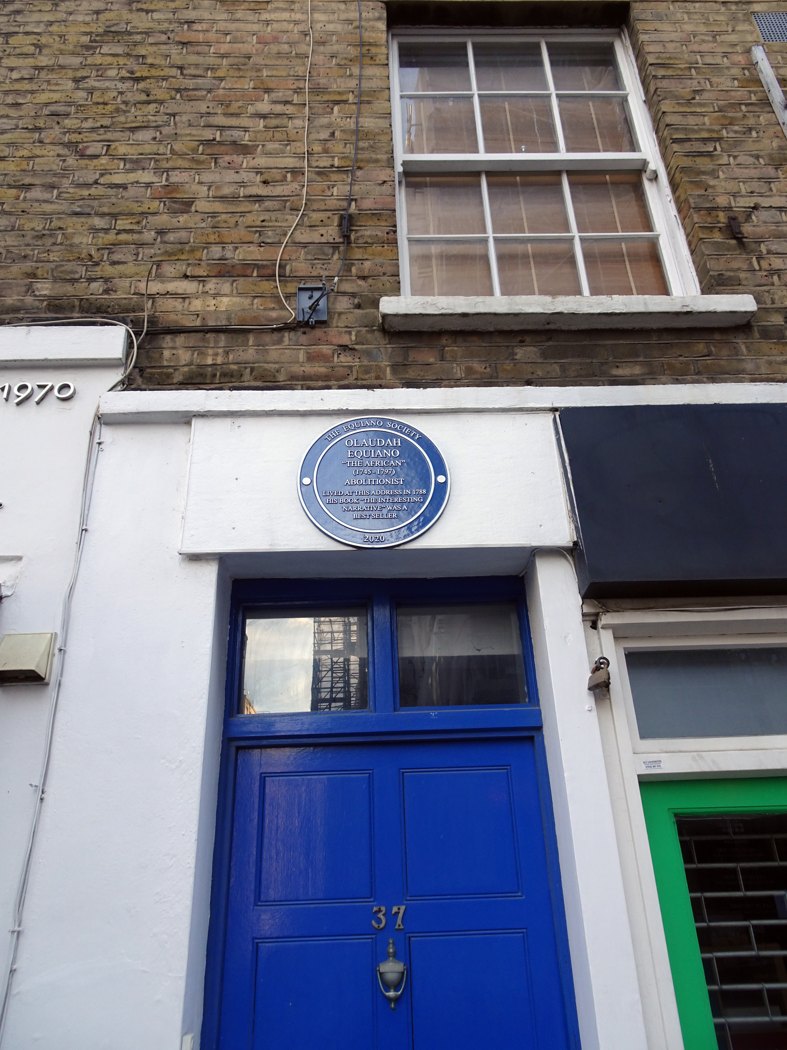
That debate matters, but it should not reduce the work to a fact-checking trap. The literary force of the printed name lies in how Equiano constructs public credibility under hostile conditions. A later memorial plaque on Tottenham Street makes the afterlife of that printed name visible in another register: not the first act of testimony, but the civic persistence of a name that slavery, commerce, and imperial paperwork repeatedly tried to unsettle.[6]
Print lets Equiano do what slavery repeatedly tries to prevent. It lets him stabilize a name, address readers directly, assemble scattered movement into narrative sequence, and convert experience into political testimony. The book became part of abolitionist public culture not because it was merely moving, but because it was portable evidence.[2][3][5]
Why The Motifs Still Work
Read through these motifs and the Interesting Narrative becomes more than a witness text assigned for historical context. It becomes a literary machine for exposing contradiction. The sea says that empire moves people and goods through the same routes, but not with the same moral status. The ledger says that money can buy legal freedom while revealing the corruption of any system that sells it. The printed name says that testimony can resist erasure, even when the life behind it has been renamed, displaced, and forced through other people's records.
The book's power is not that Equiano turns suffering into a neat ascent. He does something harder. He keeps the wound, the skill, the calculation, and the public argument in the same frame. The result is a narrative in which survival never becomes private escape. It becomes a document aimed at readers who are being asked to decide what kind of evidence they are willing to believe.
That is why a photographed memorial plaque works better here than a decorative book-page reproduction. The article's argument is not only that Equiano entered print as author, witness, and public actor; it is also that the printed name kept moving after him, into libraries, classrooms, abolition history, and the ordinary surfaces of a city street. The plaque does not undo the violence. It records the survival of a counterclaim against it.[1][2][6]
Sources
- Olaudah Equiano, The Interesting Narrative of the Life of Olaudah Equiano, Or Gustavus Vassa, The African - Project Gutenberg eBook page with public-domain text, updated October 4, 2024.
- Brycchan Carey, "The Interesting Narrative of the Life of Olaudah Equiano." British Library Discovering Literature, contextual essay on the work, publication moment, abolition campaign, and freedom purchase.
- Harriet Tubman Institute, "Equiano's World" - biographical and scholarly project on Gustavus Vassa/Olaudah Equiano, editions, abolition context, and testimony.
- Smithsonian National Museum of American History, "Olaudah Equiano" - teaching module using Equiano's account with primary-source context for life at sea and the Middle Passage.
- Encyclopaedia Britannica, "Olaudah Equiano" - biographical overview, publication history, reception, and summary of modern scholarly debate over origins and memory.
- Wikimedia Commons, "Olaudah Equiano plaque 37 Tottenham Street London W1T 4RU" - source page for the memorial-plaque photograph used as the article cover.