Most people delay War and Peace for one reason: they expect an endurance test. That expectation is understandable, but it is strategically wrong. Tolstoy did not write a “long book that eventually pays off.” He wrote a system that alternates social rooms, battlefield perception, and argument about historical causality. If you enter with the right reading posture, the size becomes a feature, not a barrier.
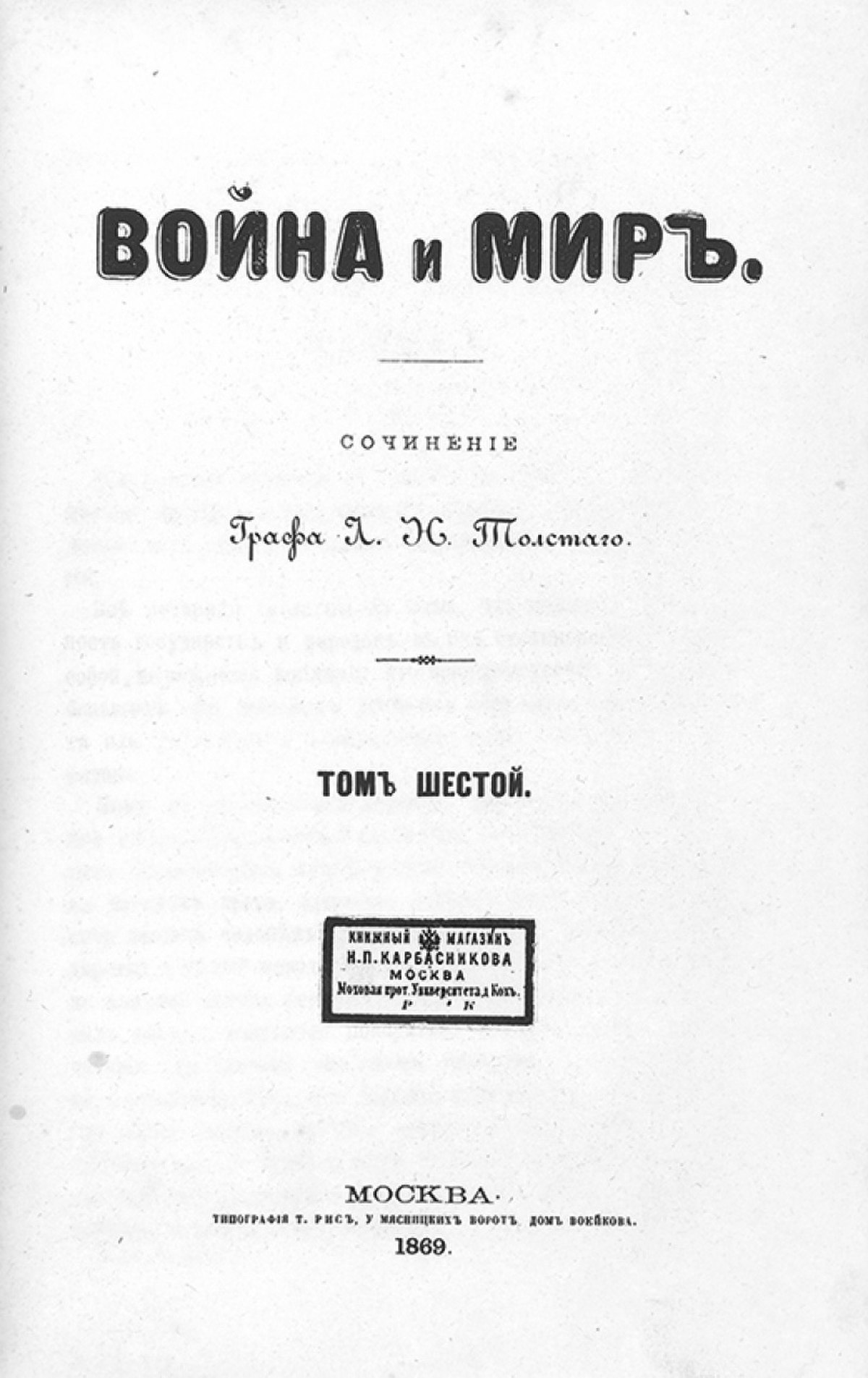
Image context: the header image uses the 1869 first-edition cover as a material cue for publication history, reinforcing that this guide starts from textual entry and edition choice before interpretation.
A useful way to start in 2026 is to treat War and Peace as three concurrent tracks:
- People track (who is changing and why),
- Event track (what pressure the Napoleonic timeline applies),
- Ideas track (what Tolstoy thinks history is, and is not).
If you keep those tracks separate in your notes, the novel stops feeling like one giant undifferentiated “classic.”
1) Start from the opening room, not from fear of the page count
Tolstoy opens with social electricity, not military exposition:
“Well, Prince, so Genoa and Lucca are now just family estates of the Buonapartes.”[1]
That line (Book One, Chapter I) tells you the reading method immediately. Geopolitics enters as drawing-room speech before it enters as cannon fire. In other words, power first appears as tone, status signaling, and conversational positioning. If you read the early salon scenes as “just setup,” you miss the novel’s core instrument: history arrives through social performance before it arrives through official narrative.
High-value first move: in your first 80–100 pages, track only five names with one-line tags (Pierre, Andrei, Natasha, Nikolai, Marya). Resist the impulse to catalog every aristocratic branch. Tolstoy rewards orientation, not total memorization.
2) Pick your text deliberately, then commit for momentum
For an English-first read, Project Gutenberg’s Maude translation is the lowest-friction legal entry point and includes full-text search, which matters in a book where motifs recur across long intervals.[1] Use that for speed and continuity.
Then, if a passage feels unusually dense or flat, compare one modern print translation sample before moving on. The goal is not to “solve” translation wars chapter by chapter. The goal is momentum first, calibration second.
A practical 2026 rule:
- Primary pass: one edition, uninterrupted.
- Selective check: compare only 3–5 key passages (opening salon, Austerlitz sky moment, Pierre captivity arc, late historical chapters).
This avoids the common failure mode where readers consume translator discourse instead of the novel itself.
3) Read war scenes for perception under pressure, not for tactical mastery
Many first-time readers over-index on military detail and under-read Tolstoy’s perception logic. Battle chapters are not written as clean command maps; they are written to show what finite actors can and cannot know in real time.
When you hit Austerlitz or Borodino sections, ask three repeatable questions:
- What does this character believe is happening right now?
- What information is missing or delayed?
- Which later narrator frame retrofits coherence onto confusion?
If you read this way, the war material becomes emotionally legible and philosophically continuous with the domestic plot. Tolstoy is not only depicting campaigns; he is dismantling the fantasy that history is made by fully informed planners.
4) Don’t skip the history chapters—change how you read them
Readers often treat Tolstoy’s explicit history argument as optional appendix. That costs too much. The novel’s narrative scenes and argumentative chapters are mutually explanatory.
Book Nine, Chapter I gives one of the programmatic lines:
“A king is history’s slave.”[1]
Later, Tolstoy pushes toward method language:
“…only by taking infinitesimally small units for observation … can we hope to arrive at the laws of history.”[1]
You do not need to agree with every claim to benefit from the sections. Read them as theory pressure applied to the fiction: Tolstoy is testing whether “great man” storytelling can survive contact with distributed causation.
A workable method is to annotate these chapters with two symbols only:
- [D] where Tolstoy argues for distributed causality,
- [R] where he rejects retrospective hero explanations.
By the end, your margin map will show how often the fiction has already staged the same argument before the essay voice names it.
5) Use character clusters, not family trees, to avoid burnout
Family trees help, but static diagrams can flatten the novel’s dynamic energy. A better approach is cluster reading:
- Search for meaning cluster: Pierre, Platon Karataev, captivity, Freemasonry arcs.
- Duty and disillusion cluster: Andrei, staff culture, battlefield ideal collapse.
- Domestic time and growth cluster: Natasha, Marya, Nikolai, household economy.
Re-grouping by moral trajectory keeps the reading alive even when chapters switch quickly between theaters of action.
6) Schedule the book by cognitive load, not by page quotas
A rigid “50 pages per day” plan fails because Tolstoy alternates densities. Some stretches are dialogue-light and concept-heavy; others are scene-fast and emotionally immediate.
Try a load-aware cadence instead:
- Light day: 20–30 pages of high-density reflection chapters.
- Flow day: 40–60 pages of scene-driven narrative.
- Reset day: reread one previously marked scene plus one short history section.
This rhythm keeps recall high and resentment low, especially for readers balancing full-time work.
7) Keep one late-book quote as your orientation check
Near the end (Book Fourteen, Chapter XV), Tolstoy writes:
“Life is everything. Life is God. Everything changes and moves and that movement is God.”[1]
Whether or not you share Tolstoy’s metaphysical framing, this line helps orient the whole architecture. The novel keeps moving between individual consciousness and mass movement, intimate scenes and continental war, error and revision. The point is not static verdict. The point is living process under historical force.
That is why War and Peace remains high-value reading in 2026: not because it is “important,” but because it trains scale-switching—between room and empire, mood and institution, event and explanation—without collapsing any level into pure slogan.
A compact entry plan (if you are starting this week)
- Choose one main text and lock it for 300 pages.[1]
- Track five core characters only until your first major battle section.
- Mark [D]/[R] in history chapters instead of skipping them.
- At each major pivot, write a 4-line checkpoint: “who changed, what pressure changed them, what remains uncertain.”
- Finish by revisiting your opening notes from Chapter I; compare what you first thought mattered with what Tolstoy proved mattered.
That final comparison is where the novel usually becomes personal.
Sources
- Leo Tolstoy, War and Peace (trans. Louise and Aylmer Maude), Project Gutenberg
- Encyclopaedia Britannica, “War and Peace”
- Encyclopaedia Britannica, “Leo Tolstoy”
- Encyclopedia.com, “War and Peace”
- Wikipedia, “War and Peace” (publication timeline and edition context)
- Wikimedia Commons, first-edition image file page