Benjamin Franklin buys too much bread on his first morning in Philadelphia. Newly arrived from Boston, he orders by price because he doesn't know the local names for the loaves. Threepence gets him more than he can put away. He eats one roll as he walks up Market Street with the other two tucked under his arms. A girl standing in a doorway takes him in. Franklin can tell us what she thought of him because he eventually married her. Imagine hearing this story as the person to whom he addressed it. The girl in the doorway is someone his son William already knows. [1]
“Dear Son” comes at the top of the manuscript Franklin began at Twyford in 1771. His first appeal is to a shared memory. William once went with him to look up relatives in England. Now the father has a week of leisure and some family stories his traveling companion has yet to hear. Open the book at that salutation and the little scene on Market Street feels like a favor. William gets to see two familiar people on the last morning they were strangers to one another. [1][2]
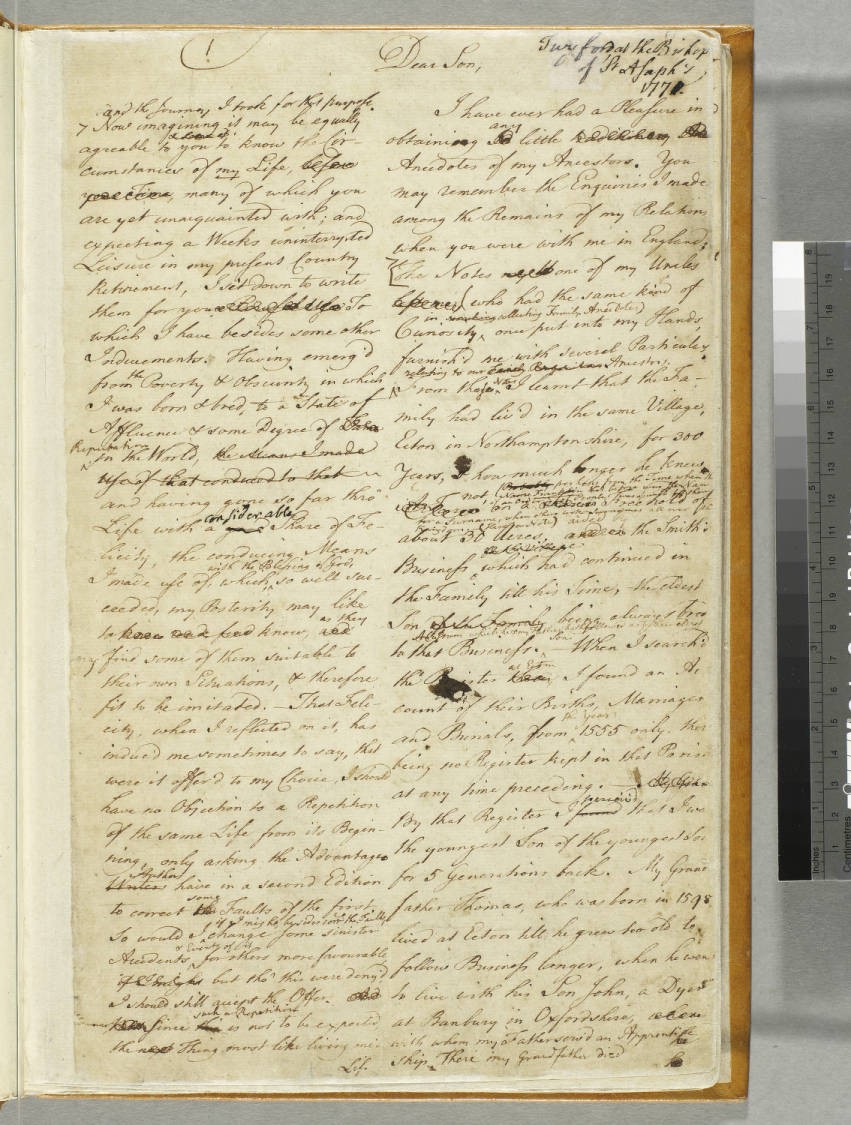
Even here, though, Franklin has an eye on what a stranger might get out of the story. Just before he walks us through his arrival, he asks us to compare the boy entering Philadelphia with the man he has become there. Try holding that instruction in mind through the business at the bakery. What talent for getting ahead does an order of bread demonstrate? Franklin has misjudged the price. His one piece of good sense comes a little later, back at the wharf, when he gives the spare rolls to a woman and her child. A less patient teller could have gone straight to that act of kindness. Franklin keeps us walking long enough for someone else to have a perfectly good laugh at him. [1]
The audience he half anticipates eventually writes back. In 1782 his friend Abel James sent him a letter and a copy of his own outline, urging him to take up the interrupted narrative. That returned outline became a working document for the later parts. Another friend, Benjamin Vaughan, also wrote to encourage him. Franklin inserted both letters at the break. The evidence of how the book got going again became part of the book itself. A reader crossing that gap in an abridged edition can miss quite a change of company. In the Standard Ebooks text, for instance, the letters survive as a mention in an editorial footnote. [1][3]
When Franklin resumes at Passy in 1784, he explicitly identifies the public as his audience. Soon he gives this larger company something a stranger could actually use. His account of practicing thirteen virtues includes the layout of a little book, with a line for each virtue and a column for each day. A fault earns a spot. A reader could rule a sheet of paper the same way that afternoon. And then comes the problem of Order, a virtue that requires Franklin to give everything its place and every piece of business its time. A printer who must see customers when they have time has an excellent professional reason for a messy row. An excellent excuse, too, as anyone keeping such a sheet is likely to notice. [1]
Here the family storyteller earns his keep again. A customer wants an ax polished all over. The smith agrees if the customer will turn the grindstone. After a spell at the handle the customer discovers a taste for a “speckled ax.” Franklin puts the joke just where he has begun to suspect that a little disorder might suit him. He lets us hear how persuasive the man at the grindstone sounds to himself. We have had some practice at this double vision. On Market Street we could see both a future citizen of consequence and a boy with no idea where to put his bread. [1]
There was once a public for whom the break in this book really was the end. The first printed edition, published in Paris in French in 1791, contained only the first part. English translations made from that French edition followed in 1793. Those readers could meet the boy with the bread without ever getting the instructions for ruling a page of virtues. [4] Read across the break today and a quieter piece of instruction travels with him. Franklin gives the stranger who wants to follow his example the privilege he first gave his son. You get to stand in the doorway and see how funny he looks. [1]
Sources
- Benjamin Franklin, The Autobiography of Benjamin Franklin. Standard Ebooks, especially the Philadelphia arrival, the note at the break, and the plan for moral perfection.
- The Huntington Library, Franklin’s autograph manuscript, part one, page one. Source of the manuscript photograph.
- Library of Congress, The Autobiography in Manuscript. Abel James’s letter and the working outline.
- Library of Congress, The Autobiography in Print. Early French and English editions.