Esther Waters gets plenty to eat in her new situation. There are sandwiches, porter, carefully prepared meat; her employer takes a personal interest in her supper. After childbirth and near destitution, the attention feels extraordinary. It also has a purpose. Esther has been hired as a wet nurse, and every nourishing mouthful helps her produce milk for somebody else's baby.[1]
Her own son is elsewhere, in the care of a woman she pays. To keep him alive she must earn money; to earn this money she must leave him. George Moore places that contradiction inside an apparently comfortable nursery, then watches Esther discover how little room the arrangement allows for her wishes.
First published in 1894, Esther Waters makes a domestic servant's continuing life the subject of a novel. Andrzej Diniejko places it within the transition from fiction about the disgraced unmarried mother to New Woman fiction, while stressing how far Esther stands from the educated, financially independent heroine associated with that label.[2] Her independence has to be attempted with a baby in her arms and almost nothing in her pocket.
This essay discusses the novel's ending. Chapter references follow the 1899 text reproduced by Project Gutenberg.[1]
Who is allowed to be anxious?
In chapter XVIII, the bargain has exact terms. Mrs. Rivers offers fifteen shillings a week, with board and lodging. Esther had hoped for a pound. Mrs. Spires, who will mind her son, insists on six shillings rather than the five Esther proposes. Before Esther begins work, her time and money already answer to competing demands: the household buying her time and the household charging to care for her child.[1]
Moore lets the prospect excite her. After leaving Jack with Mrs. Spires, she imagines her luck turning, and nearly misses her stop. This pleasure matters to the portrait. Esther can be hopeful, relieved, susceptible to the promise of good wages. Her later refusal gains force because she has first wanted the arrangement to succeed.
Then the meals accumulate and the supervision becomes apparent. Her walks are restricted; she never goes out alone. When she asks for a couple of hours to visit her son, Mrs. Rivers suggests a letter. Esther cannot write. The apparent compromise therefore requires another person's assistance even before it fails to meet her wish to see the baby herself.[1]
Her answer uses the evidence immediately before her. Mrs. Rivers visits the nursery repeatedly because she worries about her own child. Esther asks that the same feeling count when it belongs to a servant. The comparison is almost embarrassingly simple. Its simplicity exposes the effort required to keep these two mothers in different moral categories.
Mrs. Rivers understands anxiety perfectly well. She treats Esther's anxiety as a disturbance to be managed, because an upset nurse might affect the child she employs her to feed. Concern travels down the household hierarchy and returns as a question about performance.
When Mrs. Spires arrives with news that Esther's boy is unwell, Mrs. Rivers pays for medical attention and instructs her to stop troubling the nurse. The payment addresses an expense while keeping Esther at work. It cannot answer the question Esther is trying to settle: what is happening to her child?[1]
The cost of leaving
Esther repeats, “I must see my baby.” Later, her sentence becomes “I'm going to my own child.”[1] The change is small and decisive. A need has become an action. She no longer waits for her employer to recognize the claim before acting on it.
The exchange retains an uncomfortable tenderness toward the other infant. Esther says she is sorry to leave the little girl, who has been doing well. Moore allows that attachment to remain. Her choice hurts because two children need care and the employment arrangement has made their needs compete.
Mrs. Rivers threatens to withhold her pay. Esther leaves anyway. In chapter XIX, the first thing she does outside is feel in her pocket. There is enough for the omnibus, barely. That practical gesture keeps the departure from becoming an effortless declaration of freedom. We have heard her courage; now we feel what it has cost.[1]
At Mrs. Spires's house, Esther finds her son thinner and the promised doctor unsummoned. The child-minder gradually offers to take the baby permanently for five pounds, disguising a lethal arrangement as adoption. Esther understands what she is being invited to purchase. She refuses, escapes with her son after being physically restrained, and walks until she realizes she has nowhere to go.[1]
The sequence gives her judgment its proper scale. She can identify a wrong and resist it. She cannot produce a bed, a wage, and trustworthy childcare by being right. Rescue ends with another search for shelter.
There is also a reason to read Moore's admiration carefully. In the nursery episode, his narrator calls Esther's mind an “obtuse brain,” even while following her toward an understanding her employer would rather suppress.[1] Florence Boos's University of Iowa teaching questions draw attention to the narrator's role and ask how readers are meant to judge Esther's limitations.[3] The question helps us hear the friction: the narration grants her sustained attention while sometimes describing her from above.
Esther's speech can outgrow that condescension. She discovers the arrangement's cruelty by connecting the food, the restrictions, the sick baby, and the money. Her reasoning develops through what people do to her. Reading her only as an instinctively devoted mother would miss the work of understanding that makes her refusal possible.
Help that lets her remain a mother
Much later, after marriage, bereavement, and further labor, Esther returns to service at Woodview. The final chapters offer companionship with her former employer, Mrs. Barfield. The two women sew, talk about their sons, and worship together; Mrs. Barfield reads aloud. They still eat separately, and Esther still says “ma'am.” Affection has grown within a relationship whose social distinctions remain visible.[1]
Yet a crucial difference emerges when Jack needs money. Esther has already sent all she can spare. Mrs. Barfield offers help, accepting that work on the neglected garden must wait. Where Mrs. Rivers regarded the servant's child as an interference with household needs, Mrs. Barfield allows his needs to change the household's plans.[1]
That is the practical support Esther's determination has been missing. Someone with resources agrees to bear a cost. The garden can remain untidy; the boy must eat.
The novel ends with Jack visiting in army uniform. Esther is proud, and her happiness is real. The narrator nevertheless inserts the possibility that he could become “food for powder and shot.”[1] She has brought him to adulthood without acquiring control over the conditions of his adult life.
Her final introduction is beautifully plain: “This is my son, ma'am.”[1] The respectful address survives beside the possessive. Esther remains a servant, and she can introduce the child whom other people repeatedly treated as an obstacle to her employment. The sentence holds both facts without making either disappear. Its quiet pleasure has been paid for, visit by visit, wage by wage, through years in which keeping him meant finding another way to go on.
Sources
- George Moore, Esther Waters, 1899 text, chapters XVIII–XIX and XLV–XLVIII — primary evidence for wet nursing, the rescue, the return to Woodview, and the ending; Project Gutenberg.
- Andrzej Diniejko, “George Moore's Esther Waters As a New Woman Novel,” Victorian Web, updated 12 July 2014 — publication history and critical context for the working-class unmarried mother.
- Florence Boos, “George Moore, Esther Waters (1894),” University of Iowa — teaching questions on narrative sympathy, character judgment, employment, and the ending.
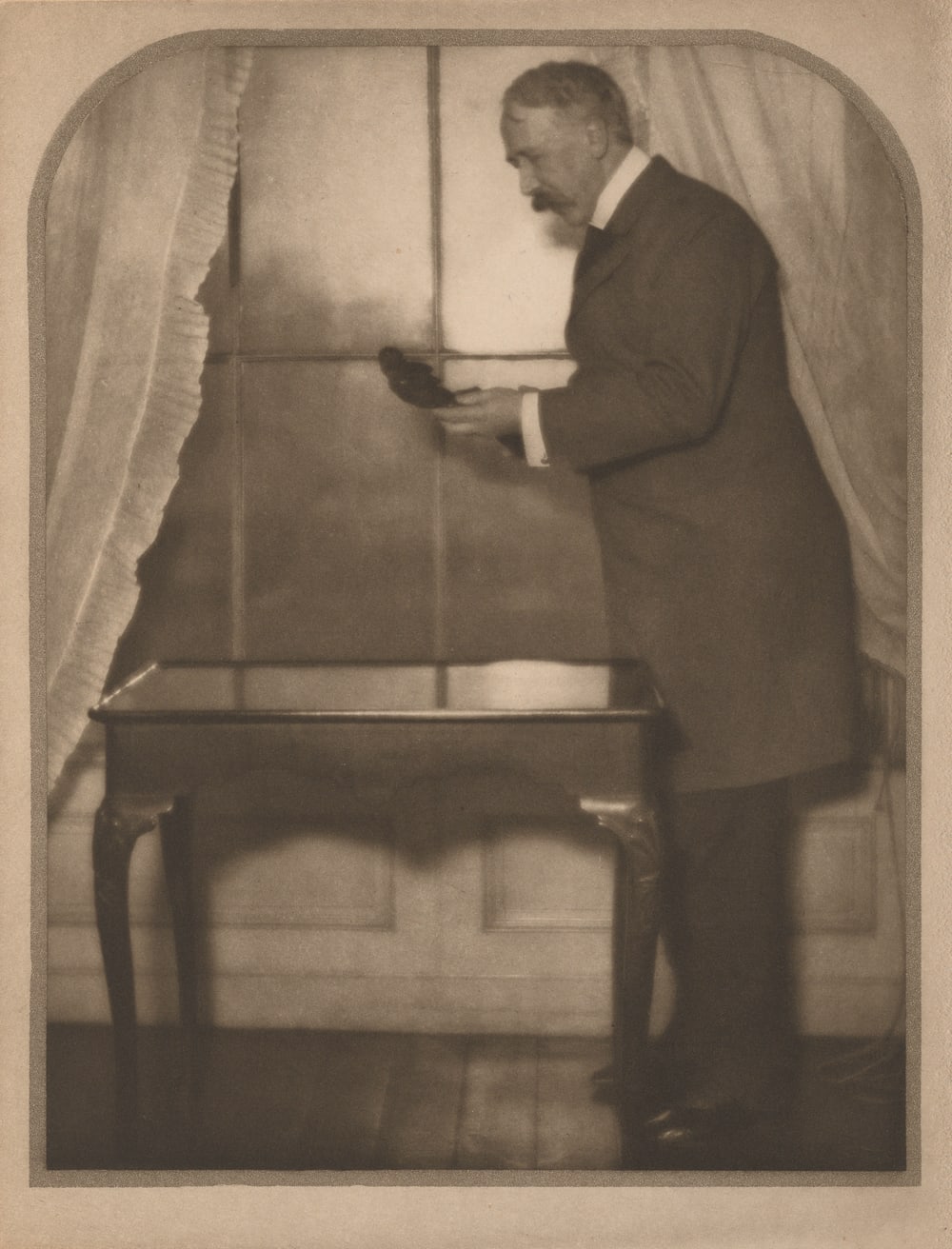
- Wikimedia Commons, “George Moore by Alvin Langdon Coburn (cropped)” — photograph dated 23 January 1908, reproduced from the National Portrait Gallery, Smithsonian Institution, object S/NPG.87.288.R.