Sylvia climbs down the pine rehearsing her success. Her fingers ache, her feet slip, and she nearly cries; still, she imagines the young hunter’s response when she tells him where the white heron nests. She has completed the dangerous part of her plan. The part she cannot complete will be speaking at her grandmother’s door.[1]
That interval gives Sarah Orne Jewett’s “A White Heron” its peculiar force. We may remember the story as a girl climbing a tree and choosing a bird over a hunter. But the climb and the choice happen at different moments. The view supplies knowledge; remembering it, under pressure to speak, changes what Sylvia can do with that knowledge.
This essay discusses the ending. Page references follow the Library of America edition in source 1.
Upward, with a reward in mind
The hunter has offered ten dollars for the location of the nest. Sylvia and her grandmother are poor, and the offer sets the child imagining things they might buy. She also wants his approval. He shares his knowledge of birds and gives her a jackknife; she is delighted by his company, even as his shooting troubles her. These attractions make the expedition possible. She leaves before dawn hoping to return with something he wants.[1]
Jewett makes the effort tangible. Sylvia first climbs a familiar white oak, then edges along a branch to reach the pine. The crossing matters: she takes herself beyond an old competence into a new risk. Her grasp resembles “bird’s claws,” while the dry twigs scratch like “angry talons” (p. 676).[1] The comparison puts her body into the bird’s world without making that world harmless. It can support and wound her in the same movement.
The prose then changes scale. The pine becomes a mast carrying the earth through space; the narrator imagines it protecting its small climber from the wind. A child’s private errand briefly becomes an enterprise in which the tree participates.
This imaginative enlargement belongs to the story’s original literary predicament. The Atlantic Monthly declined it; William Dean Howells suggested that the taste for realism might have made its romance seem unfashionable. Jewett nevertheless placed it first in her 1886 collection. Library of America’s publication history records the warm response it then received, including praise from Mary Wilkins Freeman.[2] The sympathetic pine is central to the kind of story Jewett chose to preserve: the physical ordeal can be exact while the surrounding world seems capable of answering it.
The narrator asks her to wait
At the top, Sylvia sees the sea she has long imagined. Hawks that once seemed remote now fly below her, and the villages spread out in the distance. Yet she still needs the nest. The beauty of the view has not cancelled the errand.
As the heron appears, the narrator’s excitement breaks into commands: “look, look!” and then “wait! wait!” (pp. 677–678).[1] The first summons attention; the second checks movement. The narrative teaches a small discipline in the space between them. Finding the bird requires looking, but remaining beside it requires holding still.
The heron comes from a dead hemlock and perches near Sylvia in the pine. It calls to its mate and tends its feathers. The distinction between the trees is essential: Sylvia has reached a vantage point, and from there discovered a home. She is close enough to observe an ordinary beginning to the bird’s day.
Heidi Kelchner’s study of the story’s narrative voice warns against treating these interventions as a transparent guide to one settled moral. The narrator keeps changing position, becoming emotionally involved and addressing Sylvia directly; such shifts can unsettle the authority of the voice telling us what the experience means.[3] We can feel the encouragement without assuming that every consequence has been resolved.
The descent makes that caution useful. Sylvia still imagines the moment “when she told him” (p. 678).[1] When gives the disclosure the status of an expected event. She has not come down carrying a finished declaration of independence. The story lets her continue toward the reward.
A memory at the doorway
Her grandmother and the hunter wait together. Sylvia arrives with her dress torn and stained with pitch. Her body displays the labour that might earn their admiration. All she needs to supply is the location.
The pressure is intimate. Her grandmother rebukes her, and the young man looks at her appealingly. The narration allows the promise of money and the pleasure of making him happy to remain persuasive. Refusal costs something because these wishes have survived the climb.[1]
Then the pine returns as a sound in Sylvia’s ears. She remembers watching the sea and morning with the heron. Jewett gives that recollection the word “together” (p. 679).[1] What had been a successful search becomes, in memory, a shared interval. A set of directions would let the hunter end the life that occupied it with her.
This is the small delay worth noticing. Experience need not arrive with its meaning attached. Sylvia can discover the nest, feel pleased with herself, and anticipate telling; only when the answer is demanded does the remembered encounter stop her. The doorway brings the possible consequence of her knowledge close enough to interrupt her plan.
Jewett leaves the interruption costly. Sylvia misses the departing hunter, and his whistle continues to haunt her walks. The narrator asks whether the birds will prove better friends, then appeals to the woods and summer to give the child something in return.[1] An appeal carries hope, rather than a guarantee that every loss will be repaid.
The nest remains where she found it. Sylvia’s achievement is that its location can remain hers to know without becoming hers to give away.
Sources
- Sarah Orne Jewett, “A White Heron,” first published in 1886; Novels & Stories, Library of America, 1994, pp. 669–679—primary text, especially part II, pp. 675–679.
- Library of America, “A White Heron,” Story of the Week, August 28, 2015—publication history, Jewett’s response to rejection, and early reception.
- Heidi Kelchner, “Unstable Narrative Voice in Sarah Orne Jewett’s ‘A White Heron,’” Colby Quarterly 28, no. 2, June 1992, pp. 85–92—critical account of shifting voice, direct address, and narrative authority; repository record.
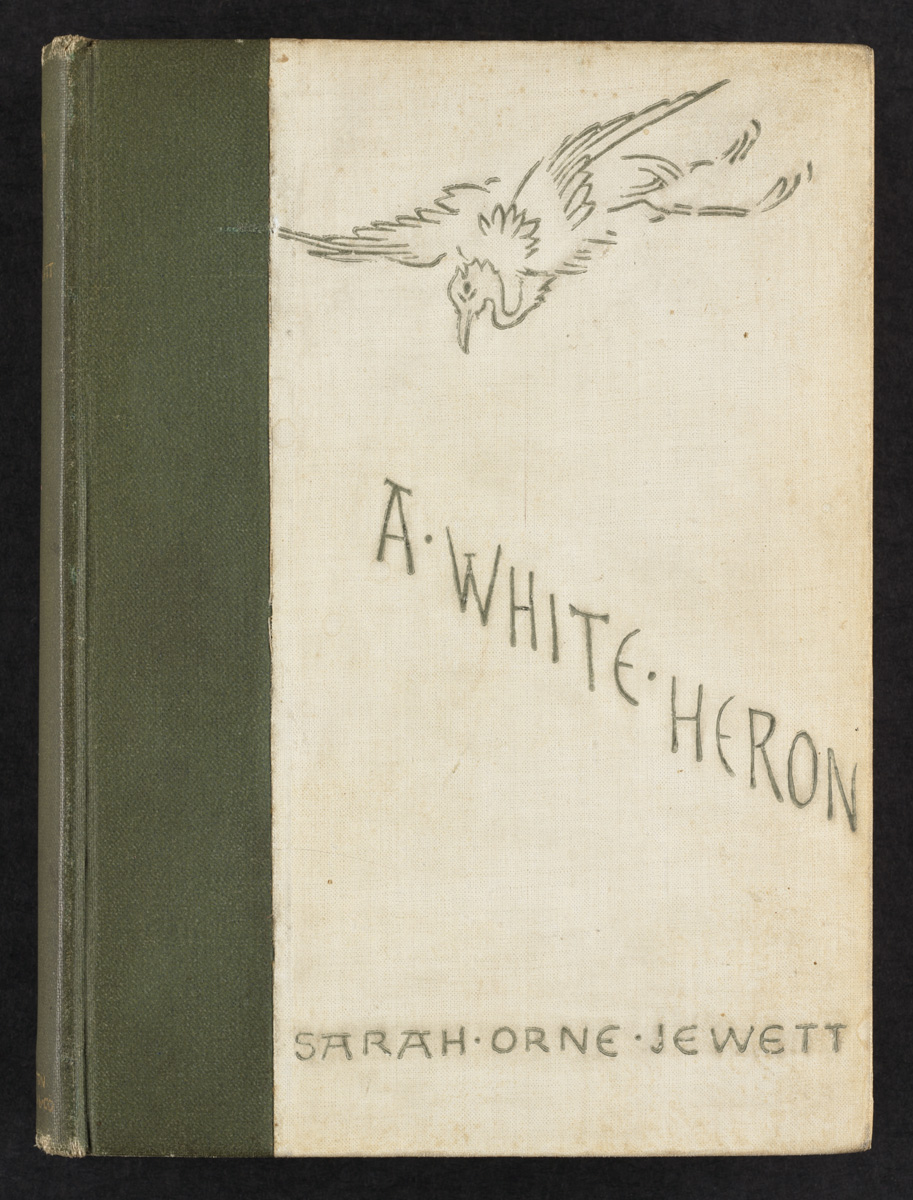
- Boston Public Library, photograph of the 1886 A White Heron and Other Stories binding designed by Sarah Wyman Whitman, reproduced on Wikimedia Commons—image provenance, dimensions, and attribution.