Invisible Man is often reduced to a single clean proposition: America refuses to see the Black subject standing in front of it. That reading catches the novel's central wound, but it does not fully explain the book's long life. Ralph Ellison's 1952 novel endured because it arrived with two kinds of force at once. It was a racial and political reckoning, and it was also a formal event: a book that could move from sermon to jazz riff, from grotesque comedy to nightmare, from social documentary to modernist inwardness without losing pressure.[1][2][3]
The opening line still does the necessary work: "I am an invisible man." Readers remember the declaration because it is morally direct. They keep returning because the novel spends hundreds of pages showing how invisibility is manufactured by schools, employers, political organizations, philanthropists, and readers themselves. Ellison gives the condition a social history and a rhetorical texture. Even in the prologue, where the narrator speaks from his underground room lit by 1,369 bulbs and tuned to Louis Armstrong, invisibility becomes a problem of time, sound, and interpretation as much as sight.[2][5]
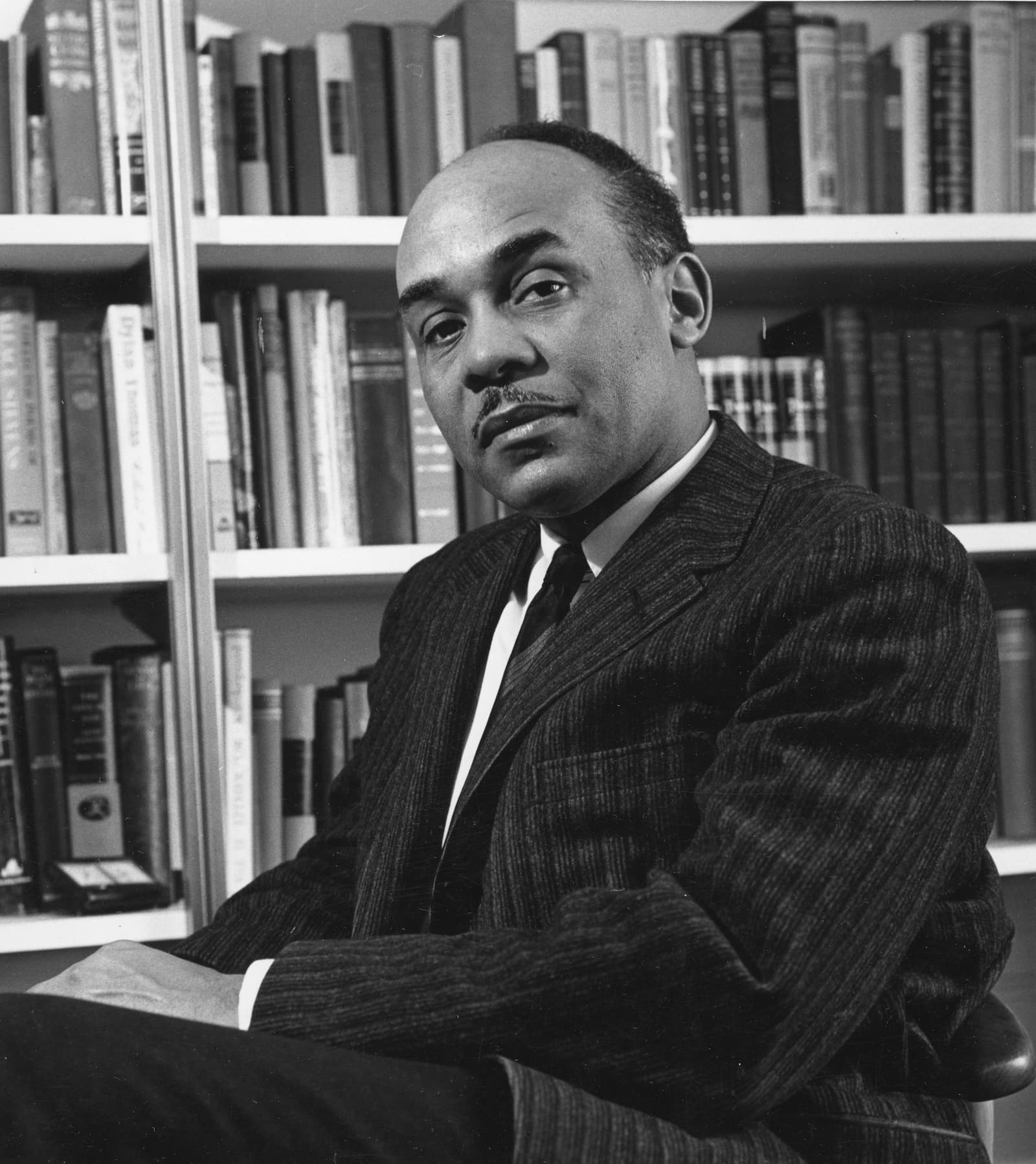
The image here matters for that reason. The seated 1961 portrait on Wikimedia Commons belongs to the period after Ellison's breakthrough but before the novel became a fixed monument of syllabus culture, which makes it a useful entry into a dossier about how a living contemporary novel became a canon object.[7]
The 1952 publication moment was larger than "social protest"
Ellison did not emerge from nowhere. Britannica's biographical outline tracks a path from Oklahoma City to Tuskegee Institute, then to New York, where he moved in literary and political circles shaped by the Depression, Black intellectual life, and modernist ambition.[6] The National Book Foundation's author note is a useful reminder that Ellison's horizon was never narrowly documentary. It situates his fiction in conversation with T. S. Eliot, James Joyce, and Fyodor Dostoevsky alongside African American musical and vernacular traditions.[3] That mixed inheritance matters because Invisible Man was built to exceed a single shelf label from the start.
When the novel appeared in 1952, it entered an American field already crowded with arguments about what a Black novel ought to do. The pressure for sociological legibility was intense: a serious novel about race was expected to testify, diagnose, and indict. Invisible Man certainly does all three. The battle royal sequence, the Liberty Paints factory, the eviction speech, and the Brotherhood chapters give readers no shortage of institutional cruelty.[1][5] But Ellison's larger gamble was to refuse the trade in which political seriousness required stylistic plainness. He wanted the novel to carry argument through performance, to make syntax, scale shifts, grotesque staging, and tonal instability part of the meaning.
That is why the book feels larger than a case study in oppression. Ellison writes social misrecognition as an experience of being overinterpreted by systems. School administrators, industrial managers, party cadres, and reform-minded patrons all insist they already know what the narrator means before he speaks. The novel's formal restlessness answers that pressure. A stable institutional language would have betrayed the material. Ellison instead gives the reader velocity, improvisation, comic excess, and sudden symbolic overloading. The result is a novel that sounds like argument happening under duress.
Style is the novel's political method
The prologue is the clearest place to see why the novel would never remain a simple protest artifact. On the Penguin extract page, the narrator says invisibility "gives one a slightly different sense of time."[2] That sentence does more than define alienation. It changes the scale of the book. Social exclusion is no longer only a matter of rights denied or doors closed. It becomes a distortion in temporal experience, a warped relation to memory, anticipation, repetition, and delay.
From there the novel keeps changing registers. The battle royal is written with the velocity of a public humiliation machine. The paint factory chapters move into industrial allegory without surrendering bodily panic. The Brotherhood sections widen into ideological comedy and coercive speech. The Harlem riot becomes a scene in which public language breaks into shards. Through all of this, Ellison preserves a first-person voice agile enough to sound wounded, sardonic, naive, lyrical, and analytical in the same movement.[1][3][5]
This formal agility is the real reason the book resists reduction. Readers who come looking only for message find themselves inside a novel that keeps demanding attention to rhythm, staging, color, and verbal performance. Readers who come for technique find that the technique is inseparable from the social argument. Ellison's politics live in style because the narrator's crisis is partly a crisis of available language. Every institution in the book offers him a prefabricated script. The novel's energy comes from how often he slips those scripts, inhabits them, mistrusts them, and eventually speaks past them.
Seen that way, Invisible Man belongs to a line of twentieth-century novels that use voice as a battlefield. Ellison was writing after high modernism, but he did not merely borrow modernist fragmentation as prestige equipment. He converted it into a historically specific Black American medium, one shaped by sermon cadence, blues inflection, jazz improvisation, political oratory, and the pressure of code-switching across hostile rooms.[3][5][6]
The reception story is one of triumph, friction, and repeated return
The immediate recognition was substantial. Invisible Man won the 1953 National Book Award for Fiction, and the award history is a useful marker because it shows the novel entering the center of American literary recognition almost at once.[4] That early success did not settle the matter. Canonization rarely arrives without residue, and Ellison's case is unusually revealing because the arguments about the book have never been separable from arguments about what literary prestige is for.
The NEH's seventieth-anniversary essay traces that afterlife well. It notes the novel's extraordinary durability, including its placement at the top of a 1965 survey of postwar American fiction and its later standing on end-of-century "best novels" lists.[5] Just as important, the piece captures why the consensus stayed unstable. For some later readers and writers, especially in periods when urgent political clarity was demanded of Black art, Ellison's irony, modernist indirection, and suspicion of party language could feel evasive. For others, those same qualities are the point: the novel refuses to let social violence simplify the interior life it is trying to protect.[5]
That friction is part of the book's vitality. A novel that everyone can summarize in one approved sentence usually loses oxygen after its historical moment passes. Invisible Man keeps renewing itself because it can be taught as a civil-rights precursor, read as a Künstlerroman, studied as a modernist experiment in voice, argued over as a Cold War text, and returned to as a book about institutions that demand legibility on their own terms.[1][5][6]
Why the novel still speaks on the lower frequencies
The last line of the epilogue remains one of the best descriptions of literary afterlife in American prose: "Who knows but that, on the lower frequencies, I speak for you?"[5] Ellison's wager was that a novel intensely shaped by its own historical emergency could still travel by refusing to flatten that emergency into a slogan. That wager worked.
The novel's continuing force lies in a double achievement. It gives an unforgettable map of how democratic institutions learn to misrecognize the people they claim to include. At the same time, it demonstrates that style is not decorative surplus added after politics. Style is how pressure is registered, how experience escapes official language, and how a narrator keeps a self intact while passing through systems that would prefer a type, a function, or a symbol.[2][3][5]
That is why Invisible Man refused to stay a protest novel, even though protest is in its blood. Ellison wrote a book that could indict the nation and outlast the immediate news cycle of that indictment. The context explains the shock of 1952. The reception explains the canon. The style explains the survival.
Sources
- Ralph Ellison, Invisible Man. Penguin Random House book page for the 1952 novel and current editions.
- Penguin Random House UK, "Invisible Man by Ralph Ellison" extract page, including opening-prologue excerpts.
- National Book Foundation, "Ralph Ellison" author profile.
- National Book Foundation, "National Book Awards 1953" winners page.
- National Endowment for the Humanities, "Invisible Man at Seventy".
- Encyclopaedia Britannica, "Ralph Ellison" biography.
- Wikimedia Commons, "Ralph Ellison photo portrait seated.jpg" image file page.