A house grows larger without gaining a room. In Joachim du Bellay’s sonnet beginning “Heureux qui, comme Ulysse,” the speaker’s modest home amounts to a province, and more, in his imagination. G. K. Chesterton gives it a promotion: “a kingdom and much more.” The difference is small enough to pass unnoticed when we read for the general feeling of homesickness. Read the two poems together, however, and that little crown begins to change the scale of everything around it.[1][2]
The French poem is sonnet XXXI of Les Regrets, first published in Paris in 1558. Chesterton’s version appears as “Translation from Du Bellay” in his Poems, here read in the 1916 New York edition. Both speakers imagine a return to familiar surroundings from the perspective of distance. Both set the home country against Rome. But the English makes belonging more physically welcoming and more forcefully asserted, even as it loosens the original’s formal enclosure.[1][2][4]
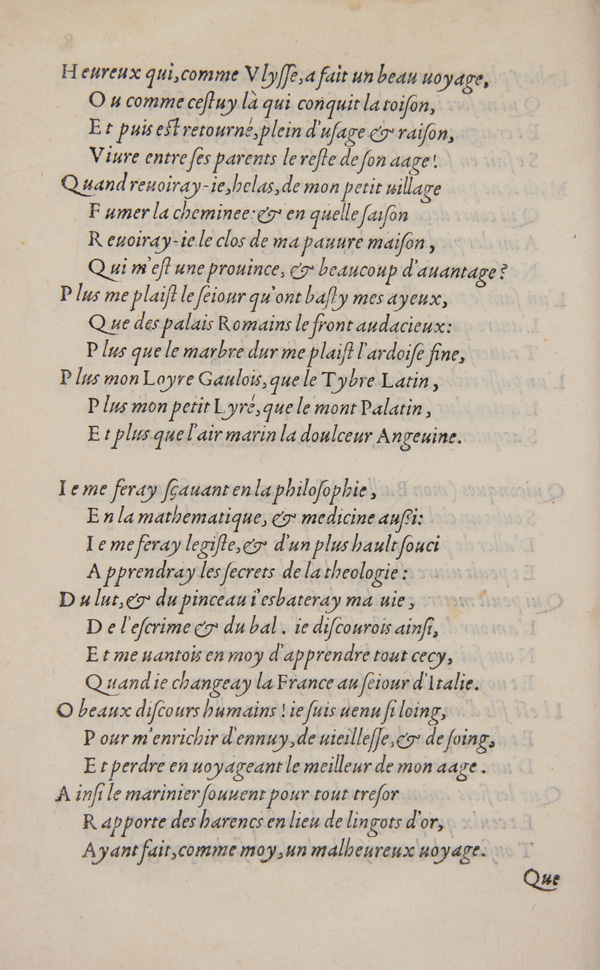
An enclosure becomes a threshold
The opening quatrain looks outward to legendary travelers. Ulysses and the conqueror of the Golden Fleece provide examples of a desirable journey completed by a return. Then the speaker turns toward his own village. The distance between those scales gives the poem much of its pleasure: a chimney can become the destination that matters after a voyage through the heroic world.[1]
At line 7, Du Bellay asks when he will see le clos of his house again. An English gloss might call this an enclosure or enclosed ground. It gives the desire a boundary, a small piece of the world held apart. Chesterton replaces that object with an action: passing through the doorway. His “old dear door” adds age, affection, and a sequence of sounds the mouth can almost linger against. We picture an arrival being enacted.[1][2]
That is a consequential freedom. Looking toward an enclosure lets the home remain a visible shape at a distance. Passing a door brings the body to a threshold. Chesterton makes the reader rehearse the return before the poem has granted it. The repeated consonants do some of the work that a remembered touch might do in prose: they give familiarity a local, physical texture.
The adjective changes too. Du Bellay’s ma pauvre maison allows the house to be modest or to receive the speaker’s pity. Chesterton settles on “unhappy,” encouraging us to hear the building as sharing its absent inhabitant’s distress. A translator’s adjective can quietly distribute feeling between person and place. Here the house seems to be waiting as well.
These are readings of the words, rather than claims about a translator’s private intention. The useful question is what the English invites us to imagine. Its doorway and sorrowing house bring the wished-for reunion closer to a domestic scene.
A house acquires a crown
The next line tests how much that small place can contain. Du Bellay’s une province expands the enclosed property into a territory; the qualification that follows makes even that measure insufficient. Chesterton’s kingdom gives the expansion an extra implication. To an English ear, it can suggest sovereignty: a place whose value the speaker has authority to declare.[1][2]
Neither poem needs the house to rival Rome in measurable size. The French keeps returning to words of personal relation: me, mon, mes. The comparison belongs to someone. His preference can give familiar slate greater value than prestigious marble without requiring an architectural demonstration.
Chesterton raises the volume at precisely this point. Where Du Bellay’s line 9 begins Plus me plaist—a literal gloss would be “pleases me more”—the English begins “Mightier.” Preference acquires the vocabulary of strength. The Roman buildings are then addressed directly. What was a comparison can be heard as a challenge delivered to the city.[1][2]
The gain is dramatic energy. The cost is a change of pressure. Pleasure can acknowledge another object’s grandeur and still choose differently; might sounds ready to compete with grandeur on its own ground. I hear Chesterton’s kingdom and might reinforcing each other. His home becomes a rival seat of value, while the French allows the speaker’s attachment to remain sufficient reason for choosing it.
Yet the English does not simply turn the house into a monument. Its “thin sad slates” keep fragility audible. The roof matters because it shelters a life. The translation’s force comes partly from letting that vulnerable material face the impressive permanence of Roman stone.[2]
Two extra lines for the air
There is a visible change before we reach the final word. Du Bellay’s sonnet has fourteen lines, with a six-line closing movement. Chesterton gives the poem sixteen, turning that closing movement into eight lines with alternating rhymes. The extra room allows the marble and slate to occupy separate lines, and the last comparison to unfold across two.[1][2]
This expansion makes an illuminating companion to Hilaire Belloc’s praise. In On Translation, Belloc argues that fidelity need not preserve the original’s dimensions or fixed form. Later he holds up Chesterton’s Du Bellay as an exceptional achievement in verse translation. His admiration offers evidence from the translation’s critical reception that the English poem could succeed through the feeling it recreated, despite its altered proportions.[3]
The ending shows what that room buys. Du Bellay closes with la doulceur Angevine. The phrase leaves sweetness, gentleness, and the experience of a region close together. Chesterton’s “quiet kindness” makes the atmosphere sound hospitable. Air seems capable of receiving someone well. That effect answers the welcoming door earlier in the translation: the surrounding country has acquired something like the manners of a home.[1][2]
Meanwhile, the French sea air expands in English into “all the winds of all the sea.” The repeated totality gives the final preference a larger world to turn away from. After that swell, the gentleness of the last line feels earned by a deliberate settling of the voice.
A literal gloss helps us notice these decisions, but it cannot replace the finished poem. Chesterton has made a sequence of English pleasures: the doorway’s familiar sounds, the sudden strength of the comparison, the spacious descent into kindness. Reading him beside Du Bellay lets us enjoy those pleasures and hear their price. The small house still wins our affection. In English, it also receives a crown.
Sources
- Joachim du Bellay, Les Regrets et autres œuvres poétiques, Paris: Fédéric Morel, 1559, sonnet XXXI, folio 8 verso. Bibliothèque municipale de Tours, Rés. 3530 (1), digitized by CESR–Digibook; Bibliothèques Virtuelles Humanistes catalog record and facsimile access. Source of the archival image; French quotations follow this edition, with long s and u/v letterforms normalized.
- G. K. Chesterton, “Translation from Du Bellay,” in Poems, New York: John Lane Company, 1916. Project Gutenberg transcription; source of the English wording and sixteen-line arrangement.
- Hilaire Belloc, On Translation, especially pp. 9 and 16–17 of the hosted text: freedom of form and length, followed by praise and quotation of Chesterton’s version. PDF hosted by Ca’ Foscari University of Venice.
- Bibliothèque nationale de France, Joachim du Bellay: Les Regrets, Le Songe, Les Antiquités de Rome, selective bibliography, August 2021, p. 2. Records the Paris edition of Les Regrets printed by Fédéric Morel in 1558.