Oscar Wilde’s The Picture of Dorian Gray has long been packaged as a scandalous fin-de-siècle fable about beauty, vice, and punishment. That description is not false, but it is too neat for the way the book actually entered culture. Dorian Gray became durable because it arrived as a compromised object, then kept changing the terms on which it could be read: first as an edited magazine provocation, then as a novel with a defensive preface, then as one of the most portable machines in modern literature for thinking about surface, secrecy, and moral residue.
That history matters because Wilde’s only novel did not merely survive hostile reception. It converted reception into part of its operating system.
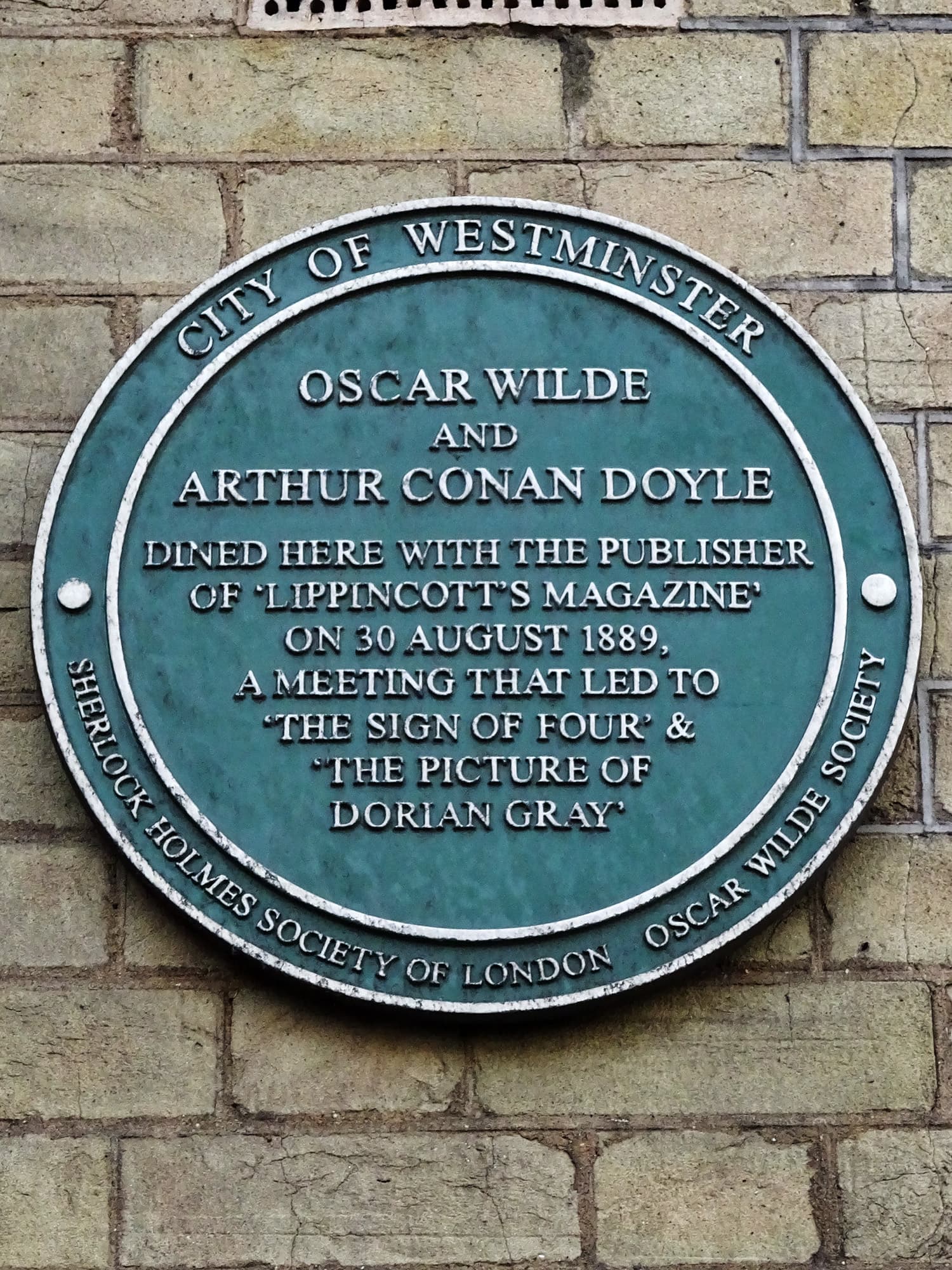
Image context: the hero image shows the Portland Place commemorative plaque for the 1889 dinner that led to the commission. It works here because this essay is about publication history and reception machinery as much as plot, and the dinner itself is one of the book’s real historical ignition points.
1) The novel entered the world already split
The publication story is unusually consequential. In August 1889, J. M. Stoddart dined in London with Wilde and Arthur Conan Doyle and commissioned novellas for Lippincott’s Monthly Magazine. Wilde delivered Dorian Gray; the shorter version appeared in the July 1890 issue, sold to American readers for 25 cents, with a simultaneous London issue from Ward, Lock & Co.[1][2]
But the text that met first readers was already a filtered text. The Morgan Library’s manuscript note, Standard Ebooks’ publication summary, and the broader publication record all point to a pre-publication chain of annotated typescript edits and cuts before the magazine issue reached readers.[1][3] That means the book’s first public life begins in contradiction: it was already censored and still judged scandalous.
The shape of the cuts matters too. The publication history commonly notes that pre-publication edits trimmed some of Basil Hallward’s more intense language about Dorian, references to Gray’s lovers, and other cues that editors considered risky for a respectable monthly audience.[2][3] That sharpens the later scandal. Reviewers were not reacting to Wilde at full exposure, but to a version already morally narrowed for the magazine market.
This is one reason the novel’s early reception feels so charged. Critics were not reacting to one stable literary object. They were reacting to a work that had already been compressed, morally managed, and framed as risky before the review cycle even started.
2) Why the scandal attached so quickly
The mechanism of offense was larger than “decadence” in the abstract. Wilde gives readers a beautiful young man, an artist whose attachment carries unmistakable emotional intensity, and a social philosopher who turns epigram into contamination. Lord Henry’s wit sounds detachable until the plot shows what it does inside another person.
One of his most famous lines still explains the danger of the book’s tone: “The only way to get rid of a temptation is to yield to it.”[4] The sentence glitters; it also performs influence in real time. Wilde understood that aphorism can move like perfume: it enters as style before it declares itself as ethics.
That mattered in 1890 because the book did not offer scandal as mere plot content. It made aesthetic talk itself feel morally active. The result was a work accused of immorality even though its structure keeps demonstrating that charm, pose, and detachment have costs. Britannica’s summary of the early controversy remains useful here: the novel was denounced for its “immorality” and “unhealthiness,” even as later readers increasingly treated that reaction as evidence of how sharply Wilde had exposed Victorian reading habits.[5]
3) The 1891 preface did more than defend Wilde
When Wilde expanded the novella into the 1891 novel, he did two things at once: he added six chapters, and he inserted one of the most famous prefaces in English prose. The prefatory aphorisms are usually quoted as a public shield, but their function is deeper than self-protection.
“There is no such thing as a moral or an immoral book. Books are well written, or badly written. That is all.”[4]
That line does not erase the scandal. It changes the tribunal. Wilde shifts judgment away from character conduct and toward artistic execution, while also taunting the reader with the possibility that moral panic may itself be a failure of reading. The preface becomes part of the novel’s reception machinery: a device that tells every later reader how unstable the category of “offense” will be once style enters the room.
The expansion also matters formally. The 1891 book turns a sharp provocation into a roomier study of influence, social circulation, theatricality, and delayed corruption.[3] Dorian’s descent becomes less abrupt and more ambient. The novel is no longer only a brilliant premise about a portrait that absorbs damage. It becomes a study of how a person learns to treat the self as a public surface while relocating consequence elsewhere.
4) Why the afterlife kept growing
A long afterlife was built into the concept. The adaptation record starts early—film versions appear from 1910 onward, with the 1945 Albert Lewin adaptation becoming the canonical screen landmark for many viewers.[6] That persistence is not just a sign of fame. It is evidence that Wilde discovered a nearly perfect transfer device between media.
The portrait gives later artists a ready-made structure for externalized conscience. Cinema can show it. Theatre can stage around it. Popular culture can simplify it without exhausting it. You do not need to preserve every one of Wilde’s epigrams for the idea to survive, because the core relation is visually brutal and instantly legible: the face remains marketable, the record of use rots somewhere else.
This is why Dorian Gray keeps returning whenever a culture becomes preoccupied with managed surfaces. The book’s enduring concept is not eternal youth by itself. It is outsourced consequence.
5) Why the novel still feels contemporary
The deepest modernity of Dorian Gray is not that it predicted vanity. Many books do that. Its sharper insight is that people want damage to remain off-ledger, out of sight, and aesthetically displaced. Basil loves beauty as revelation. Lord Henry treats style as a method of occupation. Dorian learns to treat the self as an exhibit whose hidden costs can be pushed into another surface.
That is why the book survives changes in taste. It is readable as Gothic fable, as aesthetic manifesto under pressure, as a novel of influence, as queerly charged social theater, and as a reception object that keeps exposing the values of whoever reads it. Its scandal has never fully vanished because the novel never stops asking a humiliating question: what if elegance is just a better storage system for corruption?
Read that way, Wilde did not merely write a book that caused outrage. He wrote one that made outrage renewable.
Sources
- The Morgan Library & Museum, The Picture of Dorian Gray (earliest surviving manuscript, 25-cent Lippincott’s issue, Ward, Lock publication context)
- The British Library, Oscar Wilde’s The Picture of Dorian Gray (1890 magazine appearance, revised and expanded novel context)
- Standard Ebooks, The Picture of Dorian Gray (serial publication, cuts, and later expansion overview)
- Project Gutenberg, The Picture of Dorian Gray plain text (preface and quoted lines)
- Encyclopaedia Britannica, The Picture of Dorian Gray (controversy and legacy overview)
- Wikipedia, Adaptations of The Picture of Dorian Gray (afterlife across film and stage)