Most author profiles begin by asking what happened to the writer. Borges is clearer if you ask what formats he trusted.
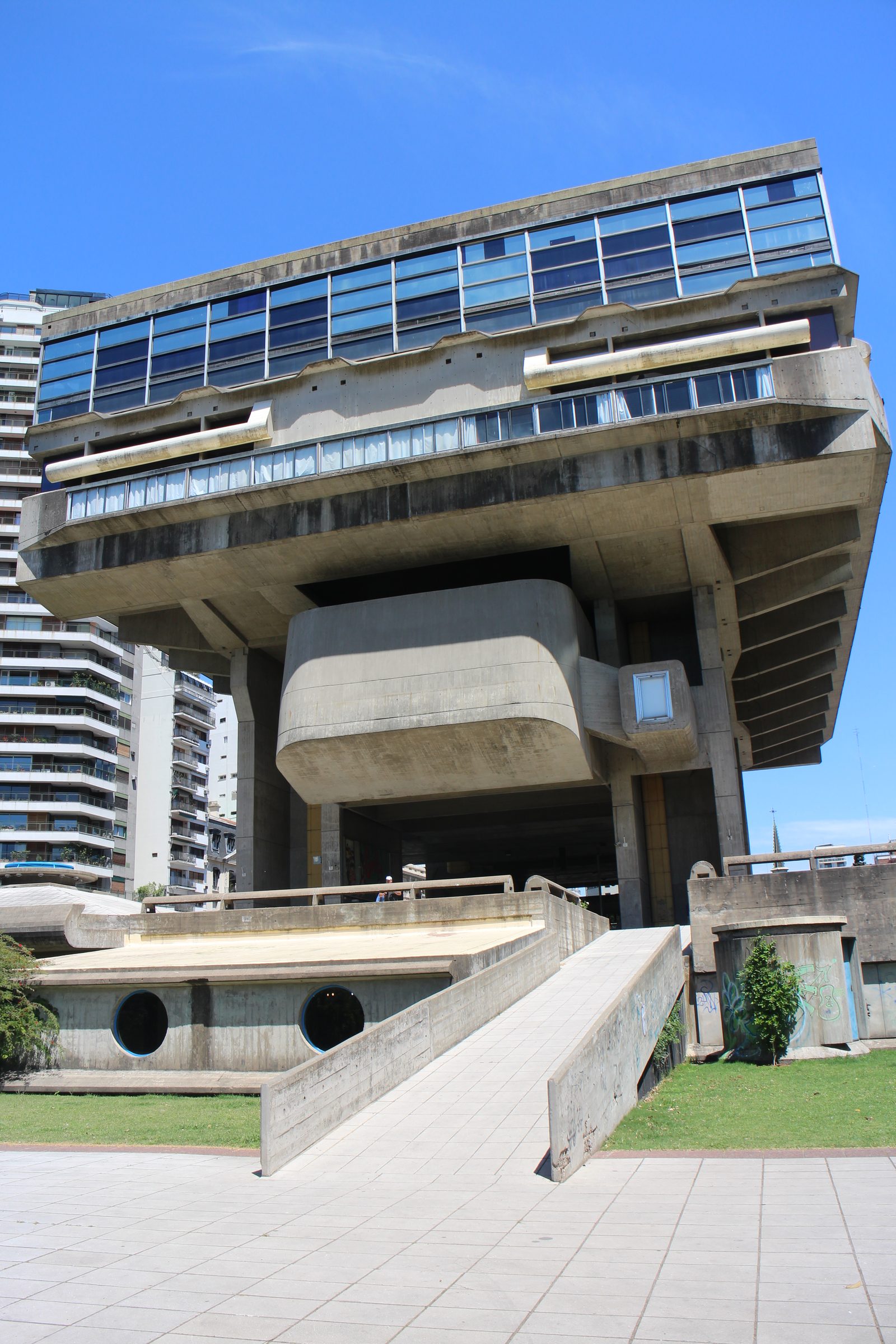
The lead image matters as context rather than decoration: the National Library of Argentina is not just a Buenos Aires landmark but the institution Borges directed from 1955 to 1973, which makes it a fitting visual entry for an essay about libraries, catalogs, and fiction that behaves like an archive.[2][8]
Read through that lens, Jorge Luis Borges stops looking like an oracle of abstract cleverness and starts looking like a very specific kind of builder. He built stories out of reference forms: encyclopedia entries, fake reviews, afterwords, scholarly notes, catalog logic, and miniature thought experiments with the force of whole novels compressed inside them. That is why Ficciones (1944; expanded 1956) and The Aleph (1949) still feel unusually fresh. Borges does not merely tell stories about infinity, forgery, and interpretation. He makes reading itself feel like moving through a system that keeps changing the value of every document you touch.[1][2][3][4]
A career shaped by shelves before myths
The biographical cliché is true because it is structurally useful: Borges grew up inside books. On the biographical page that remains one of the cleanest entry points into his career, he recalls, “if I were asked to name the chief event in my life, I should say my father’s library.”[1][9] That sentence is more than nostalgia. It explains why his fiction so often begins where other writers would end: not with dramatic action, but with a shelf, an attribution, a missing source, a translated fragment, a suspicious quotation.
Britannica’s outline helps fix the sequence. Borges was born in Buenos Aires in 1899, spent formative years in Geneva and Spain during and after World War I, returned to Argentina in 1921, and moved from poetry and essays toward the short fictions that made his international reputation.[2] The important point is not simply cosmopolitan biography. It is that he learned early to treat literature as a multilingual field of echoes, republications, commentaries, and re-entry points. Even before the library became one of his recurring images, it was already his working model of literary life.
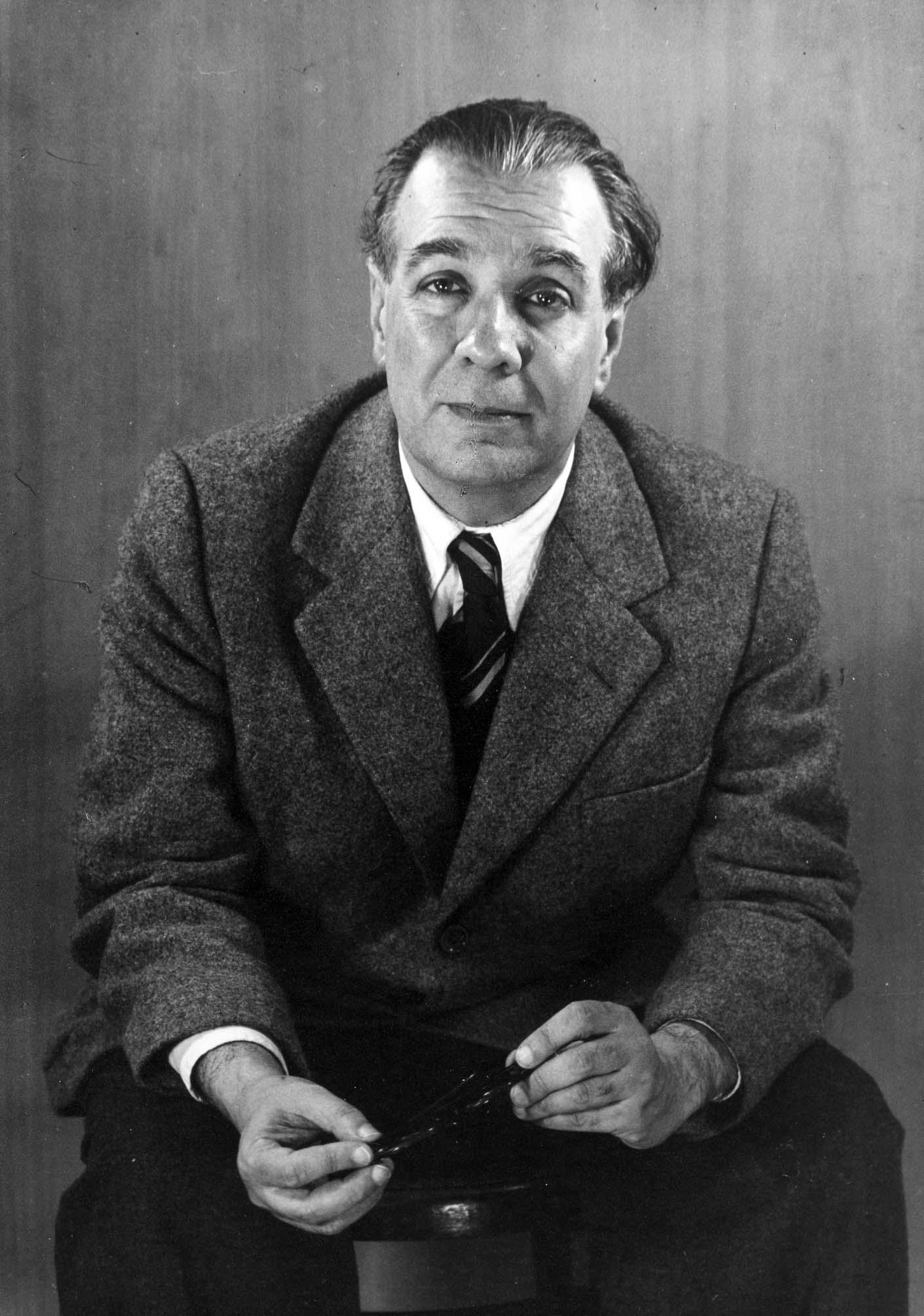
A 1951 portrait by Grete Stern helps keep this profile on method rather than myth: Borges appears before the late-career “blind sage” image hardened into a single public icon, still close to the magazine-and-library world that shaped his short-form intellectual machinery.[10]
Why Ficciones is the real center of gravity
A work-centered Borges profile has to pass through Ficciones, because that is where his method stops looking experimental and starts looking fully native to him.[3]
The book’s signature trick is not fantasy in the broad genre sense. It is documentary destabilization. In “Pierre Menard, Author of the Quixote,” Borges invents a writer whose impossible achievement is to produce Don Quixote again, word for word, without copying it. The narrator then absurdly insists that Menard’s identical pages are “richer in allusion” because they are read after later history has happened.[6] The joke lands because Borges understands that context is not a wrapper around a text. Context can become part of the text’s meaning engine.
In “Tlön, Uqbar, Orbis Tertius,” the whole story begins with what looks like a bibliographic glitch: an encyclopedia entry that appears in one copy and not another.[7] The famous sentence about how “mirrors and copulation are abominable” arrives not as epic revelation but as quoted reference material, already framed by editorial mediation.[7] Borges knows that citations can be plot devices. A footnote, a missing volume, a forged article, a suspicious preface—these are not decorative intellectual props in his fiction. They are the machinery.
That is why Borges still reads as modern even when the technology is pre-digital. He discovered early that indexing, attribution, and metadata can generate suspense as effectively as chase scenes.
The container stories: library, point, labyrinth
If Ficciones establishes the method, The Library of Babel and the title story in The Aleph show how large that method can become without needing novelistic scale.
“The Library of Babel” pushes a librarian’s imagination to its absolute limit: a universe shaped as a library containing all possible books in a fixed format.[5] The result is not a cozy metaphor for reading. It is an ontological trap. Total information does not create clarity; it creates theological panic, superstition, and the exhaustion of verification. Borges’s brilliance lies in how little stage machinery he needs. A few spatial rules, one archival premise, and suddenly metaphysics feels like room design.
“The Aleph” works by opposite compression. Instead of an endless archive, Borges gives you a single point in space that contains all other spaces at once.[4] Readers often remember the concept as mystical spectacle. What matters formally is how it replays a larger Borges habit: impossible totality arrives inside a manageable container. A shelf, a coin, an index, a point under a staircase, a short review of a nonexistent book. He keeps shrinking the vessel while expanding the implication.
This is the most durable Borges competency. He can make scale feel unstable without losing control of prose. Vastness in his stories is almost never described as loose overflow. It arrives as precision.
Blindness, the National Library, and the late-career voice
The biographical temptation is to over-mystify Borges’s blindness. The stronger reading is more technical. By the mid-1950s, as Britannica notes, he had become director of the National Library while also losing the ability to read and write in the old visual way.[2] The irony is obvious and has often been repeated because it deserves to be: the writer of libraries presided over a national library while going blind. But the career consequence is more interesting than the anecdote.
Blindness did not turn Borges into a prophet of darkness. It intensified his preference for compression, dictation, and forms that could survive being held in memory before they were fixed on the page.[1][2] Even when later collections become plainer on the surface, the underlying habits remain recognizable: parable structures, recursive images, conceptual symmetry, a voice that can move from essay to tale without warning the reader that a border has been crossed.
This is one reason Borges matters as an author profile and not only as a list of famous stories. He made a career out of reducing the distance between criticism and fiction. The essay can become a story; the story can masquerade as reference work; the reference work can behave like a philosophical prank.
Why Borges keeps returning in 2026
It is tempting to flatten Borges into a prophet of the internet. The smaller claim is the more useful one. Borges understood that readers do not meet texts in isolation. They meet them through excerpts, catalogs, republication, commentary, mistranslation, indexing, anthology logic, and institutional storage. That is why his afterlife has been so unusually durable. The English-language breakthrough around the Formentor Prize era and the 1960s translations did not merely export him; it proved that his stories could survive being recontextualized, which is exactly what many of them are already about.[1][2][3]
Read him now and the pleasure is still double. On one level, Borges gives you intellectual toys of absurd elegance: infinite libraries, rewritten classics, fictional encyclopedias, impossible points in space. On another level, he keeps asking a harder question: what happens when the apparatus around a text becomes part of the event of reading?
If you want to feel the method rather than merely hear about it, a clean three-story entry path is “Pierre Menard” for contextual mischief, “Tlön, Uqbar, Orbis Tertius” for document-spawned worldbuilding, and “The Library of Babel” for the compression of infinity into architecture.[6][7][5]
That is why a Borges profile works best through Ficciones and The Aleph, not through the mythology of the sage alone. His real achievement was to make secondary forms primary. He turned the note, the catalog, the summary, the archive, and the shelf into engines of fiction. Once you see that, the famous labyrinths stop feeling ornamental. They are simply the shape his reading life took when converted into prose.
Sources
- Library of Congress, “Jorge Luis Borges”
- Encyclopaedia Britannica, “Jorge Luis Borges”
- Penguin Random House, “Ficciones”
- Penguin Random House, “The Aleph and Other Stories”
- Wikipedia, “The Library of Babel”
- Wikipedia, “Pierre Menard, Author of the Quixote”
- Wikipedia, “Tlön, Uqbar, Orbis Tertius”
- Biblioteca Nacional Mariano Moreno, “Historia de la Biblioteca Nacional”
- Poetry Foundation, “Jorge Luis Borges” (contains the autobiographical “father's library” quote context)
- Wikimedia Commons image file page, “Jorge Luis Borges 1951, by Grete Stern.jpg” (in-body portrait provenance)
- Wikimedia Commons image file page, “Biblioteca Nacional BA.jpg” (lead image provenance)