People often remember Dombey and Son through its largest emotional outlines: the proud merchant father, the frail child Paul, the neglected Florence, the oily manager Carker, the eventual collapse of a house that thought money could organize love.[1][2] What makes the novel feel stranger and more exact than that summary is Dickens's habit of turning commercial power into recurring signals. He does not leave Mr. Dombey's worldview inside speeches about rank or trade. He keeps sending it back as atmosphere and object. The sea, the railway, and Carker's teeth are the clearest of those returns.[1][2][4]
The opening sentence cluster already gives the method away. For Mr. Dombey, "The earth was made for Dombey and Son to trade in," while "Rivers and seas were formed to float their ships."[1] This is not just characterization. It is a cosmology of ownership. But Dickens immediately begins placing rival meanings against it. Young Paul asks the devastatingly simple question, "what's money after all? ... what can it do?"[1] From that point on, the novel's motifs keep exposing the gap between mercantile command and human life. What Dombey treats as system, the novel keeps redistributing into sound, movement, appetite, and machinery.[1][2]
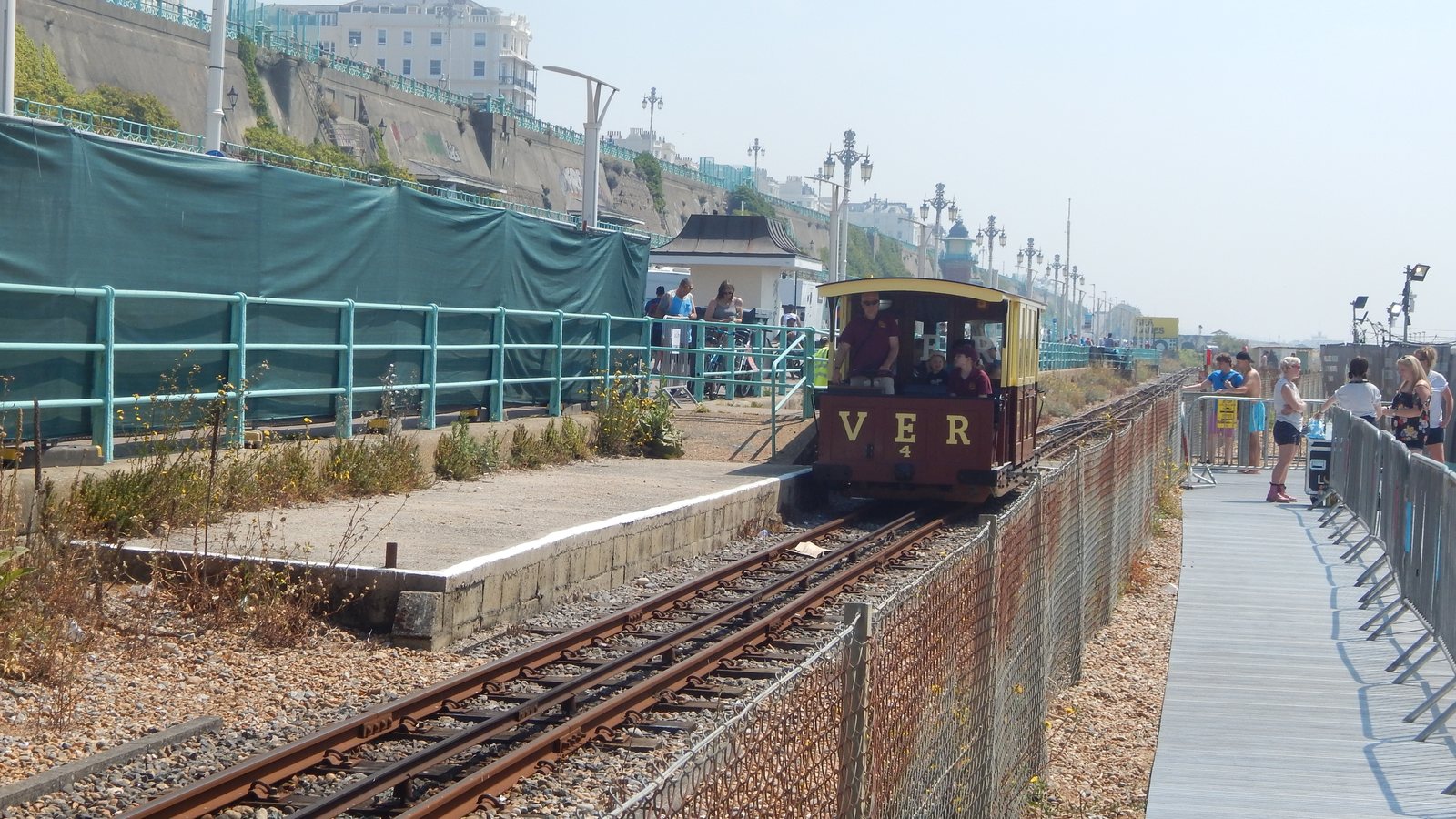
Image context: the cover uses a real photograph of Volk's Electric Railway on the Brighton seafront rather than a later adaptation still, portrait, or explanatory graphic.[5] Brighton is where Paul's sea-listening scenes gather their emotional force, and the image also brings rail, coastline, and mechanical movement into one grounded scene. The point here is not period costume. It is the way Dickens makes recurring signs carry the novel's argument about trade, family, and control.
1. The sea keeps saying what money cannot answer
The sea enters the novel before it becomes one of little Paul's great fixations. Dombey's business imagination assumes rivers and seas exist to float the firm's ships, as though nature itself were a branch office.[1] Dickens then steadily loosens the image from that commercial confidence. Around Sol Gills and Walter Gay, maritime space becomes something more rambling, affectionate, and improvised: ship instruments, seaweed, models, stories, and horizons that suggest travel rather than ownership.[1] The ocean belongs as much to dream, danger, and fellowship as to trade.
That shift matters most in the Brighton chapters. Listening with Florence, Paul asks, "The sea, Floy, what is it that it keeps on saying?" She answers that it is only the sound of the rolling waves, but he insists they are "always saying something."[1] The scene is one of Dickens's quiet masterstrokes. Paul does not hear the sea as freight route or imperial medium. He hears it as a voice coming from farther away than any ledger can reach. The same child who asks his father what money can do becomes the character most attuned to a rhythm money cannot translate.[1][2]
So the sea does two things at once. It preserves the novel's trading world, because Dombey's name and fortune depend on maritime circulation; but it also keeps undoing the arrogance of that dependence.[1] Waves carry uncertainty, distance, mortality, and beckoning. When Paul imagines a moonlit boat that seems "to beckon me to come," the sea has become a threshold image, almost a summons beyond the firm's earthly logic.[1] Dickens does not sentimentalize this. Sea-space remains dangerous and mournful. Yet it repeatedly opens a horizon larger than Mr. Dombey's belief that commerce can give structure to everything worth loving.
2. Carker's teeth turn polished business into predation
If the sea is the novel's most open motif, Carker's teeth are its most concentrated one. Dickens introduces the manager with "two unbroken rows of glistening teeth" whose regularity and whiteness are "quite distressing," then sharpens the effect by saying the smile suggests "the snarl of a cat."[1] This is one of those Dickensian exaggerations that becomes more exact each time it returns. The teeth are not mere caricature. They are an instrument panel. Every polished smile announces appetite under discipline.
That is why the image belongs to the novel's commercial world rather than to villainy alone.[1][2] Carker's power depends on surfaces that reassure while they prepare to seize. He is efficient, smooth, watchful, and deferential in all the ways a great house of business claims to admire. Dickens translates those professional virtues into something almost zoological. The smile is always too ready, too white, too even. It makes civility itself look carnivorous.[1]
The motif also clarifies one of the novel's harshest judgments on Dombey. He can read accounts, ranks, and subordination, but he cannot read the human expression that most plainly advertises danger.[1][2] He mistakes polish for loyalty because he already believes the world should run on disciplined submission. Carker's teeth therefore become the visible form of a deeper blindness in the master. Business pride teaches Dombey to trust hardness when it arrives in correct dress.
By the time Carker begins circling Florence, the image has done its work.[1] Dickens does not need to pause for psychological explanation every time the manager enters a room. The grin carries the threat ahead of him. It is the novel's quickest way of showing how a house devoted to order can breed a predator inside its own decorum.
3. The railway turns commercial will into modern force
The sea gives the novel its long distance; the railway gives it its violent present tense. Dickens is unusually alert to the railway as a force that rebuilds whole neighborhoods, habits, and clocks. His Staggs's Gardens passage is famous for a reason: the old waste is gone, warehouses rise, new streets swarm, and there is now "railway time observed in clocks, as if the sun itself had given in."[1] That sentence is comic, but it is also severe. Standardized time is one more sign that private life must now adjust itself to mechanical schedule.
Victorian Web's discussion of the railway in Dombey and Son is useful here because it catches the full range of Dickens's treatment. He can see real urban improvement and new circulation, yet he also makes the locomotive monstrous, noisy, penetrating, and death-bearing.[4] The novel itself stages both sides. After Paul's death, the train's speed mocks "the swift course of the young life" already gone; the machine becomes, in Dickens's phrase, a type of "the triumphant monster, Death."[1][4]
That matters because the railway is not just a new setting added to an older family story. It is the mechanical completion of Dombey's worldview. Here at last is a system that does pierce through obstacles, drag classes behind it, and insist on its own line.[1][4] The father's commercial abstraction becomes public infrastructure. Steel, timetable, and urban demolition do in space what Dombey has been trying to do in feeling: impose one victorious route.
Carker's end under the railway makes the motif brutally exact.[1][4] The smiling manager who seemed to embody controlled predation is finally overtaken by a larger machine of appetite and momentum. Dickens turns the railway into judgment without pretending it is morally pure. The force that destroys Carker is the same force that remakes streets and disciplines time. Modernity punishes the predator, but in a form that remains impersonal and terrifying.
4. Why the pattern still holds
Read through these motifs, Dombey and Son stops looking like a sentimental-business novel with a memorable villain attached.[1][2] It becomes a system of recurring conversions. Sea becomes distance, voice, and limit. Teeth become polish, appetite, and concealed violence. Railway becomes progress, schedule, and death. Dickens keeps moving between domestic scene and public structure by way of these signals, so that fatherhood, trade, urban change, and emotional neglect all begin to belong to one design.[1][4]
That is why the book feels so much more modern than a simple plot summary suggests.[2][3] Britannica is right to place the novel among the works in which Dickens's social breadth and technical ambition widen decisively.[2][3] What he discovers here is not only how to expose commercial pride, but how to make that pride recur as weather, grin, and machine. The motifs do not decorate the argument. They are the argument in portable form.
Once you see that, Paul's question keeps sounding through the whole novel: what can money do?[1] It can build a firm, command a house, misread a daughter, hire a manager, ride a railway, and mistake motion for mastery. What it cannot do is answer the sea, soften the teeth it breeds, or keep the machine from carrying its own logic beyond anyone's control. That is the real pressure inside Dombey and Son, and the reason its signals keep returning long after the plot is over.
Sources
- Charles Dickens, Dombey and Son (Project Gutenberg HTML text).
- Encyclopaedia Britannica, "Dombey and Son" (novel overview, publication dates, and plot context).
- Encyclopaedia Britannica, "Charles Dickens" (biographical overview covering the novel's middle-period importance).
- George P. Landow, "Railways as Image and Plot Device in Dombey and Son," Victorian Web.
- Wikimedia Commons, "File:Volk's Electric Railway 02.jpg" (source page for the Brighton seafront railway lead photograph).